
Cash, Check, or Venmo? How Gold Buyers Pay You
Published Oct 27, 2026
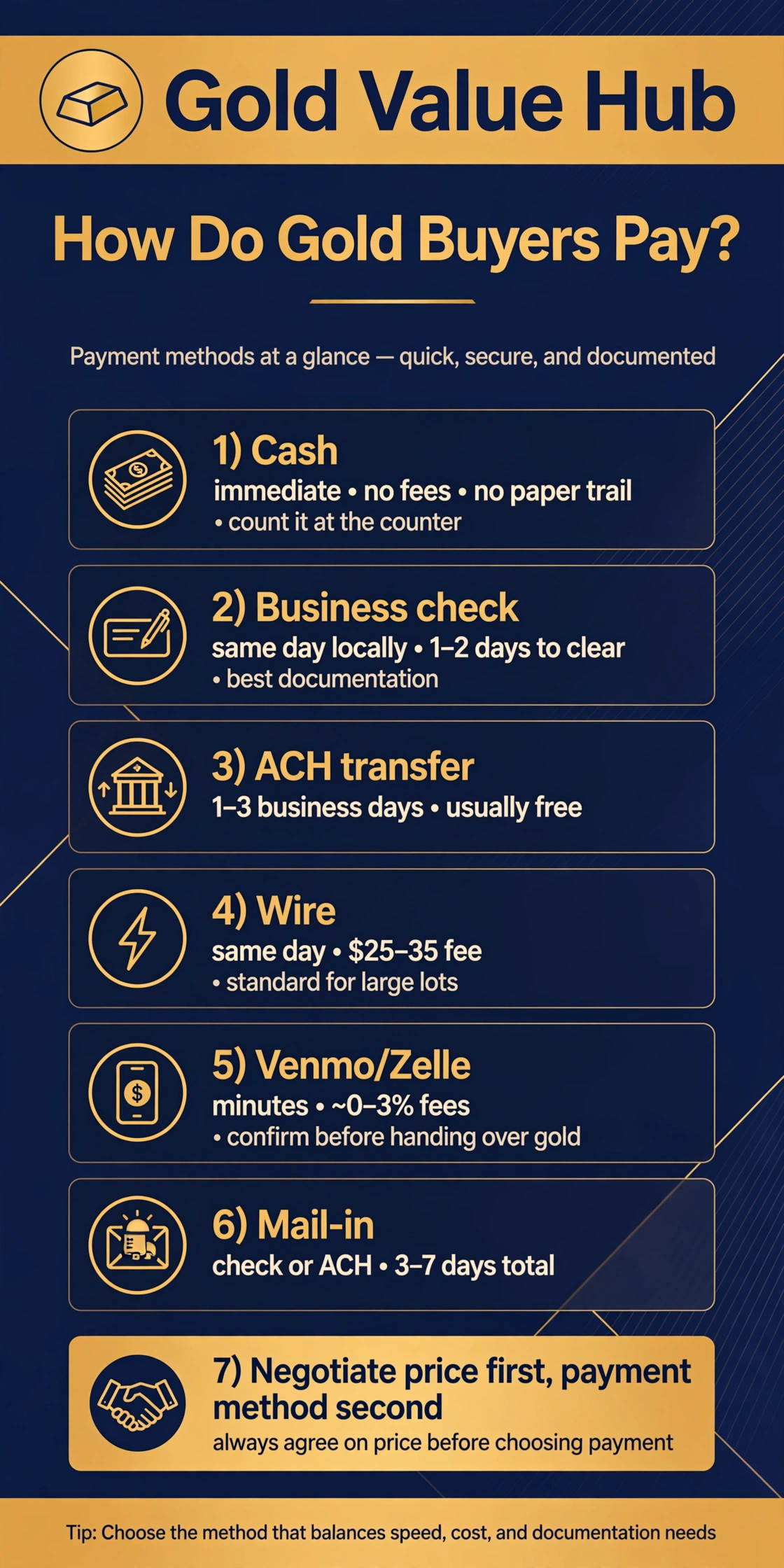
Quick Answer: How do gold buyers pay? Most commonly by business check or cash on the spot at local shops, and by check or ACH (3–7 days) for mail-in sales. Wires cover large lots; Venmo/Zelle appear at some local buyers. Cash is fastest but untraceable — checks and ACH create the paper trail you’ll want at tax time.
The buyer counted your gold, named a price you can live with — and now asks, “Cash or check?” You hesitate. Is a stack of bills normal, or is something shady happening? How do gold buyers pay, and which method actually protects you best?
Here’s the reassuring truth: cash payment for gold is completely normal at local shops and pawn shops — gold has been a cash business for centuries. But “normal” doesn’t mean “always best.” The right payment method depends on the amount, the buyer, and whether you want a paper trail.
This guide covers every way gold buyers pay — cash, check, ACH, wire, and digital apps — with timelines, fees, risks, and when to insist on each. Examples use the October 7, 2026 spot price ($4,098/ozt, $131.76/g pure gold).
How Do Gold Buyers Pay? The Full Menu
| Method | Typical timeline | Fees | Paper trail |
| Cash | Immediate, in person | None | None — receipt only |
| Business check | Same day locally; 3–7 days by mail | None | Strong |
| ACH / bank transfer | 1–3 business days | Usually none | Strong |
| Wire transfer | Same day | $25–$35 sometimes | Strong |
| Venmo / Zelle / Cash App | Minutes to 1 day | ~0–3% | Moderate |
| PayPal | Minutes to 1 day | ~3% | Moderate |
How do gold buyers pay in practice? Local shops default to cash or check — your choice. Mail-in companies default to check or ACH after you accept their offer. Large lots ($5,000+) often go by wire. Digital apps are the newcomer: convenient, but with quirks worth understanding.
Cash vs Check: Which Is Safer When Selling Gold?
Cash wins on: immediacy (no waiting, no clearing), simplicity, and privacy. Check wins on: provability — a deposited check is ironclad documentation of the sale amount and date, which you’ll appreciate at tax time or in any dispute.
Is it safe to take cash for gold? At an established local buyer, yes — count it at the counter before leaving, and be discreet traveling home with large sums. The risk isn’t the cash itself; it’s carrying it. For sales over a few thousand dollars, many sellers prefer a check or ACH precisely to avoid walking around with an envelope of bills.
One caution: a buyer who insists on cash and resists writing a receipt is waving a red flag. Legitimate cash sales still come with itemized receipts — the payment method doesn’t change the paperwork requirement. So when you ask how do gold buyers pay, also ask: “and will I get a receipt either way?”
Venmo, Zelle, and Cash App: Digital Payments for Gold Sales
Some local buyers now offer digital payment — fast and convenient, but know the quirks. Zelle transfers are instant and irreversible: great when you’re receiving, but confirm the money landed before handing over gold. Venmo/Cash App personal payments can be reversed in fraud disputes, and business transactions may incur ~3% fees. PayPal Goods & Services offers buyer/seller protections but takes its cut.
Rules for digital gold payments: confirm receipt before the gold changes hands, use business/commercial payment modes (not “friends and family”), screenshot the confirmation, and factor fees into your price comparison. How do gold buyers pay digitally without risk? The honest answer: carefully — never accept “I’ll send it when I get home,” and never release gold on a screenshot alone without verifying the funds in your own account.
How Long Until You’re Paid? Timelines by Method
How do gold buyers pay, and how fast? Speed varies wildly by method — here’s the full timeline picture:
- Cash: immediate — counted at the counter.
- Local check: handed over same day; clears in 1–2 business days.
- Wire: same day, often within hours.
- Zelle: minutes.
- ACH: 1–3 business days after acceptance.
- Mail-in check: mailed 1–3 days after acceptance, plus transit — 3–7 days total.
- PayPal/Venmo: minutes to a day; instant-transfer fees may apply.
What to Research Before Accepting Payment
Decide your preferred method before the appointment: how do gold buyers pay at this particular shop (ask when you call), what are the fees, and how long until funds are usable? Also know your karat, weight, and today’s spot price — payment method never compensates for a bad price.
How Much Will You Get? Payout Ranges
How do gold buyers pay affects speed, not generosity — here’s what each channel typically pays as a percentage of melt:
| Buyer type | Typical % of melt | Usual payment |
| Online gold buyer | 80–90% | Check / ACH, 3–7 days |
| Local jeweler / coin shop | 70–85% | Cash / check same day |
| Pawn shop | 30–60% | Cash same day |
| Refinery (large lots) | 90–98% | Wire / check, 5–10 days |
How Buyers Test Your Gold
- Hallmark check — karat stamp reading.
- Magnet test — gold isn’t magnetic.
- Acid / electronic test — karat range confirmation.
- XRF analyzer — precise non-destructive purity reading.
Offer vs Melt Value vs Retail Value
Payment method doesn’t change what you’re owed — only how it arrives. Melt value is the ceiling; the offer is melt minus margin; retail value is irrelevant. A $1,310 offer is $1,310 whether it arrives as bills, a check, or an ACH — don’t let payment-method talk distract from the percentage of melt. Whatever the answer to “how do gold buyers pay,” the real question is always “how much of melt.”
Weight Units: Grams, Pennyweight, Troy Ounces
Weigh in grams (1 dwt = 1.55517g; 1 troy oz = 31.1035g). At October 7, 2026 spot, 14K = $77.08/g. Settle the weight and price before discussing how you’ll be paid — in that order.
Where to Sell Gold: Payment Options by Channel
| Channel | Typical payout | Payment options |
| Top online buyer | 80–90% of melt | Check, ACH (3–7 days) |
| Local jeweler | 70–85% of melt | Cash, check, sometimes digital |
| Coin dealer | 75–85% of melt | Cash, check same day |
| Pawn shop | 30–60% of melt | Cash same day |
| Refinery | 90–98% of melt | Wire, check (5–10 days) |
The Selling Process Step by Step
- 1. Calculate melt value — weight × karat × spot.
- 2. Get three written quotes — price first, payment second.
- 3. Agree on method — confirm how do gold buyers pay at this shop before committing.
- 4. Verify at handover — count cash, confirm digital receipt, or take the check.
- 5. Keep records — receipt plus payment proof for taxes.
How to Prepare for Payment Day
Sort by karat, weigh in grams, bring photo ID, and decide your payment preference in advance. Scrap is melt math; resellable pieces deserve estate quotes; diamonds add nothing at scrap counters. If taking cash, plan discreet transport; if taking a check, verify the business first.
Insurance, Shipping, and Payment Guarantees
- Mail-in insurance: free insured kit; photograph everything before sealing.
- Free returns: decline the offer, get your gold back insured — non-negotiable.
- Price-match guarantees: submit competing written quotes to top online buyers.
- Payment guarantees: established buyers pay on accepted offers — if payment stalls past the stated timeline, escalate in writing.
Preliminary estimates are directional only — the binding offer and payment terms follow the buyer’s testing and your acceptance.
How Do Gold Buyers Pay for Mail-In Sales? Step by Step
Mail-in payment follows a fixed sequence. 1. You request a free insured kit. 2. Your gold is tested on arrival (usually same day). 3. You get a written offer by email. 4. You accept or decline — declining triggers a free insured return. 5. Payment goes out 1–3 business days after acceptance: most mail-in buyers default to check, with ACH or PayPal on request. Total timeline: roughly 7–12 days from shipping to cash in hand.
Ask three payment questions before mailing: What is the default payment method? How many days after acceptance does payment go out? Who pays return shipping if I decline? How do gold buyers pay matters most here because you’re separated from your gold — get the answers in writing.
How Do Gold Buyers Pay Large Lots? Wires and Security
Selling $5,000+ of gold? Payment security becomes the main event. Wires are the standard for large lots: same-day, bank-to-bank, fully documented, typically with a $25–$35 fee the buyer often absorbs. Cash for large sums is legal but attracts risk — discreet transport, no social-media talk, and consider going straight to your bank afterward.
For very large lots, refineries pay 90–98% of melt by wire or check — the highest payouts in the industry, with settlement in 5–10 days after assay. The delay is the trade-off for near-wholesale pricing. If a buyer offers top dollar and instant cash on a huge lot, verify the business twice.
Payment Red Flags
- Gift cards or crypto from strangers — never acceptable.
- Personal checks from individuals — can bounce; require business checks or better.
- “I’ll pay you next week” — payment should be immediate or on a stated timeline.
- Last-minute method switch — agreed check becomes “cash only” at handover.
- No receipt with any method — every payment type comes with paperwork.
- Off-platform digital payments — “friends and family” mode removes your protections.
The FTC advises understanding payment terms fully before agreeing to sell gold — including when and how you’ll be paid.
Negotiation: Price First, Payment Second
Always negotiate the price before the payment method — a buyer offering “extra if you take cash” is usually just reframing the same number. Get three written quotes, counter on percentage of melt, and only then choose how do gold buyers pay you at the winning shop. Payment method is logistics; percentage of melt is money.
Questions to Ask About Payment
- How do you pay — cash, check, ACH, digital?
- Are there fees on any method?
- Exactly when will funds be available?
- Will I get an itemized receipt regardless of method?
Mistakes to Avoid
- Handing over gold before digital payment confirms.
- Accepting personal checks from strangers.
- Carrying large cash sums without discretion.
- Letting payment talk replace price negotiation.
Pawning vs Selling: Payment Compared
| Factor | Pawn loan | Outright sale |
| Payment | Cash loan immediately | Cash/check/ACH per agreement |
| Repayment | Cash + monthly interest | None |
| Paperwork | Loan ticket | Bill of sale + receipt |
Taxes and Payment Records
The IRS treats physical gold as a collectible: profit on gold held over a year faces up to the 28% collectibles rate. This is where payment method matters most: checks, ACH records, and wire confirmations are automatic tax documentation, while cash leaves only your receipt. Whichever method you choose, keep proof. (See the IRS rules on capital gains and our taxes on selling gold guide.)
Illustrative Examples: Payment Method Costs
20g 14K chain, $1,541.59 melt, 85% offer = $1,310.35 — what each method nets. Run your own numbers with our gold profit calculator:
| Method | Fees | You net | Available |
| Cash | $0 | $1,310.35 | Immediately |
| Business check | $0 | $1,310.35 | 1–2 days to clear |
| ACH | $0 | $1,310.35 | 1–3 days |
| Venmo (3% fee) | $39.31 | $1,271.04 | Minutes |
| Wire ($30 fee) | $30.00 | $1,280.35 | Same day |
Pre-Sale Payment Checklist
- Decide your preferred payment method in advance.
- Ask the buyer how do gold buyers pay here — before you commit.
- Confirm fees and timelines in writing.
- Count cash at the counter; confirm digital receipts.
- Keep payment proof with your tax records.
Key Takeaways
- How do gold buyers pay? Cash/check locally, check/ACH by mail, wire for large lots, digital apps at some shops.
- Cash is normal and fastest — but count it at the counter and transport discreetly.
- Checks and ACH create the paper trail you’ll want for taxes and disputes.
- Confirm digital payments before handing over gold; use business modes, not friends-and-family.
- Never accept gift cards, stranger crypto, or personal checks from individuals.
- Negotiate price first, payment method second — method is logistics, margin is money.
- Keep payment proof — gold profits face up to 28% collectibles tax.
Frequently Asked Questions
How do gold buyers pay you?
Most commonly by business check or cash at local shops, and by check or ACH (3–7 days) for mail-in sales. Large lots often go by wire; some local buyers offer Venmo, Zelle, or Cash App. The method is agreed before the sale completes.
Is it safe to take cash for gold?
Yes, at established buyers — cash is the traditional answer to “how do gold buyers pay.” Count it at the counter before leaving and be discreet traveling with large sums. For sales over a few thousand dollars, many sellers prefer check or ACH to avoid carrying cash.
Should I take cash or check when selling gold?
Cash for immediacy and simplicity; check for documentation. A deposited check proves the sale amount and date — valuable at tax time or in disputes. Either is fine at a legitimate buyer; always get an itemized receipt regardless.
Can gold buyers pay with Venmo or Zelle?
Some local buyers can — confirm the payment lands before handing over gold. Zelle is instant and irreversible; Venmo personal payments can be reversed in disputes. Use business payment modes and factor in any fees (~3%).
How long does it take to get paid for gold?
Cash and Zelle: immediate. Local checks: same day (1–2 days to clear). Wire: same day. ACH: 1–3 business days. Mail-in check: 3–7 days total. If payment stalls past the stated timeline, follow up in writing.
Do gold buyers pay more for cash deals?
Sometimes a buyer offers slightly more for cash — but it’s usually the same number reframed, since cash saves them check-processing hassle, not real money. Negotiate the percentage of melt first; treat any cash “bonus” skeptically.
What if a buyer’s check bounces?
It’s rare at established businesses but devastating — you’ve surrendered the gold. Reduce risk by selling to well-reviewed buyers, and for large amounts prefer wire or ACH. If a check bounces, contact the buyer immediately in writing, then consider small-claims court and a police report.
Do I have to pay taxes if I’m paid in cash?
Yes — the payment method doesn’t change the tax obligation. Profits on physical gold held over a year face up to the 28% collectibles capital-gains rate. Cash just means you must keep your own records, since there’s no bank trail.
Can I get paid in gold or silver instead of cash?
Some dealers offer trade-in credit or metal-for-metal exchange, occasionally at better rates than cash since it keeps you as a customer. It can make sense if you’re upgrading jewelry — but get the cash offer first so you can compare fairly.
What payment proof should I keep?
Keep the itemized buyer receipt plus payment evidence: check images, ACH confirmations, wire receipts, or digital payment screenshots. Together they document your sale amount and date for taxes — especially important for cash sales.
Cash, check, or app — the method matters less than the math behind it. Settle your price as a percentage of melt first, then pick the payment that fits your needs. Now that you know how do gold buyers pay, compare vetted gold buyers and check your melt value with our scrap gold calculator.