
Published Mar 8, 2026 · Updated Sep 5, 2026
How Gold Buyers Calculate Gold Price
If you have old gold jewelry, coins, or scrap gold sitting around, you might be thinking about selling it. But before you walk into any shop, you need to understand how gold buyers calculate gold price. When you know how to calculate gold price yourself, you can spot a fair offer instantly. It protects you from lowball offers. Most people are surprised to learn that the process is actually quite simple. In this guide, we break down exactly how to calculate gold price step by step — so you always know what your gold is worth before you sell.
Knowing how to calculate gold price gives you real power. Whether you are visiting a pawn shop, a jewelry buyer, or a bullion dealer, the method they use to calculate gold price is always the same. Once you understand it, no one can fool you.
Quick Answer: How Gold Buyers Calculate Gold Price
Gold buyers use a straightforward formula to calculate gold price.
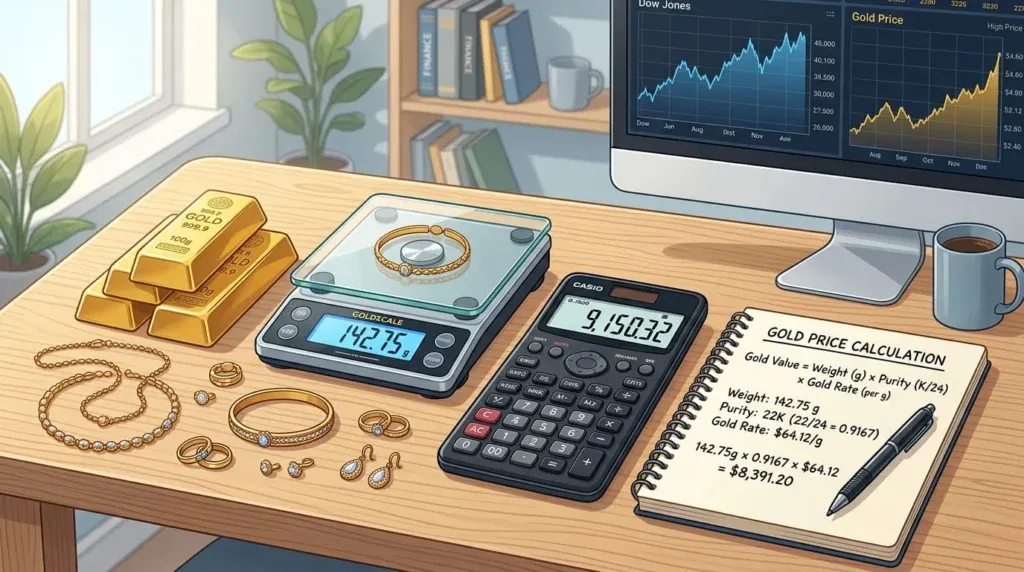
Gold Value = Weight × Purity × Spot Price
Want to see the formula in action? Plug in your own weight, purity, and the live spot price.
First, they weigh your gold. Then they check its purity (the karat). Finally, they multiply those numbers by the current gold spot price. The result is the gold melt value — the raw material value of your gold. Most buyers then pay you a percentage of that melt value, typically between 60% and 90%.
This simple formula is all you need to calculate gold price on your own before you sell anything.
Use Our free gold calculator to find the value of your gold
Understanding the Gold Buyer Formula
The gold buyer formula has three main parts. Each one plays a key role when you want to calculate gold price accurately. Let’s look at each one closely.
Gold Weight
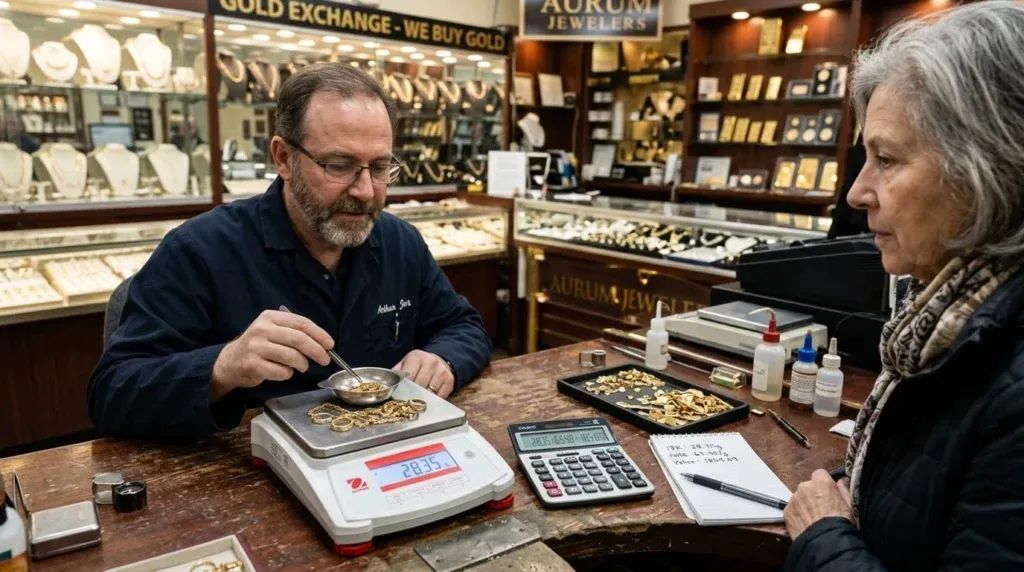
The first step to calculate gold price is weighing your gold. Gold buyers use a digital jewelry scale for accurate measurements. They measure in grams, troy ounces, or pennyweights depending on where you are.
Understanding the units helps you verify the calculation yourself and calculate gold price with confidence.
| Unit | Conversion |
| 1 Troy Ounce | 31.1035 grams |
| 1 Troy Ounce | 20 pennyweights |
| 1 Pennyweight | 1.555 grams |
| 1 Gram | 0.643 pennyweights |
Most gold buyers in the United States use grams or pennyweights. Some bullion dealers and gold refiners prefer troy ounces, especially for larger quantities like gold bars and gold coins.
Pro tip: Always watch the scale when your gold is being weighed. Ask the buyer which unit they are using. Weight is the foundation of how buyers calculate gold price correctly. If the weight is wrong, the entire calculation is wrong.
Gold Purity (Karat Value)
Gold purity is the second key element used to calculate gold price. Purity is expressed in karats. Pure gold is 24 karat. Most gold jewelry is a mix of gold and other metals. The karat number tells you how much of the item is actually gold.
Here is the gold karat percentage table:
| Karat | Purity | Gold Content |
| 24K | 99.9% | Pure Gold |
| 22K | 91.7% | Very High |
| 18K | 75.0% | High |
| 14K | 58.5% | Medium |
| 10K | 41.7% | Lower |
A 10K gold ring has only 41.7% actual gold. An 18K necklace has 75% pure gold. This difference has a huge impact on how buyers calculate gold price for your item.
If a buyer wants to calculate gold price for an 18K item, they multiply the total weight by 0.75. This gives them the pure gold content — the true amount of gold in the item.
Gold purity calculation is one of the most important steps when you calculate gold price. Misidentifying the karat is a common mistake. Always check the hallmark stamped on your gold item before selling. A wrong karat reading will completely change how buyers calculate gold price for your piece.
Current Gold Spot Price
The gold spot price is the live market price of one troy ounce of gold at any given moment. It changes constantly throughout the trading day. You cannot calculate gold price accurately without checking the current spot price first. he gold spot price is officially set twice daily by the London Bullion Market Association, which is the global authority for precious metal pricing used by gold buyers worldwide.
Gold buyers check the spot price before making any offer. Key sources used to calculate gold price accurately include:
- LBMA (London Bullion Market Association) — sets the global gold benchmark price twice daily at lbma.org.uk
- COMEX — the New York commodity exchange where gold futures are actively traded
- Kitco — a popular platform where buyers, sellers, and the public check live gold prices in real time
The spot price is quoted per troy ounce. To calculate gold price per gram, divide the troy ounce price by 31.1035.
For example: If gold is $2,100 per troy ounce, the price per gram is:
$2,100 ÷ 31.1035 = $67.52 per gram
This per-gram number is what most gold buyers use to calculate gold price for smaller scrap gold items.
Use Our Free scrap gold calculator
Step-by-Step Process Gold Buyers Use to Calculate Gold Price
Now that you understand the three parts of the formula, here is the complete process that gold buyers follow to calculate gold price when you bring them gold to sell.
Step 1 – Test Gold Purity
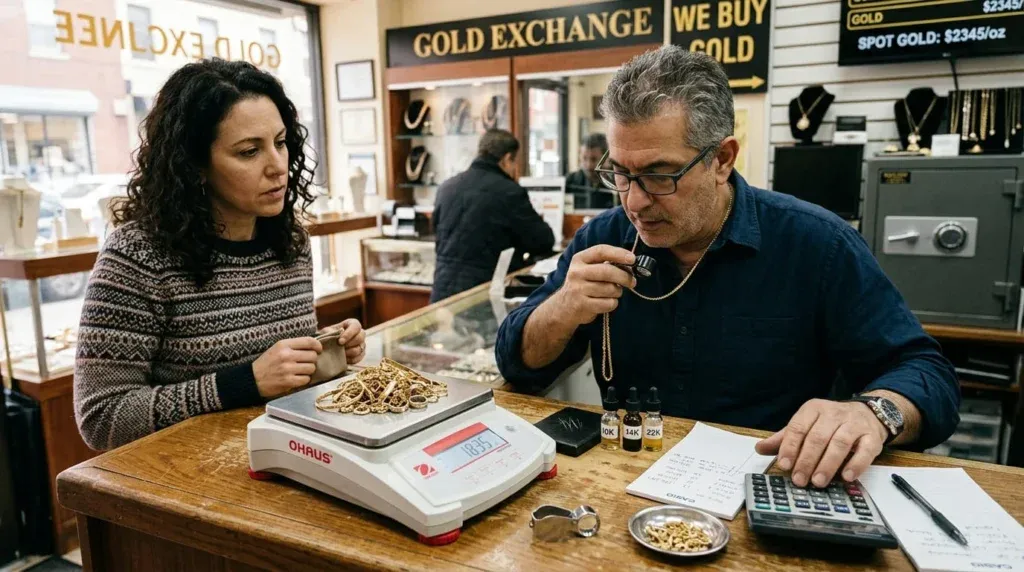
The buyer checks what karat your gold is. They look for stamps on the item. Common stamps include “14K,” “585,” “750,” or “18K.” If there is no stamp, or the buyer wants to confirm, they use an acid testing kit or an XRF analyzer. You cannot calculate gold price correctly without knowing the exact karat.
Step 2 – Weigh Gold Accurately
The buyer places your item on a digital jewelry scale. They record the total weight. If your jewelry has gemstones, those add weight but have no gold value. Accurate weight is essential to calculate gold price properly.
Step 3 – Calculate Pure Gold Content
Using the karat value, the buyer calculates how much pure gold is in the item. This is a critical step to calculate gold price correctly.
Formula: Total Weight × Purity Decimal = Pure Gold Weight
Example: 10 grams of 14K gold = 10 × 0.585 = 5.85 grams of pure gold
Step 4 – Multiply by Spot Price
The buyer multiplies the pure gold weight by the current gold price per gram. This step finalizes how buyers calculate gold price in real money terms.
Formula: Pure Gold Weight × Spot Price per Gram = Gold Melt Value
Example: 5.85 grams × $67.52 = $395.00 melt value
Step 5 – Apply Buyer Margin
The buyer does not pay you the full melt value. They apply a payout percentage. This covers their costs and profit. The typical gold buyers payout percentage is between 60% and 90% of melt value.
Example: $395.00 × 80% = $316.00 offered to seller
This is the complete process of how gold buyers calculate gold price in real life. Now you can follow along and check their math every time.
Example Calculation: How to Calculate Gold Price Step by Step
Let’s walk through a real-world example so you can see exactly how to calculate price using the formula.
Scenario:
- Gold item weight: 10 grams
- Purity: 18K (75%)
- Spot price: $70 per gram
Step 1: Find the pure gold content.
10 × 0.75 = 7.5 grams of pure gold
Step 2: Multiply by spot price to calculate gold price (melt value).
7.5 × $70 = $525 gold melt value
Step 3: Apply the buyer’s payout percentage (let’s say 80%).
$525 × 0.80 = $420 offer to you
So for a 10-gram 18K gold item with gold at $70 per gram, you could expect around $420 from a fair buyer paying 80% of melt value.
This is exactly how most jewelry buyers, pawn shops, and gold refiners calculate gold price every single day. Use this same method to calculate gold price for any item you plan to sell.
Want to calculate price for a different item? Just swap in your weight, your karat decimal, and today’s live spot price per gram. The formula never changes.
Gold Buyer Payout Percentage
When buyers calculate gold price, they never offer you 100% of the melt value. They pay a percentage of it. Understanding the gold buyers payout percentage helps you set realistic expectations every time you calculate gold price and compare it to an offer.
Typical range: 60% to 90% of melt value
Here is why buyers keep a portion after they calculate gold price:
- Refining costs: Scrap gold must be melted and refined to remove other metals. Gold refiners charge fees for this.
- Business expenses: The buyer has overhead — rent, staff, equipment, and insurance.
- Market risk: Gold prices move daily. The buyer takes on risk holding your gold until they can sell it.
- Profit margin: Like any business, gold buyers need to earn a profit to stay open.
Pawn shops typically offer the lowest payouts — sometimes as low as 50–60%. Dedicated gold buyers and bullion dealers usually offer better rates. Some online gold buyers offer up to 90% of melt value because their operating costs are lower.
Always ask a buyer what percentage of melt value they are paying. If they cannot explain how they calculate gold price, walk away.
Jewelry Gold Price vs Scrap Gold Value
This is one of the most misunderstood areas when people try to calculate gold price. Many people think their gold jewelry is worth its retail price. It is not.
Retail Jewelry Value: This is what a store charges for the finished piece. It includes design, labor, branding, and markup. A necklace bought for $800 might only have $200 worth of gold. Retail price has nothing to do with how buyers calculate gold price.
Gold Melt Value: This is the pure metal value of the gold. Calculated using: Weight × Purity × Spot Price. This is the true baseline used to calculate gold price for selling purposes.
Scrap Gold Value: This is the price a buyer offers you. It is the melt value minus the buyer’s margin. When buyers calculate gold price for scrap, this is the final number they share with you.
What about gemstones?
Most gold buyers do not pay for gemstones set in gold jewelry. Always separate gems before you try to calculate gold price yourself. If your jewelry has valuable diamonds or gems, get those appraised separately before selling.
Units Used in Gold Price Calculations
To calculate gold price accurately, you need to know which unit your buyer is using. Gold can be measured in several different units.
| Unit | Equal To | Commonly Used By |
| 1 Troy Ounce | 31.1035 grams | Bullion dealers, COMEX |
| 1 Gram | 0.032 troy ounces | Most jewelry buyers |
| 1 Pennyweight | 1.555 grams | US jewelry trade |
| 1 Grain | 0.0648 grams | Rarely used today |
Most scrap gold price calculations use grams. If a buyer quotes you a price per pennyweight, convert it to grams so you can properly calculate gold price and compare with other buyers.
Tools Gold Buyers Use to Calculate Gold Price
Reputable gold buyers use professional equipment to calculate price accurately. Here is what to look for:
Digital Jewelry Scale
A precision scale that measures to 0.01 grams. This is the foundation of how buyers calculate gold price accurately. If a buyer does not use a certified scale, that is a red flag.
Acid Testing Kit
A classic method for testing gold purity. The buyer scratches the gold on a testing stone and applies specific acids. The reaction confirms the karat. It is affordable and widely used by jewelry buyers and pawn shops.
Electronic Gold Tester
A handheld device that estimates purity using electrical conductivity. It is fast and non-destructive. Good for quick checks. Buyers use it to calculate gold price on the spot.
XRF Analyzer (X-Ray Fluorescence)
The most accurate tool available to calculate gold price. An XRF analyzer shoots X-rays into the gold and measures what elements are present. It gives an exact purity reading without damaging the item. Used by serious bullion dealers and gold refiners.
Common Mistakes People Make When Trying to Calculate Gold Price
Avoid these errors. These mistakes can cause you to calculate price incorrectly — and cost you money.
Using the Wrong Gold Price
Many people check the gold spot price online but do not convert it correctly. The spot price is per troy ounce. You need the gold price per gram to properly calculate gold price. Divide by 31.1035.
Ignoring Purity
A 10K ring and an 18K ring of the same weight are worth very different amounts. Always know the karat before you calculate gold price.
Weighing Stones and Settings
Gemstones, glue, and non-gold metal parts all add weight. If you weigh jewelry with these included, you will calculate gold price incorrectly. Remove stones if possible.
Misunderstanding Karat
Some people confuse “karat” (gold purity) with “carat” (gemstone weight). To calculate gold price properly, karat always refers to purity.
Not Comparing Multiple Buyers
Prices vary widely between buyers. Always calculate gold price yourself first, then get at least three quotes before selling.
Tips to Get the Best Price When Selling Gold
Follow these steps to maximize your payout every time you calculate price and go to sell.
- Check the live gold spot price before you visit any buyer. Use Kitco or the LBMA website. Know the current rate you need to calculate gold price yourself.
- Calculate price on your own using the formula before going in. Use: Weight × Purity × Spot Price per gram.
- Separate your gold by karat. Do not mix 10K, 14K, and 18K pieces together. Keep each karat separate so buyers cannot average down when they calculate gold price for your lot.
- Remove gemstones if possible. Get them independently appraised if they look valuable.
- Compare at least three buyers. Ask each buyer to explain how they calculate gold price so you can compare their methods and margins.
- Avoid selling under pressure. A legitimate buyer will give you time to think.
- Ask what percentage of melt value they pay. A transparent buyer will answer directly and show you how they calculate price.
Factors That Influence Gold Prices
The spot price that buyers use to calculate price changes constantly. Here is what drives those changes.
Inflation
When inflation rises, people buy gold as a store of value. Higher demand pushes prices up — and changes how buyers calculate price offers daily.
Interest Rates
When interest rates rise, gold becomes less attractive. Gold prices often fall, which directly affects how you calculate price on any given day.
US Dollar Strength
Gold is priced in US dollars globally. When the dollar weakens, gold prices rise. This affects the baseline used to calculate price worldwide.
Global Demand
Jewelry demand, investment buying, and industrial use all affect global gold prices — and therefore how buyers calculate price from day to day.
Central Bank Reserves
When major central banks buy or sell gold in large quantities, it moves the market significantly and shifts the numbers used to calculate price.
Understanding these factors helps you time your sale strategically. Selling during periods of high gold prices means better offers from gold buyers.
Frequently Asked Questions
How do gold buyers calculate gold price?
Gold buyers use the formula: Gold Value = Weight × Purity × Spot Price. They weigh your gold, identify its karat purity, and multiply by the current gold price per gram to calculate price in melt value terms. They then offer you a percentage of that number. Understanding this gold buyer formula helps you verify every offer you receive and calculate price yourself before you walk in.
What formula do gold buyers use to calculate gold price?
The core formula to calculate price is: Weight (grams) × Purity Decimal × Spot Price per Gram = Gold Melt Value. For example, 10 grams of 18K gold at $70/gram equals $525 in melt value (10 × 0.75 × 70). This formula is standard across jewelry buyers, pawn shops, and bullion dealers whenever they calculate price.
How much do gold buyers pay?
Most gold buyers pay between 60% and 90% of the gold melt value after they calculate price. Pawn shops often pay less (50–65%). Dedicated gold buyers and online gold buyers typically pay more (75–90%). Always calculate price yourself first, then compare multiple offers before selling.
Do gold buyers pay full spot price?
No. Gold buyers never pay the full spot gold price when they calculate price for your item. They need to cover refining costs, operating expenses, market risk, and profit. Your actual payout is a percentage of the melt value. Knowing this helps you understand the gap when you calculate price vs. what you actually receive.
How can I calculate gold price for my scrap gold?
Use this simple process to calculate price yourself: (1) Find the weight in grams. (2) Identify the karat and find its decimal (14K = 0.585). (3) Multiply weight × purity decimal = pure gold grams. (4) Check spot price per gram (divide troy ounce price by 31.1035). (5) Multiply pure gold grams × price per gram. This gives your full melt value — the starting point every buyer uses to calculate price.
What is the difference between melt value and scrap gold price?
Gold melt value is the theoretical value you get when you calculate price using the spot price and pure gold weight. Scrap gold price is what a buyer actually pays you — a percentage of the melt value. The gap represents refining fees, overhead, and profit margin.
What karat gold is most common in jewelry?
In the United States, 14K gold is the most common karat used in jewelry. It contains 58.5% pure gold. In Europe and Asia, 18K gold is more common. When gold buyers calculate gold price for most American jewelry, 14K is usually what they are working with. Knowing this helps you calculate gold price faster for typical items.
Why does the gold price change every day?
The gold spot price is driven by global markets, including COMEX and the LBMA. It reacts to economic news, inflation data, currency movements, and investor sentiment. This is why gold buyers always check the live price before they calculate gold price for any transaction. You should do the same.
Conclusion
Understanding how gold buyers calculate gold price puts you in complete control when you sell. The process is logical and consistent. Every reputable buyer uses the same core formula to calculate gold price: Weight × Purity × Spot Price.
From there, they determine your gold melt value and offer you a percentage of it — typically between 60% and 90%. The exact payout depends on the type of buyer, their costs, and current market conditions.
Now that you know how to calculate gold price yourself, you can check the live spot price on Kitco or the LBMA, weigh your gold, identify the karat, and run the numbers before visiting any buyer. When you calculate gold price in advance, you walk in prepared. You know what a fair offer looks like. You can spot a bad deal immediately.
Whether you are selling gold jewelry, gold coins, or gold bars, the formula to calculate gold price never changes. Weight × Purity × Spot Price = your starting point. Everything else is just the buyer’s margin.
Use this guide every time you need to calculate gold price for any gold you plan to sell. Sell smart. Know your numbers. And always compare before you commit.