Gold Parties: How They Work and Are They Worth It?
Published Oct 24, 2026
Quick Answer: Are gold parties worth it? Rarely. Gold parties typically pay 30–50% of melt value — among the lowest payouts of any selling channel — while adding social pressure that discourages comparison shopping. They’re fun social events but poor financial decisions; a top online buyer usually pays nearly double for the same gold.
You got the invitation: “Gold party at Sarah’s! Bring your old jewelry, get cash on the spot!” It sounds fun — wine, friends, and money for that tangled drawer of broken chains. But before you RSVP, ask the real question: are gold parties worth it financially, or are you trading dollars for hors d’oeuvres?
Here’s the short version: gold parties are among the most expensive ways to sell gold. The typical payout runs 30–50% of melt value — meaning a $1,500 gold lot fetches $450–$750 at a party versus $1,200–$1,350 from a top online buyer. The social setting isn’t accidental; it’s the business model.
This guide explains exactly how gold parties work, runs the payout math against every alternative, and shows you when (if ever) attending makes sense. Examples use the October 7, 2026 spot price ($4,098/ozt, $131.76/g pure gold) — check the site’s live calculator before selling anywhere.
What Is a Gold Party? How They Work
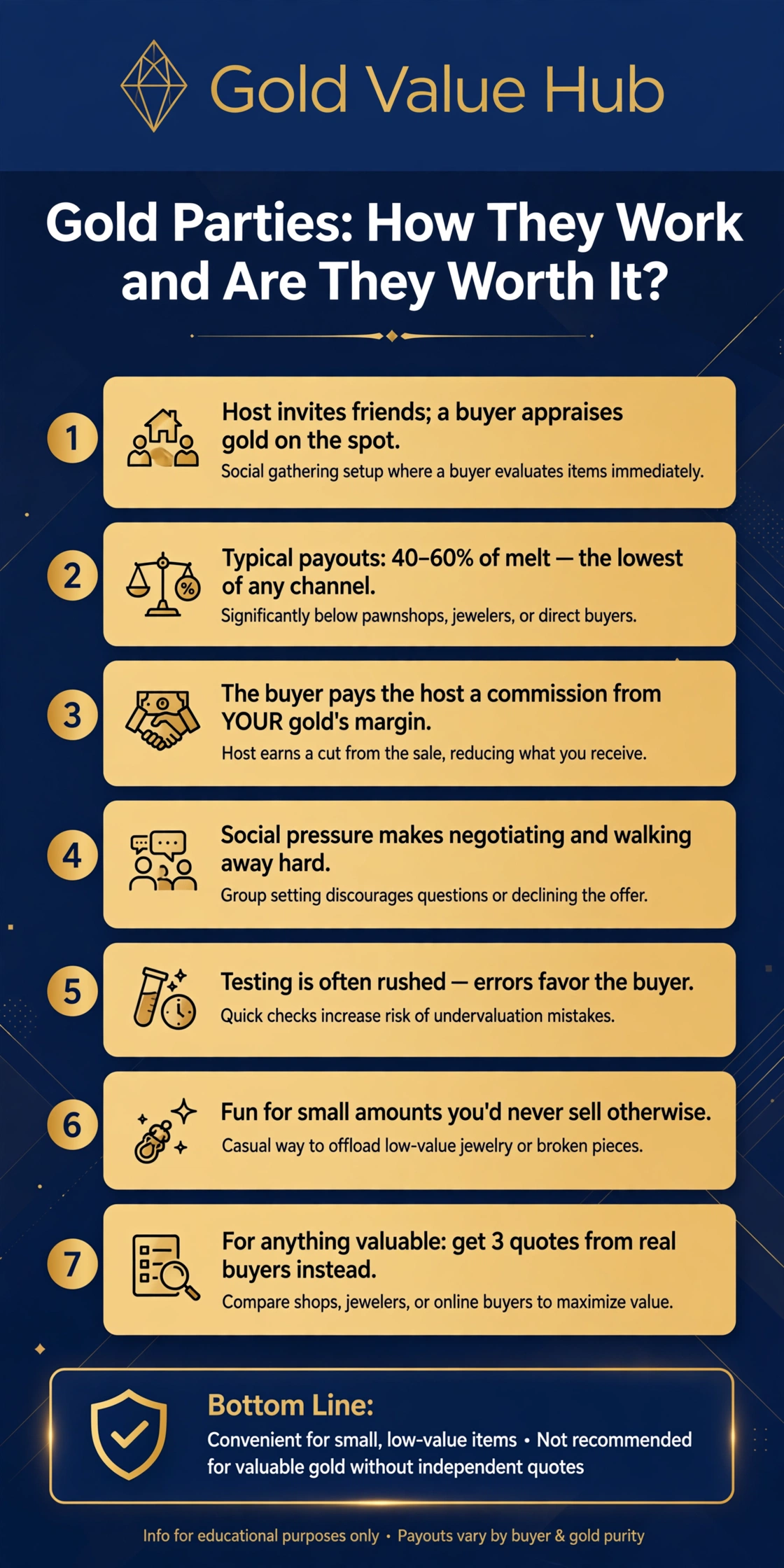
A gold party is a home-based selling event, modeled on Tupperware parties: a host invites friends, a traveling gold buyer sets up testing equipment in the living room, and guests sell their jewelry on the spot for checks or cash. The host typically earns a commission — often 5–10% of total purchases — which is why the invitations keep coming.
The format is deliberate. Each guest gets a private-ish evaluation amid party noise, offers come verbally with no written breakdown, and the festive atmosphere discourages hard questions. That social pressure is precisely why asking “are gold parties worth it” before attending is essential.
Are Gold Parties Worth It? The Payout Math
Let’s answer “are gold parties worth it” with numbers. A 20g 14K chain holds $1,541.59 in melt value (illustrative, October 7, 2026 spot). Here’s what it fetches across channels:
| Channel | Typical payout | You receive |
| Gold party | 30–50% of melt | $462–$771 |
| Pawn shop | 30–60% of melt | $462–$925 |
| Local jeweler | 70–85% of melt | $1,079–$1,310 |
| Top online buyer | 80–90% of melt | $1,233–$1,387 |
The party-to-online gap is $460–$925 on this single chain. These are the numbers behind every “are gold parties worth it” debate — memorize the gap before you RSVP.
Why Gold Party Payouts Are So Low
The cost structure explains why gold parties are worth so little to sellers:
- Host commissions (5–10%) come straight out of your payout.
- Traveling overhead — the buyer’s travel, equipment, and event costs need covering.
- No competition — one buyer, no competing quotes, no price discovery.
- Social pressure replaces negotiation — questioning the offer feels rude.
- One-shot buyers — traveling buyers never see you again, so reputation matters less.
How to Say No at a Gold Party (Scripts)
Declining in front of friends feels awkward — so rehearse. Try: “Thank you! I promised myself I’d get a second quote before selling anything.” Or: “I need to check with my spouse first — can I reach you tomorrow?” Or the honest one: “Your offer is about 40% of melt and I’ve been quoted 85% elsewhere — I can’t accept, but I appreciate your time.” None of these insult the host; all protect your money. If the buyer gets pushy, that’s information — pushiness confirms the “are gold parties worth it” answer. Leave with your gold and your friendships intact, then sell tomorrow.
Gold Parties Worth It? vs Every Alternative
Side by side, the “are gold parties worth it” question answers itself:
| Channel | Payout | Speed | Pressure level |
| Gold party | 30–50% of melt | Same day | High — social |
| Hotel/event buyer | 30–50% of melt | Same day | High — urgency |
| Pawn shop | 30–60% of melt | Same day | Medium |
| Local jeweler | 70–85% of melt | Same day | Low |
| Online buyer | 80–90% of melt | 3–7 days | None |
When Are Gold Parties Worth It? The Rare Exceptions
Are gold parties worth it for anyone? A few narrow cases: if your lot’s melt value is under $100, the dollar gap between channels is small enough that convenience can win — $40 at a party vs $75 online may not justify a week of mail-in process for you. If you genuinely enjoy the social event and treat the sale as incidental entertainment, the experience has value beyond the payout. And a party can serve as a free, no-commitment appraisal: get the buyer’s verbal assessment, decline politely, and sell to a vetted buyer the next day armed with information.
But notice what these exceptions share: none of them involve accepting the party’s offer as your best price. Even when gold parties are worth attending, they’re rarely worth selling at.
Are Gold Parties Worth It for the Host?
Hosts earn 5–10% commission on total party purchases — so a party that buys $5,000 of gold nets the host $250–$500 for an evening’s entertaining. Sounds decent until you consider the source: that commission comes directly out of your friends’ payouts. You’re effectively charging your friends hundreds of dollars for wine and introductions.
The ethical math is worse than the financial math. When your friend later discovers her $1,500 in gold fetched $600 at your party versus $1,275 online, she won’t remember the canapés — she’ll remember who invited the buyer. If friends ask about selling gold, the genuinely helpful move is sharing payout data and vetted buyer options, not a party invitation.
What to Research Before Attending
If you’re going anyway, go armed: know your karat, weight, and today’s spot price so you can convert any party offer to a percentage of melt on the spot. Get at least one outside quote beforehand — it takes ten minutes online and transforms the party from a trap into a data point. Knowledge is the only advantage you’ll have in that living room.
How Party Buyers Test (and What They Skip)
- Acid test — the party standard; quick but less precise than XRF.
- Magnet test — basic fake screening.
- Scale weighing — watch the readout; party chaos is cover for light weighing.
- Often skipped: XRF analysis, itemized breakdowns, written quotes.
Ask for the breakdown anyway: weight, karat, per-gram price. A party buyer who can’t produce it confirms the “are gold parties worth it” answer for informed sellers: no.
Offer vs Melt Value vs Retail Value
Party buyers love retail anchors: “this cost $2,000 new — I’ll give you $700!” The only number that matters is melt. A $700 offer on $1,541.59 of melt is 45% — poor by any standard, regardless of what the piece cost new or how fun the party was.
Weight Units at the Party
Party quotes often come in pennyweight to sound generous. Convert: 1 dwt = 1.55517g. At October 7, 2026 spot, 14K = $77.08/g ($119.88/dwt). A “$55 per dwt” party quote is $35.37/g — just 46% of melt. Do the division before the wine does your thinking.
Where to Sell Gold: Every Channel, Ranked
| Rank | Channel | Typical payout | Best for |
| 1 | Top online buyer | 80–90% of melt | Maximum payout |
| 2 | Coin dealer / jeweler | 70–85% of melt | Same-day fair sale |
| 3 | Refinery (large lots) | 90–98% of melt | Large lots |
| 4 | Pawn shop | 30–60% of melt | Cash in an hour |
| 5 | Gold party | 30–50% of melt | Social event (not selling) |
The Selling Process: Party vs Everywhere Else
Compare the two processes — and notice which one answers “are gold parties worth it” for you:
- At a party: evaluation amid socializing → verbal offer → on-the-spot check → no comparison, no receipt detail.
- Everywhere else: calculate melt → vet buyer → get written itemized quotes (3+) → negotiate → verify math → get paid → keep records.
How to Prepare (If You Insist on Going)
These steps won’t make gold parties worth it, but they’ll limit the damage. Sort by karat, weigh in grams, get an outside quote first, bring photo ID, and set a walk-away percentage before arriving (say 60% — which the party likely won’t meet, telling you everything). Scrap is melt math; resellable pieces deserve estate quotes, not party counters; diamonds add nothing at party buyers.
Payment at Gold Parties
- On-the-spot checks — the norm; verify the buyer is established before accepting.
- Cash — sometimes offered; count it immediately.
- No ACH/wire — party buyers rarely offer traceable electronic payment.
- Host commission — remember 5–10% of the buyer’s spend goes to your host.
Gold Parties Worth It for Small Amounts? A Decision Rule
Here’s the one honest case for going: you have a few grams of broken chains and single earrings worth maybe $50–$100 in melt, and you’d never bother driving to a buyer for it. If the party is genuinely fun — wine, friends, no pressure — treating it as entertainment with a small payout is reasonable. The decision rule: only bring what you’d throw away. Anything worth real money deserves real quotes. And never let a party be your first price discovery — once you know your melt value and what a real buyer pays, the party offer stops being mysterious and starts being a choice.
Red Flags Specific to Gold Parties
Party-specific red flags — each one more evidence for the “are gold parties worth it” verdict:
- Verbal-only offers — no written breakdown means no comparison shopping, ever.
- “Party special” pricing — discounts that expire when the party ends.
- Discouraging outside quotes — “our prices are only good tonight.”
- No verifiable business identity — traveling buyer, no storefront, no reviews.
- Recruiting you to host — the pitch shifts from buying gold to MLM-style hosting.
The FTC advises comparing offers and understanding terms before selling gold — nearly impossible in a party setting, which is the point.
Negotiation at a Party: Your Only Moves
Negotiating at a gold party is hard by design — but not impossible. Your moves: cite your outside quote (“an online buyer offered 85% — can you match it?”), ask for the percentage of melt directly, and be willing to say “I’ll think about it” in front of everyone. If the buyer counters, counter once on the percentage — “I need 60% to sell tonight” — and mean it. The nuclear option — and usually the right one — is treating the party as entertainment and selling elsewhere the next day. Remember: the buyer’s “tonight only” price is almost always available tomorrow, because their business depends on it.
Questions to Ask the Party Buyer
- What percentage of melt are you paying today?
- Can you write down the weight, karat, and per-gram price?
- Are there fees deducted? What is your business name and license?
Mistakes to Avoid
- Attending without knowing your melt value.
- Accepting the first (and only) offer.
- Letting social pressure replace math.
- Bringing resellable designer pieces to a scrap buyer.
Pawning vs Selling vs Partying
| Factor | Pawn loan | Gold party | Online sale |
| Typical payout | 25–60% (loan) | 30–50% of melt | 80–90% of melt |
| Social pressure | Low | Very high | None |
| Best when | Cash in an hour | Going for fun | Maximizing payout |
Taxes on Party Sales
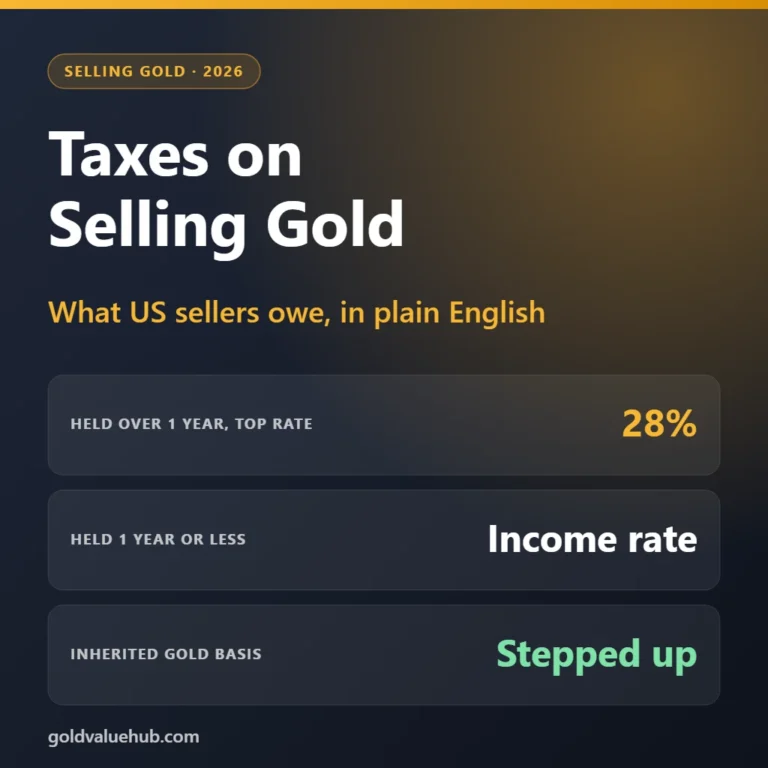
Party sales are taxed like any gold sale: the IRS treats physical gold as a collectible, with profits on gold held over a year facing up to the 28% collectibles rate. Party checks are still income records — keep them. (See our guide to taxes on selling gold and the IRS rules on capital gains.)
Illustrative Examples: Party vs Alternatives
What the same jewelry box earns — illustrative math at October 7, 2026 spot ($131.76/g). Run your own lot through our gold profit calculator:
| Lot | Melt value | Gold party (40%) | Online buyer (85%) | Party “cost” |
| 20g 14K chain | $1,541.59 | $616.64 | $1,310.35 | $693.71 |
| 35g mixed lot | $2,400.00 | $960.00 | $2,040.00 | $1,080.00 |
Pre-Party Checklist
- Calculate melt value for everything you’re bringing.
- Get one outside quote first (ten minutes online).
- Set a walk-away percentage before arriving.
- Bring ID; demand a written breakdown.
- Give yourself permission to say “I’ll think about it.”
Key Takeaways
- Are gold parties worth it? Rarely — 30–50% of melt is among the lowest payouts anywhere.
- A top online buyer typically pays nearly double the party price for the same gold.
- Host commissions (5–10%), travel costs, and zero competition explain the low payouts.
- Social pressure is the business model — it replaces comparison shopping and negotiation.
- If you attend: know your melt value, get an outside quote first, demand writing.
- Red flags: verbal-only offers, “tonight only” pricing, no verifiable business identity.
- Keep party checks for taxes — profits face up to 28% collectibles tax.
Frequently Asked Questions
What is a gold party?
A home-based selling event where a host invites friends and a traveling gold buyer evaluates and purchases jewelry on the spot. The host typically earns a 5–10% commission on total purchases. It’s modeled on Tupperware-style direct-sales parties.
Are gold parties worth it?
Financially, rarely — payouts of 30–50% of melt are among the industry’s lowest, and social pressure discourages negotiation. A top online buyer typically pays nearly double. Go for the social event if you enjoy it, but sell your gold elsewhere.
How much do gold parties pay?
Typically 30–50% of melt value — so $460–$770 on gold worth $1,541.59 in melt. Some pay less once host commissions and fees are factored in. Always convert the offer to a percentage of melt before deciding.
Are gold parties a scam?
Most are legal businesses, not scams — but the model shares scam-like features: no written quotes, social pressure, unverifiable traveling buyers, and payouts far below market. Treat every party buyer with the same skepticism you’d apply to a stranger.
Should I host a gold party?
Hosting earns you 5–10% commission on friends’ sales — but you’re monetizing your friendships at their expense, since guests get low payouts. Ethically and financially, it’s a poor trade. If friends want to sell gold, share this guide instead.
Can you negotiate at a gold party?
It’s difficult but possible: cite an outside quote, ask for the percentage of melt directly, and be willing to decline publicly. The strongest move is treating the party as entertainment and selling to a vetted buyer the next day.
What should I bring to a gold party?
Your melt-value calculations, one outside quote, a photo ID, and a firm walk-away percentage. Leave resellable designer pieces at home — party buyers pay scrap prices for everything. And bring the willingness to say no.
Do gold party buyers pay cash?
Usually by check on the spot; some offer cash. Verify the business is established before accepting either. Keep the check or receipt — it’s your tax documentation for the sale.
How do gold party hosts get paid?
Hosts typically earn 5–10% commission on the buyer’s total purchases at the event, sometimes as cash or gifts. That commission comes out of the payout pool — it’s one reason party offers run so low.
What’s better than a gold party for selling?
Almost anything: top online buyers (80–90% of melt), local jewelers (70–85%), even pawn shops (30–60%) with negotiation often beat party payouts. Get three written quotes and sell to the best — the party can’t compete with comparison.
Gold parties are fun; but on the “are gold parties worth it” question for selling, the answer is no. Enjoy the wine, keep your jewelry, and sell the next day to a buyer who pays for math instead of atmosphere. Compare vetted gold buyers and check your melt value with our scrap gold calculator.