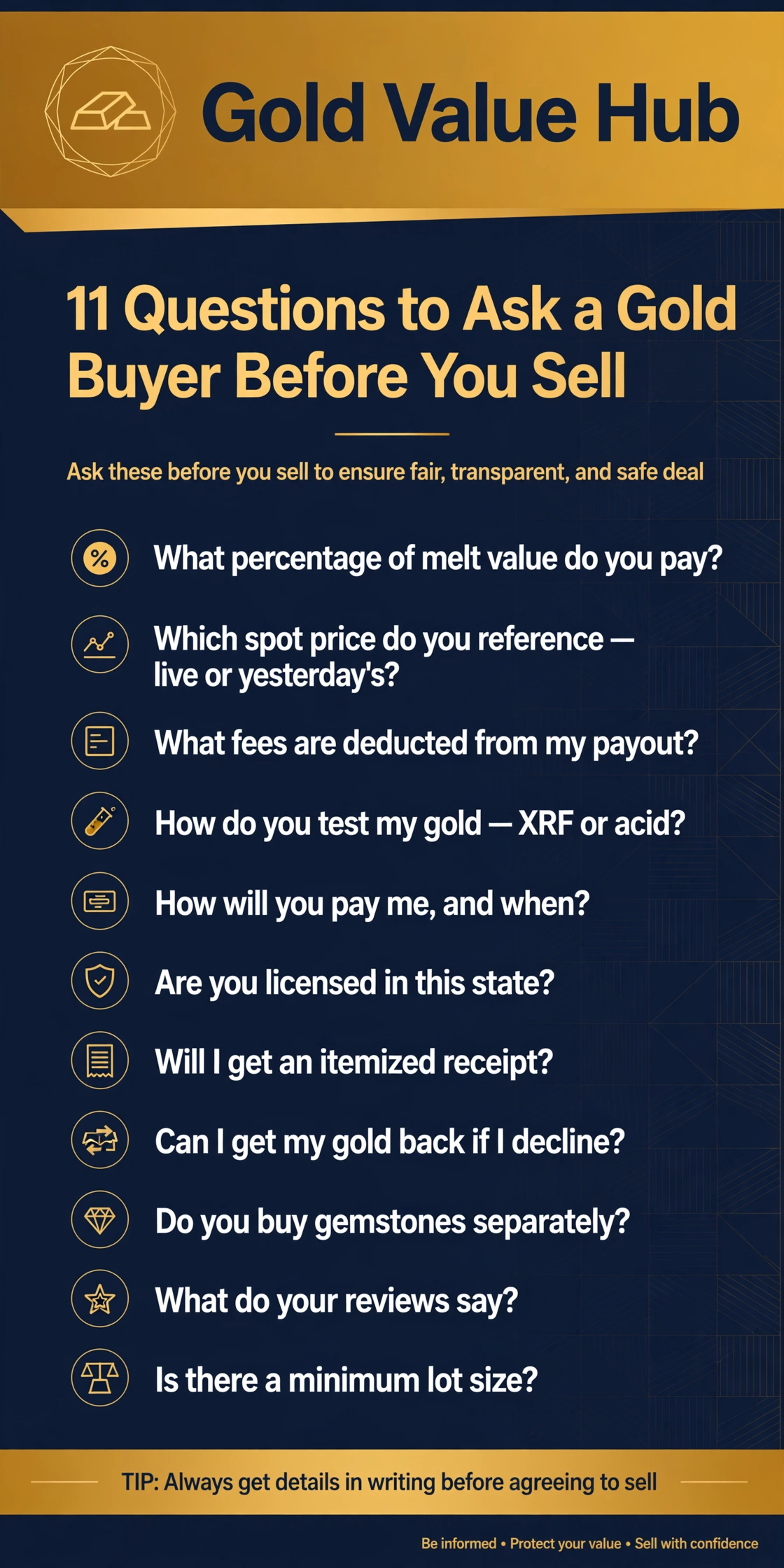
11 Questions to Ask a Gold Buyer Before You Sell
Published Oct 21, 2026
Quick Answer: Before selling gold, ask the buyer: what karat did you test, what weight in grams, what spot price you’re using, what percentage of melt the offer is, whether fees are deducted, and whether you’ll get it in writing. These questions to ask gold buyer staff expose lowball offers instantly — evasive answers mean you walk away.
You’ve never sold gold before, you’re standing at a counter, and you have no idea what’s fair to ask. That uncertainty is exactly what dishonest buyers count on. The right questions to ask gold buyer staff turn the tables — each question forces transparency, and the answers (or non-answers) tell you whether to sell or walk out.
This guide gives you 11 exact questions, explains what each one reveals, and decodes the evasive answers that signal trouble. Memorize the top five and you’ll negotiate from strength at any counter, with any buyer, on your very first sale.
All numbers use the October 7, 2026 spot price of $4,098 per troy ounce ($131.76 per gram of pure gold). Check the site’s live gold price before you sell — and bring a photo ID, since most states require it.
11 Questions to Ask a Gold Buyer Before You Sell
Ask these in order. The first four establish the math; the rest test the buyer’s honesty and process. These questions to ask gold buyer staff work at pawn shops, jewelers, coin dealers, and over the phone with mail-in companies.
- 1. What karat did you test this as — and can you show me? Karat determines everything. A buyer who “tests” your 14K as 10K without showing an XRF readout or acid result is manufacturing a ~29% discount.
- 2. What weight did you measure, in grams? Insist on grams, not pennyweight. Compare against your home scale — a gap over 0.3g deserves an explanation.
- 3. What spot price are you using, from what time today? Spot moves all day. The buyer should name a price near the live quote and a time — “morning fix” vagueness lets them use a stale low number.
- 4. What percentage of melt value is your offer? The single most revealing question. Honest buyers answer directly (“we’re at 80% today”); dodgers say “we pay top dollar.”
- 5. Are there any fees deducted from this number? Refining, processing, and assay fees appearing after the quote are a classic margin trick. The answer should be “none — this is your payout.”
- 6. Is this scrap pricing, or did you evaluate it as resellable? Designer, antique, or gemstone pieces can beat melt at the right buyer. A scrap-only quote on a resellable piece leaves money behind.
- 7. Can I get this quote in writing, itemized? Weight, karat, per-gram price, spot reference, total. A written quote is your comparison tool and your price-match ammunition.
- 8. How and when will I be paid? Cash today, check today, ACH in days — know before you commit. Last-minute payment-method switches are a red flag.
- 9. What happens if I decline your offer? For mail-in: free insured return must be the answer. In person: you simply walk out with your gold — any hesitation here is a warning.
- 10. Are you licensed to buy gold in this state? Many states require precious-metals dealer licenses, and legitimate shops display them. No license, no sale.
- 11. Will you test in front of me? XRF, acid, and magnet tests all take minutes at the counter. Any trip to the back room with your gold is your cue to leave.
What Evasive Answers to Questions to Ask Gold Buyer Staff Reveal
When you run through the questions to ask gold buyer staff, the answers matter less than the willingness to answer. Straight responses (“80% of melt, here’s the math”) signal a professional. Watch for these dodges — each maps to a specific trick:
- “We pay top dollar” (no percentage) → the percentage is embarrassingly low.
- “Our system calculates it” (no breakdown) → the math doesn’t favor you.
- “Don’t worry about the details” → the details are where they profit.
- “This offer expires soon” → pressure replacing value.
- “They’re lying to get you in” (about competitors) → they can’t beat the competing number.
Questions to Ask Gold Buyer Staff Over the Phone
Mail-in and phone quotes need the same scrutiny. These questions to ask gold buyer staff work by phone or email — and reputable firms answer all of them in writing before you ship anything:
- What percentage of melt do you pay for 14K jewelry, in writing?
- What is the mail-in kit’s insurance coverage each way?
- Is return shipping free and insured if I decline the offer?
- Will I receive an itemized assay with weights and karats?
- Do you price-match competing written offers?
Note who you spoke with and the date. Phone evasiveness sounds like: “our specialist will explain when your items arrive” (won’t state payouts) or “just send it in and see” (avoids the return-policy question). The best questions to ask gold buyer companies by phone are the ones about money and exits — Q4, Q5, and Q9 — because those are the answers a bad operator least wants to give.
How to Choose a Gold Buyer: 5-Minute Scorecard
Score each buyer on the questions to ask gold buyer checklist — 1 point per yes. Sell only to buyers scoring 4+:
| Check | What “yes” looks like |
| Posted payout rates | Percentage of melt published or stated plainly |
| Verifiable identity | Physical address, business license displayed |
| Recent reviews with numbers | Reviews quoting actual payout percentages |
| Transparent testing | In front of you, or itemized assay by mail |
| Written itemized quote | Weight, karat, per-gram, spot, total |
| Clean exit | Free insured return / walk out freely |
What to Research Before You Ask
Questions work best with homework behind them. Before you use these questions to ask gold buyer staff, know your karat (hallmark), weight (your own gram scale), and today’s spot price — the trio that produces your melt value. Then check reviews and posted payout rates so you know what a good answer sounds like.
How Much Will You Get? Payout Ranges by Buyer Type
Use these ranges to grade the answers you get — a buyer whose percentage lands far below their channel’s norm failed your test:
| Buyer type | Typical % of melt | Example: $1,541.59 melt |
| Online gold buyer | 80–90% | $1,233–$1,387 |
| Local jeweler / coin shop | 70–85% | $1,079–$1,310 |
| Pawn shop | 30–60% | $462–$925 |
| Gold party / hotel buyer | 30–50% | $462–$771 |
How Buyers Test Your Gold (and What to Watch)
- Hallmark check — loupe reading of the karat stamp.
- Magnet test — gold isn’t magnetic.
- Acid test — scratch plus acid indicates karat range.
- Electronic tester — conductivity probe estimates karat.
- XRF analyzer — precise, non-destructive purity reading.
Question 11 of the questions to ask gold buyer checklist exists because testing location matters as much as method: in front of you is professional, in the back room is a red flag.
Offer vs Melt Value vs Retail Value
Question 4 of the questions to ask gold buyer set only works if you know which “value” you’re asking about. Melt value (pure gold × spot) is the ceiling. The offer is melt minus margin. Retail value is the new-jewelry price — irrelevant.
Weight Units: Ask in Grams, Always
Question 2 specifies grams for a reason: pennyweight quotes hide weak payouts. Convert on the spot — 1 dwt = 1.55517g, 1 troy ounce = 31.1035g. At October 7, 2026 spot, 14K melts at $77.08/g ($119.88/dwt). A “$70 per dwt” quote is $45.01/g — just 58% of melt.
Where to Sell Gold: Every Channel, Ranked
Not all channels welcome scrutiny equally. Here’s how buyer types rank — and how the questions to ask gold buyer staff land at each:
| Rank | Channel | Typical payout | Question-friendliness |
| 1 | Top online buyer | 80–90% of melt | High — published rates, price-match |
| 2 | Coin dealer | 75–85% of melt | High — expects informed sellers |
| 3 | Local jeweler | 70–85% of melt | Medium — varies by shop |
| 4 | Refinery (large lots) | 90–98% of melt | Low — fixed rates, assay reports |
| 5 | Pawn shop | 30–60% of melt | Medium — negotiable, pressured |
| 6 | Gold party / hotel buyer | 30–50% of melt | Low — dodge-heavy |
Pawn shop vs jewelry store: jewelers answer these questions more readily and pay 15–30 points more of melt. Why pawn shops pay less: refining costs, volatility risk, storefront overhead, testing risk — and margin.
The Selling Process Step by Step
The workflow below bakes the questions to ask gold buyer staff right into each step:
- 1. Research — karat, weight, spot price; calculate melt value.
- 2. Vet buyers — run the 5-minute scorecard above.
- 3. Ask the 11 questions — in order, at each buyer.
- 4. Collect written quotes — three minimum, itemized.
- 5. Compare and negotiate — counter on percentage of melt.
- 6. Get paid, keep records — count payment; save receipts for taxes.
How to Prepare Your Gold for Questioning
Sort by karat, weigh in grams, photograph everything, bring photo ID. Scrap (broken, plain pieces) is pure melt math. Resellable pieces (designer, antique) deserve estate quotes — ask Question 6 before accepting scrap pricing. Diamonds add nothing at scrap counters. A soap rinse is fine; never clean coins.
Payment, Insurance, Shipping, and Guarantees
- Cash: same day locally — count at the counter.
- Business check / ACH: paper trail for taxes; 3–7 days by mail.
- Wire: same-day on $5,000+ lots, sometimes a $25–$35 fee.
- Mail-in insurance: free insured kit, confirmed coverage, free insured returns.
- Price-match guarantees: submit competing written quotes to top online buyers.
The payment questions to ask gold buyer staff (Q8) exist because payment surprises are a real profit leak: fees, delays, and method switches all cut your effective payout. Preliminary estimates are directional only — the binding offer follows testing.
Red Flags These Questions Expose
Each red flag maps to one of the questions to ask gold buyer staff — the question number tells you which tripwire it triggers:
- Won’t state a percentage of melt (Q4).
- Won’t show the scale or test (Q2, Q11).
- Fees appear after the quote (Q5).
- Won’t put it in writing (Q7).
- Pressures a fast decision (defeats all 11).
- No license displayed (Q10).
The FTC advises comparing multiple offers and understanding terms before selling gold — these questions are how you do both.
Negotiation After the Questions
With your questions to ask gold buyer checklist complete, you negotiate from facts: three written quotes in hand, counter on percentage of melt, use the best quote as leverage, walk away at least once.
Costly Mistakes to Avoid
- Asking zero questions and accepting the first number.
- Accepting verbal-only quotes you can’t compare.
- Letting retail-price talk replace melt math.
- Skipping the license check (Q10).
- Treating pressure deadlines as real.
Pawning vs Selling Gold
| Factor | Pawn loan | Outright sale |
| Keep the gold? | Yes, if you repay | No |
| Typical payout | 25–60% as a loan | 70–90% of melt (good buyers) |
| Interest/fees | Monthly 10–25% | None |
Pawn loans suit only short-term needs — interest compounds brutally. Otherwise sell outright. Either way, run the 11 questions first; they apply to pawn counters too.
Taxes When You Sell Gold
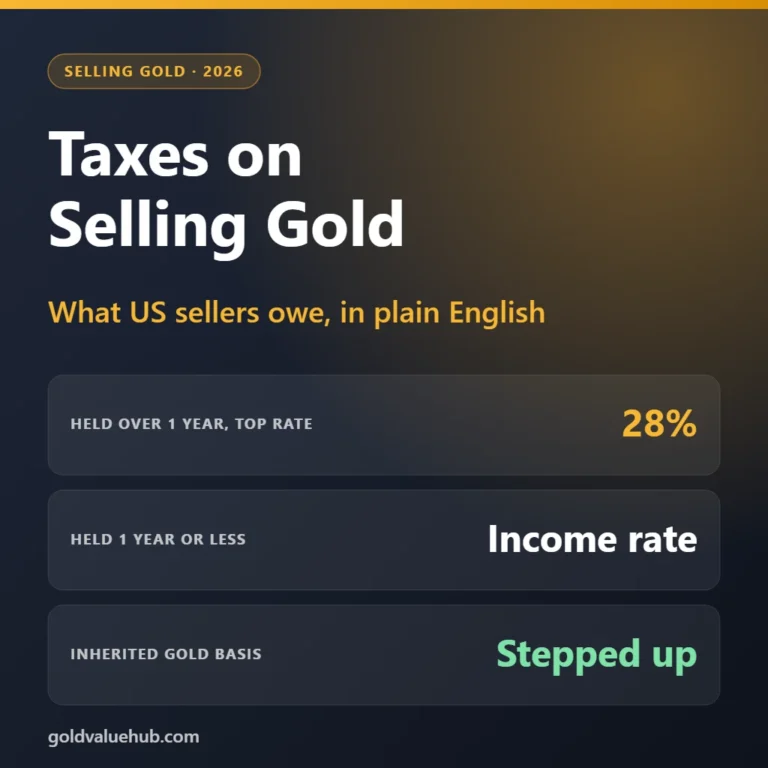
The IRS treats physical gold as a collectible: profit on gold held over a year faces up to the 28% collectibles rate; under a year, ordinary income. Your written quotes and final receipt are your tax records — keep them. (See the IRS rules on capital gains.)
What Good Answers Are Worth: Illustrative Examples
Asking Question 4 exposes the spread — illustrative math at October 7, 2026 spot ($131.76/g) on a 20g 14K chain ($1,541.59 melt):
| Buyer answer to Q4 | % of melt | You receive |
| “We’re at 85% today” | 85% | $1,310.35 |
| “Around 70%” | 70% | $1,079.11 |
| “We pay top dollar” (no number) | ~50% | ~$770.80 |
Pre-Sale Checklist
- Calculate melt value; print the 11 questions.
- Score buyers with the 5-minute scorecard.
- Bring photo ID; weigh in grams at home.
- Ask all 11; collect three written quotes.
- Negotiate on percentage; walk away once.
- Keep receipts for taxes.
Key Takeaways
- The 11 questions to ask gold buyer staff: karat, weight, spot price, % of melt, fees, scrap vs resellable, written quote, payment, decline terms, license, in-front testing.
- Question 4 (percentage of melt) is the most revealing — dodgers won’t answer it.
- Evasive answers map to specific tricks: “top dollar” = low percentage, “our system” = bad math.
- Score buyers with the 5-minute scorecard; sell only to 4+ scores.
- Get three written, itemized quotes before deciding anything.
- Walk away from pressure, mystery fees, and back-room testing.
- Keep quotes and receipts — gold profits face up to 28% collectibles tax.
Frequently Asked Questions
What should I ask a gold buyer first?
Start with the math trio: what karat did you test, what weight in grams, and what spot price are you using. Those three answers let you verify everything that follows. Then ask the percentage-of-melt question — it’s the fastest honesty test in the business.
How do I know if a gold buyer is reputable?
They publish payout percentages, display a license, test in front of you, provide written itemized quotes, and have recent reviews quoting actual payouts. Run the 5-minute scorecard in this guide — reputable buyers score 4 or higher without breaking a sweat.
Should I ask for the offer in writing?
Always — it’s question 7 for a reason. A written, itemized quote (weight, karat, per-gram price, spot, total) lets you compare buyers apples-to-apples and triggers price-match guarantees at online buyers. Verbal-only quotes can’t be compared or challenged.
What is a good percentage of melt value?
Online buyers: 80–90%. Local jewelers and coin shops: 70–85%. Pawn shops: 30–60%. Refineries: 90–98% on large lots. When you ask the percentage question, grade the answer against the channel — 75% is great at a pawn shop and mediocre online.
Can I ask a buyer to show me the scale?
Yes, and you should — it’s a normal request professionals hear daily. Watch the readout yourself and compare with your home weight. A buyer who refuses or gets defensive about the scale is telling you not to trust the weighing.
Do I need to ask about fees?
Yes — question 5 exists because fees-on-top is a classic margin trick. Ask “are there any fees deducted from this number?” before agreeing. Honest buyers build costs into their percentage and answer “none.”
What if the buyer won’t answer my questions?
Leave. Evasion is the answer — a buyer who won’t state a percentage, show a test, or write a quote has told you everything about the deal you’d get. There are plenty of buyers who answer plainly; spend your time with them.
Should I ask different questions for mail-in buyers?
Same questions, plus mail-specific ones: what is the kit’s insurance coverage, is return shipping free and insured, and will I get an itemized assay? Ask by phone or email before shipping — reputable firms answer everything in writing.
Is it rude to ask so many questions?
Not at all — professionals expect it, and the questions to ask gold buyer staff mark you as a serious seller. The only buyers irritated by questions are the ones with something to hide.
What paperwork should I bring when selling gold?
Bring a government photo ID — most states legally require buyers to record it. Original purchase receipts help but aren’t required. Bring your own weight and karat notes too; they keep the conversation honest.
These eleven questions to ask gold buyer staff take five minutes, and you’ll never be the confused seller at the counter again. Print the list, run the scorecard, and collect three written quotes. Start with buyers worth questioning and our scrap gold calculator.