
Best Time to Sell Gold During the Day: Does Timing Matter?
Published Oct 26, 2026
Quick Answer: The best time to sell gold during the day barely matters for most sellers — intraday price moves are typically under 1%, dwarfed by the 15–40% gaps between buyer payouts. What matters far more: selling on a strong-price day, knowing which price your buyer uses, and choosing the highest-paying channel. Check the live price, then focus on the buyer, not the clock.
Gold ticks up and down all day on the charts, so it’s natural to wonder: is there a best time to sell gold during the day? Should you rush to the buyer at 9 AM, or wait for the afternoon? The honest answer will save you a lot of clock-watching: for jewelry sellers, the hour you sell barely moves the needle.
Here’s why. A typical day’s gold price range is 0.5–1.5% — maybe $20–$60 per ounce on a $4,098 price. Meanwhile, the gap between a pawn shop’s 40% payout and an online buyer’s 85% payout is 45 percentage points — over $690 on a single chain. You’re optimizing pennies while dollars sit on the table.
This guide explains how intraday gold pricing actually works, when timing does matter (locking prices, volatile days), and what to focus on instead. Examples use the October 7, 2026 spot price of $4,098 per troy ounce ($131.76/g pure gold).
Best Time to Sell Gold During the Day: Does It Matter?
For scrap jewelry sellers: essentially no. The best time to sell gold during the day is “whenever the best buyer is open,” because intraday moves are noise compared to buyer margins. A 1% intraday swing on $1,541.59 of melt is $15.42 — while choosing an 85% buyer over a 60% buyer is worth $385.40. Optimize the big number first.
The exception: if you’re selling a large lot (say $20,000+ in gold) on a volatile day, a 1–2% swing is $200–$400 — worth a glance at the charts. And if you’re selling bullion bars or coins near spot, timing matters slightly more since margins are thinner. For typical jewelry lots, don’t sweat the hour.
How Gold Spot Price Timing Works
Gold trades nearly 24 hours a day across global markets, so there’s no single “opening bell.” Two benchmarks anchor the day:
- LBMA Gold Price — set twice daily in London (morning and afternoon auctions); the global reference price.
- COMEX futures — US futures market, most active during New York trading hours (8:20 AM–1:30 PM ET for the main session).
- Overnight Asian trading — thinner volume; prices can drift on news.
Most US gold buyers base quotes on the live spot feed during business hours — effectively the COMEX-influenced price. When you ask a buyer “what spot price are you using?”, you’re asking which moment of this continuous market they picked. Understanding this structure beats hunting for the best time to sell gold on the clock.
Morning vs Afternoon: When to Sell Gold for the Highest Price
There’s no statistically reliable “best” hour — anyone claiming mornings always beat afternoons is selling something. But there are practical patterns worth knowing:
- Morning (US): prices reflect overnight Asian/European trading; the LBMA morning auction posts ~10:30 AM London time (5:30 AM ET).
- Midday (US): peak COMEX volume — the most “representative” price of the day, and when most buyers update quotes.
- Afternoon (US): LBMA afternoon auction (~3 PM London, 10 AM ET) is set; late-day moves often follow US economic data releases (8:30 AM ET).
- Volatile days: major news (Fed decisions, inflation data) can swing gold 1–3% in minutes — check headlines before selling.
Practical takeaway: if gold is rallying on good news, selling sooner captures the move; if it’s sliding, waiting rarely helps — downtrends persist intraday more often than they reverse. But for jewelry, the buyer’s margin matters 20× more than finding the best time to sell gold intraday.
Best Time to Sell Gold: What Actually Moves the Price Week to Week
If intraday timing is noise, what does move gold meaningfully? Week-to-week drivers: Federal Reserve decisions and rate expectations (lower expected rates usually lift gold), inflation data, US dollar strength (a weaker dollar typically supports gold), and geopolitical shocks. None of these follow a calendar you can set a watch by — but they explain why the best time to sell gold is better measured in weeks than hours.
Practical approach: glance at the one-month chart before selling. If gold is near the top of its recent range and headlines are supportive, it’s a fine time. If it’s sliding on strong dollar news, selling sooner beats hoping for a bounce — but remember, even a “bad week” costs you 2–3% while a bad buyer costs you 30%. Keep perspective.
Best Time to Sell Gold and the Bid-Ask Spread
Here’s a timing subtlety that matters more than the hour: the bid-ask spread. Dealers buy at the bid (lower) and sell at the ask (higher); the gap is their instant margin. For scrap sellers, the “bid” is what your payout percentage applies to — so when you compare a buyer’s quote to “spot,” confirm whether they mean bid or the mid-price. A buyer quoting 85% of the ask may pay less than one quoting 82% of the bid. Ask which price their percentage applies to.
What Matters More Than the Hour
| Factor | Typical impact on $1,541.59 melt |
| Choosing 85% buyer vs 60% buyer | ~$385 difference |
| Negotiating 60% → 80% | ~$308 difference |
| Selling on a strong week vs weak week | ~$30–$75 difference |
| Morning vs afternoon timing | ~$8–$23 difference |
The hierarchy is clear. The best time to sell gold is less about the clock and more about the calendar (strong-price periods) and the counter (high-payout buyers).
How to Lock In Your Price
Timing anxiety disappears when you lock the price. Online buyers typically lock your price for 24–72 hours after you request a kit or accept a preliminary quote — if spot drops while your gold ships, you keep the locked price. Some lock at kit request, others at receipt of your gold: always ask which. Local buyers honor the day’s quote; get it in writing with the time noted. A locked strong price beats perfect timing every time — it’s the closest thing to a “best time to sell gold” guarantee.
How Much Will You Get? Payout Ranges
Payouts don’t change by the hour — but they define the real “best time to sell gold” answer (it’s whenever the best buyer is paying):
| Buyer type | Typical % of melt |
| Online gold buyer | 80–90% |
| Local jeweler / coin shop | 70–85% |
| Pawn shop | 30–60% |
| Refinery (large lots) | 90–98% |
How Buyers Test Your Gold
- Hallmark check — karat stamp reading.
- Magnet test — gold isn’t magnetic.
- Acid / electronic test — karat range confirmation.
- XRF analyzer — precise non-destructive purity reading.
Offer vs Melt Value vs Retail Value
Timing talk often confuses which “price” is moving. Spot price (the market) moves intraday; melt value follows it; the offer is melt minus the buyer’s margin — and margins don’t change by the hour. A buyer paying 80% at 9 AM pays 80% at 4 PM: the best time to sell gold changes the melt, never the margin. Retail value is irrelevant as always.
Weight Units: Grams, Pennyweight, Troy Ounces
Weigh in grams (1 dwt = 1.55517g; 1 troy oz = 31.1035g). At October 7, 2026 spot, 14K = $77.08/g. Your weight is fixed regardless of when you sell — only the per-gram price wiggles, and only slightly.
Where to Sell Gold: Every Channel, Ranked
| Rank | Channel | Typical payout | Price basis |
| 1 | Top online buyer | 80–90% of melt | Locked 24–72 hrs |
| 2 | Coin dealer / jeweler | 70–85% of melt | Day’s live spot |
| 3 | Refinery (large lots) | 90–98% of melt | Settlement-day price |
| 4 | Pawn shop | 30–60% of melt | Counter quote |
The Selling Process Step by Step
- 1. Check the live price — is today strong or weak this week?
- 2. Calculate melt value — weight × karat × spot.
- 3. Get three quotes — ask each buyer’s spot reference and lock terms.
- 4. Lock the best price — in writing, with an expiry.
- 5. Sell and document — keep receipts for taxes.
How to Prepare Your Gold
Sort by karat, weigh in grams, run the scrap gold calculator, bring photo ID, and check the live price that morning — not to time the hour, but to know whether it’s a strong day to lock. Scrap is melt math; resellable pieces deserve estate quotes; diamonds add nothing at scrap counters.
Payment, Insurance, and Shipping
- Cash: same day locally.
- Business check / ACH: 3–7 days by mail; paper trail for taxes.
- Price locks: the real timing tool — lock strong prices for 24–72 hours.
- Mail-in: price often locks at kit request or receipt — ask which.
Timing Red Flags
Timing-based pressure is a favorite of weak buyers. Watch for these lines — each one misuses the “best time to sell gold” idea to rush you:
- “Gold is dropping as we speak” — pressure tactic; check the actual chart.
- Stale spot quotes — buyer using yesterday’s lower price; ask for the time.
- “Sell before the weekend” — no basis; markets reopen where they closed.
- Intraday “deals” — margins don’t change by the hour, whatever they claim.
The FTC advises comparing offers and understanding pricing before selling — including which spot price a buyer uses.
Negotiation Beats Timing Every Time
An hour of timing optimization might earn you $15; an hour of quote comparison routinely earns $200+. Get three written quotes, counter on percentage of melt, trigger price-match guarantees, walk away once. The best time to sell gold is when you’ve done this homework — the clock is the least of it.
Questions to Ask About Timing
- What spot price and time are you basing this on?
- Is this price locked? Until when?
- What percentage of melt is your offer?
Mistakes to Avoid
- Obsessing over the hour while ignoring buyer margins.
- Accepting a stale low spot quote.
- Skipping price locks when offered.
- Letting “urgent” timing pressure replace comparison.
Pawning vs Selling: Timing Factors
| Factor | Pawn loan | Outright sale |
| Timing sensitivity | Low — loan, not sale | Low for jewelry |
| Price basis | Appraised value | Day’s spot / locked price |
| Best when | Need cash now | Strong-price day + best buyer |
Taxes When You Sell Gold
The IRS treats physical gold as a collectible: profit on gold held over a year faces up to the 28% collectibles rate; under a year, ordinary income. Timing the year of sale can matter for taxes (holding past the one-year mark); timing the hour doesn’t. (See the IRS rules on capital gains.)
Illustrative Examples: Timing vs Channel
20g 14K chain ($1,541.59 melt) — illustrative math at October 7, 2026 spot. See how channel choice beats timing in our gold profit calculator:
| Scenario | You receive | Gain vs baseline |
| Pawn shop 45%, any hour | $693.72 | Baseline |
| Pawn shop 45%, “perfect” hour (+1%) | $700.65 | +$6.94 |
| Online buyer 85%, any hour | $1,310.35 | +$616.63 |
| Online buyer 85%, strong week (+2%) | $1,336.56 | +$642.84 |
Pre-Sale Checklist
- Check the live price — strong day or weak day?
- Calculate melt value; weigh in grams.
- Get three written quotes; ask about price locks.
- Bring ID; keep receipts for taxes.
- Stop hunting the best time to sell gold by the hour — the buyer matters more.
Key Takeaways
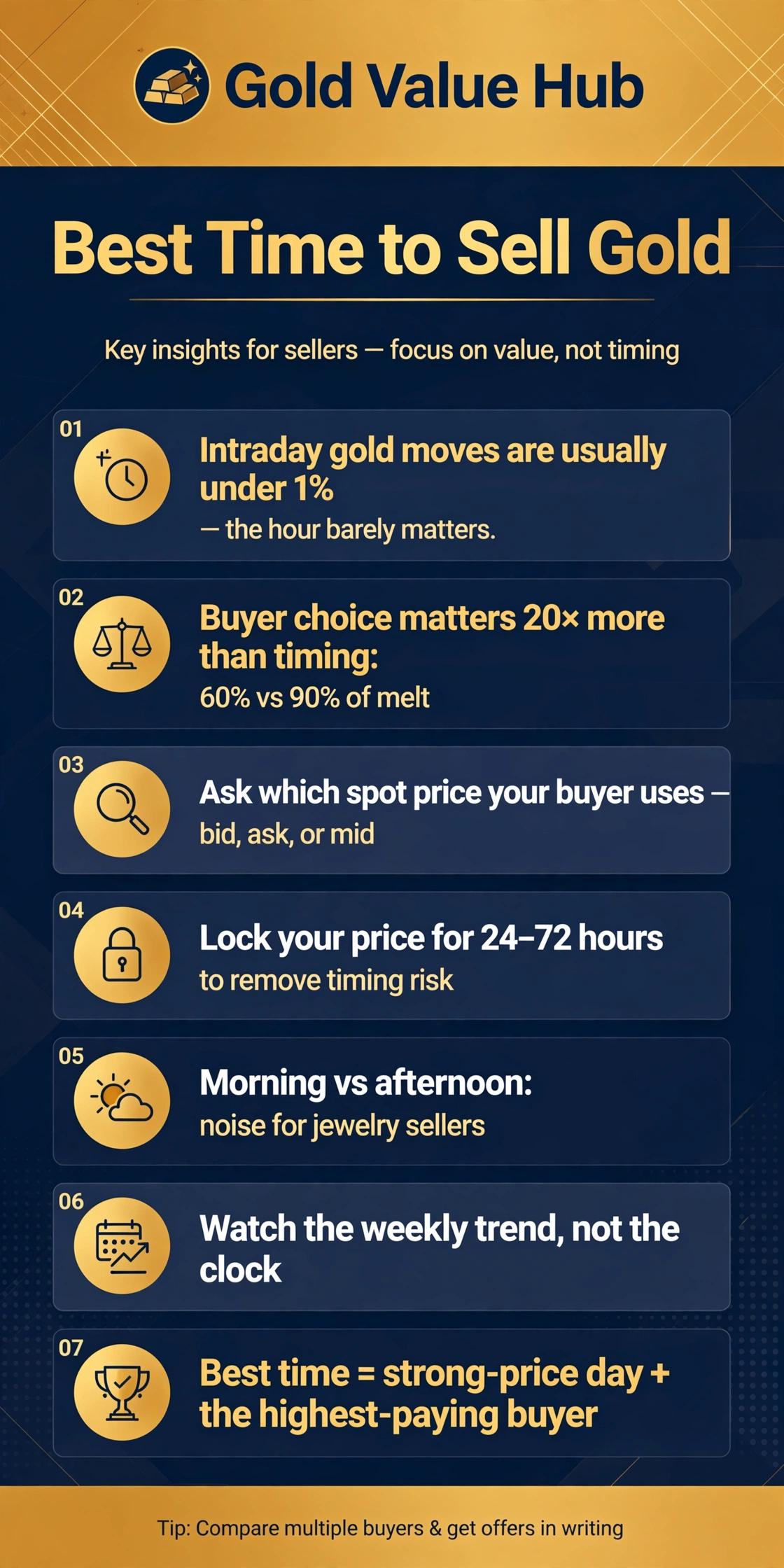
- The best time to sell gold during the day barely matters — intraday moves are typically under 1%.
- Buyer choice (85% vs 45% payouts) matters 20–40× more than the hour you sell.
- Gold trades near-continuously; LBMA auctions and COMEX hours anchor the benchmarks.
- Lock your price (24–72 hrs online) instead of timing the market.
- Ask every buyer which spot price and time their quote uses.
- Negotiation and quote comparison beat timing optimization by orders of magnitude.
- Keep records — gold profits face up to 28% collectibles tax; holding past a year helps.
Frequently Asked Questions
What is the best time of day to sell gold?
There’s no reliably best hour — intraday moves are typically under 1%. Midday US hours see peak COMEX volume and the most representative pricing. But buyer selection affects your payout 20–40× more than timing, so prioritize that.
Should I sell gold in the morning or afternoon?
It rarely matters for jewelry. Morning prices reflect overnight trading; midday has peak volume; afternoons follow US economic data. On volatile news days, check headlines — otherwise, sell whenever the best buyer is available.
Does the gold price change during the day?
Yes — gold trades nearly 24 hours a day, so spot moves continuously. Typical daily ranges are 0.5–1.5%, with bigger swings on major news days. For scrap sellers, these moves are small compared to buyer margin differences.
When is the best time to sell gold for the highest price?
During strong-price periods (weeks, not hours) to the highest-paying buyer you can find. Watch the weekly trend, lock your price when it’s strong, and sell to an 80–90% buyer. That combination beats any intraday timing.
Can I lock in the gold price before selling?
Yes — online buyers typically lock prices for 24–72 hours; local buyers honor the day’s quote. Always ask “is this price locked, and until when?” A locked strong price eliminates timing anxiety entirely.
Do pawn shops use the current gold price?
They should — but always ask what spot price and time they’re using. Some shops quote stale or low prices; verifying takes ten seconds and can be worth real money. Their margin (30–60% payouts) matters far more than their spot reference, though.
Is gold more expensive on weekends?
Markets are closed on weekends, so there’s no weekend price — buyers use Friday’s close. Don’t pay weekend “premiums” or accept weekend “discounts” as market reality; they’re dealer margin, not market moves.
Should I wait for gold to hit a new high before selling?
Only if you don’t need the money now — timing the absolute peak is luck, not strategy. A good rule: if the price is strong relative to recent months and you have a high-payout buyer lined up, sell. Waiting for higher often means watching it fall.
Does timing matter more for gold coins than jewelry?
Slightly — bullion coins trade on thinner margins near spot, so a 1% intraday move is a bigger share of the dealer’s spread. Even so, choosing the right dealer and watching the weekly trend matter more than picking an hour.
How do I know if today is a good day to sell gold?
Check the live price against recent weeks — if it’s near the top of its recent range, it’s a good day. That’s the practical meaning of “best time to sell gold” for most sellers. Then lock the price with your chosen buyer immediately.
Stop hunting the best time to sell gold by the clock and start comparing buyers — that’s where your money is. Check the live gold price, lock it with a top buyer, and sell with confidence.

