
How Much Gold Is in a Typical Wedding Band?
Published Oct 17, 2026
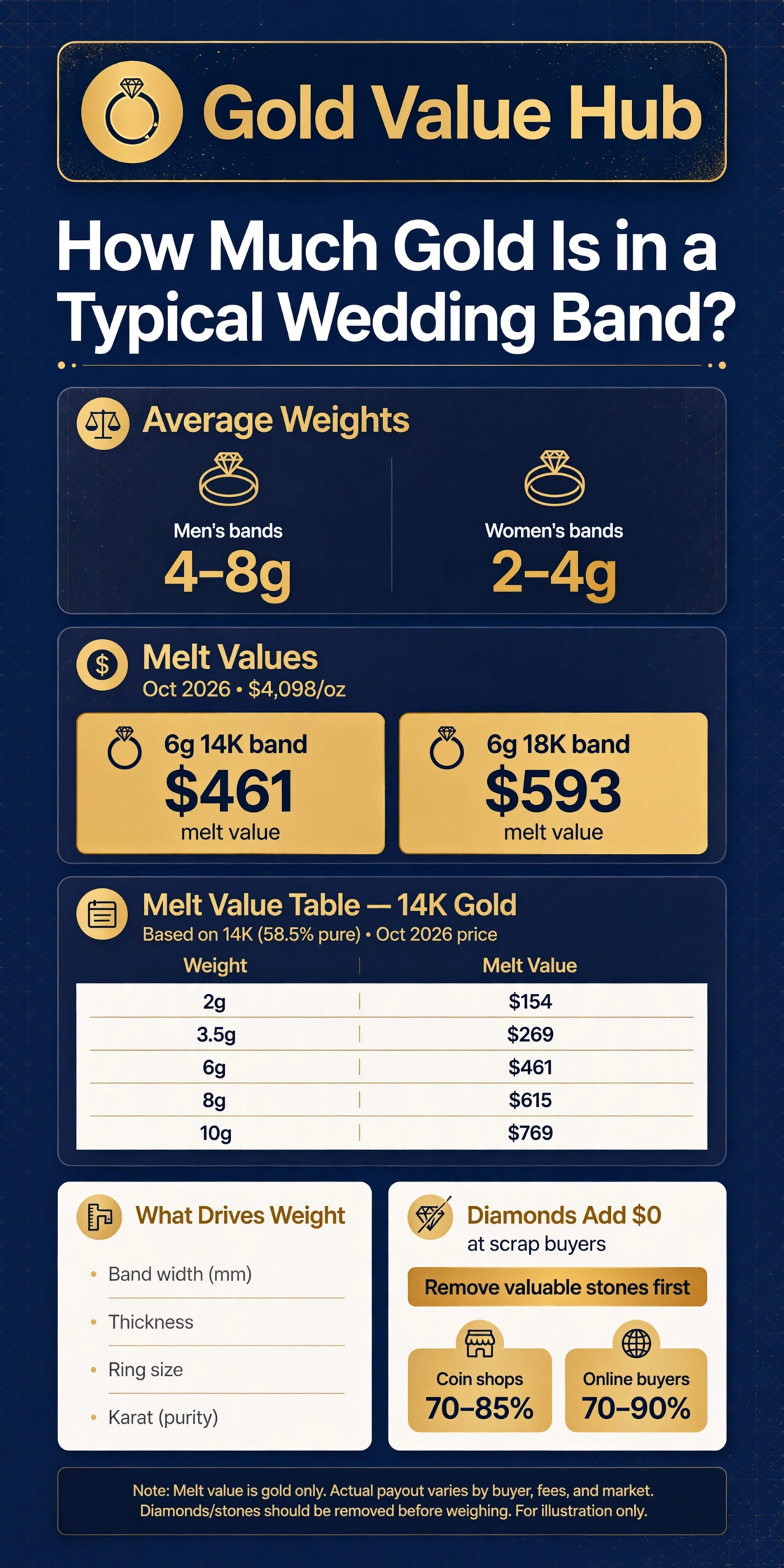
Quick answer: A typical men’s 14K wedding band weighs 4–8 grams and holds $308–$615 in melt value; a women’s band weighs 2–4 grams ($154–$308 melt) at illustrative October 2026 prices ($4,098/oz). Weight depends on ring size, band width (mm), thickness, and karat — wider, thicker bands hold more gold.
How much does a gold wedding band weigh — and what does that mean in dollars? It’s the question behind every “should I sell my wedding ring” decision. The answer varies more than you’d think: a dainty 2 mm women’s band and a hefty 8 mm men’s comfort-fit can differ by 6+ grams, which at today’s gold prices is a $460+ swing in melt value. This guide breaks down typical wedding band weights, what drives them, and exactly what your band is worth.
Whether you’re selling, insuring, or just curious, the math is the same: weight × purity × gold price. Below you’ll find average weights by style, the melt formula with worked examples, price tables, every selling channel ranked, refinery payout math, the pennyweight trick, taxes, and real payout examples — everything needed to value a wedding band like a pro.
Prices use $4,098/oz (~$131.76/g 24K) as an illustrative Oct 7, 2026 reference — check the live calculator before selling, since spot moves daily.
How Much Does a Gold Wedding Band Weigh? Averages by Style
Most US wedding bands are 14K (durable, affordable); 18K is common in high-end and European bands, while 22K and 24K bands appear in South Asian and Middle Eastern traditions. Typical weights: women’s bands 2–4 g (2–4 mm wide), men’s bands 4–8 g (4–8 mm wide). A classic 6 mm men’s 14K comfort-fit in size 10 weighs ~6 g; a 3 mm women’s 14K band in size 6 weighs ~2.5 g. Platinum bands run ~60% heavier than the same gold band (platinum is denser) — don’t confuse the two when estimating.
Three things drive weight: width (mm across the finger — the biggest factor), thickness (comfort-fit bands are thicker and heavier than flat), and size (each full size adds ~0.3–0.5 g on a men’s band). Hollow or “lightweight” bands — common in budget sets — can weigh half of a solid band the same size. When in doubt, weigh; never estimate from looks.
Wedding Band Melt Value in 4 Steps
Step 1: weigh the band in grams on a 0.1 g scale. Step 2: find the karat stamp inside the band (585/14K, 750/18K). Step 3: multiply weight by (karat ÷ 24). Step 4: multiply by $131.76/g (24K at the $4,098/oz reference). Engraving doesn’t change weight; stones do — deduct estimated stone weight or have the buyer do it.
Worked example — gold: a men’s 14K band at 6 g = 6 × 0.583 = 3.5 g pure × $131.76 = $461.16 melt value. 18K version: 6 g × 0.75 = 4.5 g × $131.76 = $592.92. Silver comparison: a 6 g 925 band = 5.55 g pure × $1.54/g (illustrative) = $8.55 — gold bands are a different universe of value.
Quote-sheet terms:
| Term | What It Means |
| Spot price | Live market price of one troy ounce of pure gold. Reference: $4,098/oz on Oct 7, 2026. |
| Melt value | Pure-gold weight × spot price. Your band’s raw commodity value. |
| Karat (K) | Purity out of 24. US bands are usually 14K (585); high-end often 18K (750). |
| Comfort-fit | Domed interior; thicker and heavier than flat bands of the same width. |
| Troy ounce (ozt) | Gold’s pricing unit: 31.1035 grams. |
| Pennyweight (dwt) | 1.55517 grams; 20 per troy ounce. $/dwt quotes flatter offers. |
| Assay / XRF | Purity tests: acid, electronic, or X-ray fluorescence scan. |
| Bid / ask | Bid = what dealers pay; ask = what they charge. The gap is the spread. |
What Today’s Gold Price Means for Wedding Bands
As of October 7, 2026, gold trades near $4,098 per troy ounce — about $131.76 per gram for pure 24K ($4,098 ÷ 31.1035), near record highs. For wedding bands this is transformative: a 14K band now melts at $76.86/g, so even a modest 4 g band holds $307 — more than many bands cost new in the 1990s. If you’re deciding whether to sell an unworn band, today’s prices are historically the best sellers have ever seen.
Buyers work off a bid/ask spread; you’ll never get full ask for scrap. Treat prices here as illustrative — gold moves daily — and value your band with the live gold jewelry calculator before accepting any offer. Sentimental value is real but unpriced — separate the emotion from the math before you walk into a shop.
Wedding Band Melt Value Table (by Weight and Karat)
Illustrative $4,098/oz reference (Oct 7, 2026). Find your band’s weight and karat — the payout column shows typical buyer ranges.
| Band | Weight | 14K melt value | 18K melt value | Typical payout (14K) |
| Women’s thin (2 mm) | 2 g | $153.72 | $197.64 | $92–$131 |
| Women’s medium (3–4 mm) | 3.5 g | $269.01 | $345.87 | $161–$229 |
| Men’s medium (5–6 mm) | 6 g | $461.16 | $592.92 | $277–$392 |
| Men’s wide (7–8 mm) | 8 g | $614.88 | $790.56 | $369–$523 |
| Men’s heavy comfort-fit | 10 g | $768.60 | $988.20 | $461–$653 |
The table answers the title question directly: most wedding bands hold $150–$800 in melt value. Engraving, brand stamps (even designer), and light wear don’t change these numbers — only weight and karat do. If your band falls between table rows, interpolate: each gram of 14K is worth $76.86 in melt, each gram of 18K $98.82, at the illustrative reference price.
What Affects a Wedding Band’s Gold Content
Beyond width and thickness: diamond settings — channel-set and pavé bands lose 10–30% of gold weight to stone seats; the diamonds aren’t paid for (small ones) so deduct generously. Hollow bands — budget “lightweight” bands can be half the weight of solid; tap-test and weigh. Two-tone bands — white and yellow sections are usually the same karat, but verify. Sizing — bands sized down have gold removed (sizing up adds some); a band sized three sizes down can lose ~1 g.
- Diamonds add $0 at scrap buyers — small stones are removed, not paid for. Large stones: remove and sell separately.
- Engraving is free — inside inscriptions don’t change weight or value either way.
- Designer stamps (Tiffany, Cartier) may beat melt on resale — check secondhand prices before scrapping.
- Wear thins bands — decades of wear can remove 5–10% of weight; weigh, don’t assume original specs.
Before You Sell a Wedding Band: Prep Checklist
Wedding bands carry emotion — which is exactly why preparation matters. Decide with math, not memories.
- Weigh to 0.1 g and photograph the readout. Confirm the karat stamp inside the band.
- Calculate melt: weight × (karat ÷ 24) × $131.76/g, or the live gold jewelry calculator.
- Deduct stone weight generously on diamond bands — or have stones removed first.
- Check designer resale: branded bands may beat melt — search sold listings.
- Separate his and hers by karat if different — never blend.
- Get three written quotes with weight, karat, price per gram, total. Bring ID.
- Sleep on it: unlike other scrap, wedding bands are irreplaceable — be sure before you sell.
Where to Sell a Wedding Band: Every Channel Ranked
Local coin shops (70–85% of melt): test in front of you, pay cash same day — the best balance for a single band. Online gold buyers (70–90%): strong rates; sensible for plain bands, less so for designer pieces. Local jewelers (60–80%): — convenient, and the right choice if the band might have designer value. Refineries (90–98%): top payout but 1–3 oz minimums — only for multiple bands or a full lot.
Pawn shops (30–60%): worst price — and wedding bands deserve better than a rushed decision. Consignment/secondhand: worth considering for designer or diamond bands that might beat melt. Skip eBay for plain bands (13%+ fees); consider it for branded pieces. Compare all options on our best place to sell gold page.
The Selling Process: Quote to Cash in 5 Steps
1. Quote: testing and weighing in front of you — grams, zeroed scale. 2. Offer: written, with weight, karat, price per gram, total. 3. Decide: never obligated; confirm free return first — and take the night to think for wedding bands. 4. Paperwork: ID and receipt; many states impose a 7–30 day hold. 5. Payment: cash/check same day locally; 1–3 business days by check/ACH online.
For mail-ins, use the insured kit, photograph everything, and keep tracking until funds clear. If the band has diamonds worth removing, have a jeweler pull them before you sell the gold — buyers won’t pay for small stones, but you can keep or sell them separately. Preliminary estimates are screening tools; the final offer follows the buyer’s own test.
Inside the Refinery: How Band Payouts Are Calculated
Four stages: 1. XRF screening reads the band’s alloy. 2. Melt and sample: bands melt into a bar; a drill sample is taken. 3. Fire assay: cupelled and weighed — definitive to 1 part in 10,000. 4. Settlement: payment on assayed fine-gold weight minus 1–3% refining plus a $25–100 lot fee, 1–5 business days after assay.
Single bands rarely go refinery-direct (minimums), but understanding the pipeline explains your buyer’s math: when a coin shop offers 80%, roughly 2–3% covers actual refining and the rest is their margin. Anyone offering 98%+ on a single band is hiding fees — demand the written breakdown.
Red Flags, Scams, and Negotiation
The FTC advises written appraisals and understanding offer math. Wedding-band traps: “sentimental value” discounts (emotion isn’t a pricing factor — but don’t let anyone rush you either); diamond weight counted as gold, then deducted punitively; mixed-karat blending of his-and-hers sets; pennyweight quotes (decoded below); “today only” pressure on an emotional sale; mail-ins without written insurance.
Negotiate calmly: “It’s 6 grams of 14K — $461 melt at current prices. Your offer is 65%; [competitor] offered 80% in writing. Can you match it?” Most buyers carry 5–10% flex. Always ask: “What spot price is this based on, and when was it locked?” Honest buyers answer instantly.
The Pennyweight Quote Trick, Fully Decoded
One dwt = 1.555 grams. “We pay $95 per pennyweight for 14K” = $61.09/g — against $76.86/g melt, that’s 79.5% of melt. On a 6 g band ($461 melt), that’s a $366 offer — $95 vanishes into the unit conversion. Emotional sellers are the trick’s favorite target; the math doesn’t care about your feelings, so let it protect you.
Defense: convert to dollars per gram, divide by melt-per-gram. $61.09 ÷ $76.86 = 0.795. Say the percentage out loud and compare it against your other written quotes.
Taxes: Wedding Bands and the IRS
Gold is a collectible to the IRS: gains past one year taxed up to 28%; under a year, ordinary income rates. Wedding bands are usually long-held, so the 28% collectibles rate typically applies — but bands bought decades ago for $200 and sold for $461 generate only $261 in gain. Keep purchase records; without basis proof the IRS can treat the whole sale as gain. See our taxes on selling gold guide; general information, not tax advice.
Real Payout Examples: Wedding Bands, Actual Numbers
At the illustrative $4,098/oz reference: a men’s 6 g 14K band (melt $461.16) fetches ~$392 (85%) coin shop, ~$369 (80%) online, ~$323 (70%) jeweler, ~$231 (50%) pawn. A women’s 3.5 g 14K band (melt $269.01): ~$229 coin shop, ~$202 jeweler, ~$135 pawn. A men’s 8 g 18K band (melt $790.56): ~$672 coin shop, ~$632 online, ~$395 pawn. Same band, same day, hundreds apart — three quotes, every time.
Key Takeaways
• Men’s 14K bands weigh 4–8 g ($308–$615 melt); women’s 2–4 g ($154–$308 melt) at Oct 2026 prices.
• Weight depends on width, thickness, ring size, and karat — weigh, don’t estimate.
• Value = weight × (karat ÷ 24) × current gold price per gram.
• Diamonds add $0 at scrap buyers — remove valuable stones before selling.
• Coin shops (70–85%) and online buyers (70–90%) suit single bands best.
• Convert pennyweight quotes to per-gram; get three written quotes.
• Long-held bands face the 28% collectibles rate on gains — keep purchase records.
Frequently Asked Questions
How much does a gold wedding band weigh?
Men’s bands: 4–8 grams (4–8 mm wide). Women’s bands: 2–4 grams (2–4 mm wide). Width, thickness (comfort-fit vs flat), ring size, and karat all move the number — weigh yours on a 0.1 g scale rather than guessing.
How much gold is in a 14K wedding band?
58.3% of its weight. A 6 g 14K band contains 3.5 g of pure gold, worth $461.16 in melt at the $4,098/oz reference. Multiply your band’s grams by 0.583, then by $131.76/g — or use the gold jewelry calculator.
What is my wedding band worth in scrap?
Calculate melt value (weight × purity × $131.76/g), then expect 60–90% from buyers. A 6 g 14K band ($461 melt) typically fetches $277–$415. Designer or diamond bands may beat melt — check resale before scrapping.
Do diamonds in a wedding band add scrap value?
No — scrap buyers pay for gold weight only; small diamonds are removed and not paid for. Stones over ~0.25 carat may have separate value: have them removed by a jeweler and sell them independently.
Where is the best place to sell a wedding band?
Coin shops (70–85%) for plain bands — cash same day. Online buyers (70–90%) for strong rates by mail. Jewelers (60–80%) if it might have designer value. Avoid pawn shops (30–60%) and rushed decisions alike.
Should I sell my wedding band or keep it?
A personal call, not a math problem — but make it with the math in hand, and never under same-day pressure from a buyer. Sell if it’s unworn, broken, or from a ended chapter and the money matters more. Keep it if there’s any chance of regret; melt value will still be there later.
How can I tell if my band is solid or hollow?
Weigh it — hollow “lightweight” bands run about half the weight of solid ones the same size. A 6 mm band under 3 grams is almost certainly hollow. Tap it too: hollow bands ring, solid ones thud.
What does “$95 per pennyweight” mean for my band?
$95/dwt = $61.09/g (one dwt = 1.555 g). Against 14K melt of $76.86/g, that’s 79.5% of melt — a $366 offer on a $461 band. Convert every dwt quote to dollars per gram first.
Do I pay taxes on selling a wedding band?
On the gain (sale minus what you paid). Long-held bands face up to 28% collectibles tax. A $461 sale on a $200 purchase = $261 taxable gain. Keep the original receipt — without basis proof the IRS can tax the whole sale.
Does engraving affect my wedding band’s value?
No — inside engravings don’t change weight or melt value, and buyers ignore them. They also don’t reduce value. The only markings that matter are karat stamps and designer marks.
Your wedding band’s worth is weight times purity times price — now you know all three. Weigh it on a proper scale, check the stamp inside the band, deduct any stone weight, and decide with a clear head. Calculate how much gold is in your wedding band with the free tool before any buyer names a number.
