
Are Gold Teeth Worth Money? Grillz and Crowns Explained
Published Oct 11, 2026
Quick answer: Yes, gold teeth are worth money — but usually less than people expect. A gold crown (60–85% gold) holds $160–$560 in melt value at illustrative October 2026 prices ($4,098/oz), while a typical 10K grillz set holds $200–$600. Buyers pay 60–95% of melt after testing the actual gold content.
Are gold teeth worth money, or is it all hype? The answer depends on which “gold teeth” you mean. A dental gold crown is a high-gold alloy worth hundreds in melt value. A grillz set is fashion jewelry — usually 10K gold, often thin — worth real money but far less per gram than a crown. Both sell the same way: by weight and purity, not by looks.
Confusion costs sellers money. People assume grillz are “solid gold” and crowns are “just dental work,” when the value equation is nearly the reverse. This guide breaks down exactly what gold teeth contain, how to calculate their melt value, what buyers actually pay, and where to sell crowns and grillz for the best price.
Below: melt formulas for crowns and grillz, gold-content tables, every selling channel ranked, refinery payout math, the pennyweight trick, taxes, and real payout examples. Prices use $4,098/oz (~$131.76/g 24K) as an illustrative Oct 7, 2026 reference — check the live calculator before selling, since spot moves daily.
Gold Crowns vs Grillz: What “Gold Teeth” Actually Are
Permanent gold crowns are dental restorations: high-noble alloys of 60–85% gold mixed with platinum, palladium, silver, and copper for chewing strength. They’re medical devices that happen to be valuable. Grillz (grills) are removable fashion pieces that snap over teeth — typically 10K gold (41.7% pure), sometimes 14K, occasionally gold-plated base metal with no melt value at all.
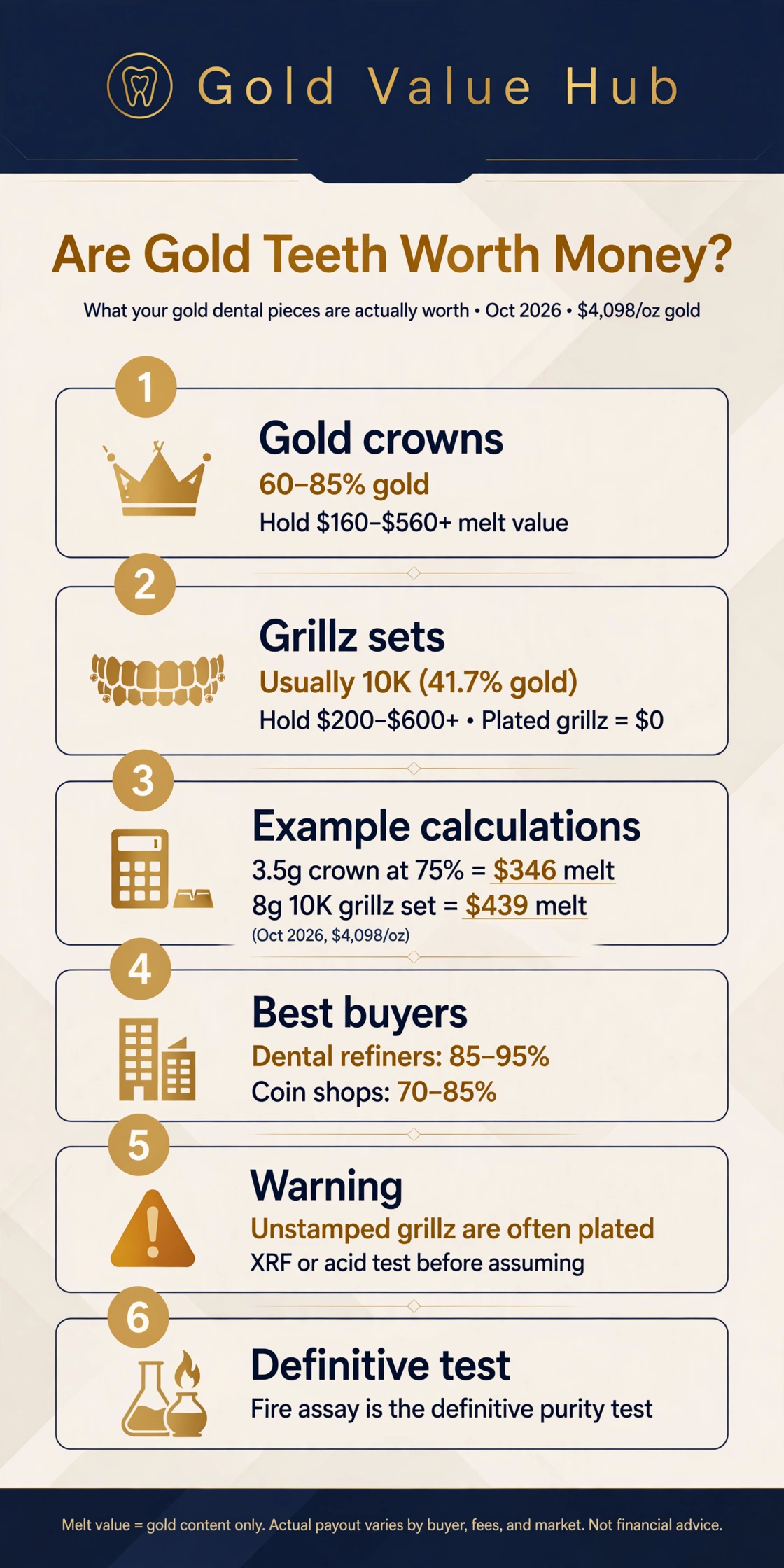
The irony: the unglamorous crown usually beats the flashy grillz. A 3.5 g crown at 75% gold holds $346 in melt; a 6 g grillz set at 10K holds $329 — similar money, but the grillz cost far more new. And plated grillz (marked “14K HGE” or with no stamp) are worth $0 to refiners. The stamp — or the lack of one — tells the story before any test. When in doubt, assume plating until a test proves otherwise; that single habit saves sellers more money than any other.
Are Gold Teeth Worth Money? The Melt Value Formula
Gold teeth worth comes down to melt value: pure-gold weight × spot price. Step 1: weigh in grams on a 0.01 g scale — clean crowns of cement and debris first; buyers pay for metal only. Step 2: determine purity. Crowns: assume 60–75% gold until tested (dental work is never stamped). Grillz: check for 10K/14K stamps; unstamped grillz need acid or XRF testing, and many are plated. Step 3: weight × purity = pure-gold content. Step 4: × $131.76/g (24K at the $4,098/oz reference).
Worked example — crown: 3.5 g at 75% gold = 2.625 g pure × $131.76 = $345.87 melt. Worked example — grillz: a 6-tooth top set weighing 8 g at 10K (41.7%) = 3.33 g pure × $131.76 = $439.17 melt. Silver comparison: some grillz are sterling silver with gold plating — an 8 g silver grillz at 92.5% = 7.4 g × $1.54/g (illustrative) = $11.40. Test before you celebrate.
Terms you’ll see on every quote sheet:
| Term | What It Means |
| Spot price | Live market price of one troy ounce of pure gold. Reference: $4,098/oz on Oct 7, 2026. |
| Melt value | Pure-gold weight × spot price. The raw commodity value of the teeth. |
| High-noble alloy | Dental alloy with ≥60% noble metal. Most gold crowns qualify. |
| Grillz / grills | Removable decorative tooth covers; usually 10K–14K gold, sometimes plated. |
| Troy ounce (ozt) | Gold’s pricing unit: 31.1035 grams. |
| Pennyweight (dwt) | 1.55517 grams; 20 per troy ounce. $/dwt quotes flatter offers. |
| Fire assay | Lab melt-and-weigh purity test, accurate to 1 part in 10,000. |
| Bid / ask | Bid = what dealers pay; ask = what they charge. The gap is the spread. |
What Today’s Gold Price Means for Gold Teeth
As of October 7, 2026, gold trades near $4,098 per troy ounce — about $131.76 per gram for pure 24K ($4,098 ÷ 31.1035), near record highs. Gold teeth have no resale-as-jewelry market (nobody buys used crowns to wear), so 100% of their value is melt — and melt has roughly tripled since 2015. A crown worth $100 a decade ago holds $300+ today.
Buyers work off a bid/ask spread; you’ll never get full ask for scrap. Treat prices here as illustrative — gold moves daily — and run your pieces through the live scrap gold calculator before accepting any offer. For grillz, use 41.7% purity (10K) as your estimate until tested.
Gold Teeth Value by Type (Price Table)
Illustrative $4,098/oz reference (Oct 7, 2026). The payout column shows typical refiner-to-pawn ranges.
| Type | Typical gold content | Melt $/gram | Example weight | Melt value | Typical payout |
| Gold crown (high) | 85% | $112.00 | 3.5 g | $392 | $235–$372 |
| Gold crown (standard) | 75% | $98.82 | 3.5 g | $346 | $208–$329 |
| Gold bridge (3-unit) | 70% | $92.23 | 9 g | $830 | $498–$789 |
| Grillz set (10K) | 41.7% | $54.90 | 8 g | $439 | $263–$417 |
| Grillz set (14K) | 58.3% | $76.86 | 8 g | $615 | $369–$584 |
| Plated grillz | ~0% | $0 | 8 g | $0 | $0 |
The plated row is the cautionary tale: gold-colored grillz with no karat stamp are usually electroplate over brass or copper — $0 melt value. A $20 acid test or free XRF scan at a coin shop settles it before you waste a trip.
What Sells for Melt — and What’s Worth $0
All real gold teeth sell for melt — there’s no secondhand market for used crowns or pre-owned grillz. But the category splits hard: full gold crowns and bridges are the prize, solid-gold grillz are decent scrap, and plated grillz are worthless. Selling for melt means instant cash with no fees and no awkward listings — and unlike jewelry, a crown is never “worth more intact.”
- Sells for melt: gold crowns, bridges, inlays; solid 10K–14K grillz sets; gold tooth caps.
- Test first: unstamped grillz — acid or XRF test before assuming they’re gold; many are plated.
- Worth $0: gold-plated grillz, porcelain/zirconia crowns, acrylic pieces, steel “grillz.”
- Diamonds don’t transfer: diamond-set grillz — stones are removed and not paid for; only gold weight counts.
Before You Sell Gold Teeth: Prep Checklist
Gold teeth punish guesswork. Purity is invisible, plating is common, and debris is expected — prepare accordingly.
- Clean everything. Soak crowns in denture cleaner; scrub grillz. Buyers pay for metal, not debris or biology.
- Weigh to 0.01 g and photograph readouts. Sort crowns from grillz, stamped from unstamped.
- Test unstamped grillz. Free XRF at most coin shops; $20 acid test kits online. Plated = $0.
- Estimate conservatively: 60–75% gold for crowns, 41.7% (10K) for grillz, via the scrap gold calculator.
- Bundle the lot. Crowns + grillz + any other scrap clears minimums and dilutes flat fees.
- Ask about palladium/platinum in white dental alloys — a buyer who “doesn’t pay for those” pockets your money.
- Get three written quotes with weight, tested purity, price per gram, and total. Bring ID.
Where to Sell Gold Teeth and Grillz: Ranked
Specialized dental-gold refiners (85–95% of melt): best for crowns — they assay gold, palladium, and platinum, and many take individual mail-ins. General refineries (90–98%): top rates, but 1–3 oz minimums; works if you’re bundling. Local coin shops (70–85%): XRF on the spot, cash same day — the easiest option for grillz sets, and they’ll tell you free whether they’re plated.
Online gold buyers (70–90%): most accept dental gold and grillz; confirm palladium/platinum payment before shipping. Grillz makers: some buy back old sets for credit toward new ones — convenient, rarely top dollar. Pawn shops (30–60%): routinely lowball dental gold they can’t test — avoid. Compare everything on our best place to sell gold page.
The Selling Process: Quote to Cash in 5 Steps
1. Quote: the buyer tests each piece (XRF/acid) and weighs in front of you — grams, zeroed scale. 2. Offer: written, with weight, tested purity, price per gram, total. 3. Decide: never obligated; confirm free return before handing anything over. 4. Paperwork: ID and receipt; many states impose a 7–30 day hold. 5. Payment: cash/check same day locally; 1–3 business days by check/ACH online; refinery mail-ins take 5–10 days with assay.
For refinery mail-ins, use the insured kit, photograph everything, and keep tracking until settlement. Read the assay report line by line — gold, silver, palladium, platinum percentages should match your payout exactly. Preliminary estimates are screening tools, not promises; the final number follows the buyer’s own test.
Inside the Refinery: How Gold Teeth Payouts Are Calculated
Four stages: 1. XRF screening sorts the lot by alloy family. 2. Melt and sample: everything melts into a bar; a drill sample is taken. 3. Fire assay: the sample is cupelled and weighed — definitive purity to 1 part in 10,000, catching palladium and platinum that surface scans miss. 4. Settlement: payment on assayed fine-metal weight minus 1–3% refining charges plus a $25–100 lot fee, 1–5 business days after assay.
The assay is the whole game for gold teeth: crowns are never stamped, so without fire assay you’re accepting someone’s guess. A buyer who “calls it 14K” on a 75%-gold crown just took 25% of your money. Specialized dental refiners assay every lot as standard practice — general buyers often don’t, which is why specialists pay more for the same crown.
Red Flags, Scams, and Negotiation for Gold Teeth
The FTC advises written appraisals and understanding offer math. Gold-teeth traps: buyers who guess purity instead of testing; no payment for palladium/platinum; flat fees devouring small lots; pennyweight quotes (decoded below); “today only” pressure; mail-ins without written insurance. For grillz specifically: buyers who price 10K sets at “gold teeth” flat rates without weighing — always demand per-gram math.
Negotiate with test results: “XRF shows 74% gold plus 6% palladium — your quote prices gold only. Adjust it or I go to [refiner].” Get three written quotes, walk away freely, and always ask: “What spot price is this based on, and when was it locked?” Honest buyers answer instantly.
The Pennyweight Quote Trick, Fully Decoded
One dwt = 1.555 grams. “We pay $95 per pennyweight” is $61.09 per gram — against a 75%-gold crown’s melt of $98.82/g, that’s only 62% of melt. Dental and grillz sellers get this trick constantly because pieces are light and buyers assume you won’t do the math.
Defense: convert to dollars per gram, divide by your piece’s melt-per-gram value. $61.09 ÷ $98.82 = 0.618 — a 62% offer versus the dental refiner’s 90%. The math makes the choice obvious.
Taxes: Do You Owe the IRS on Gold Teeth?
Gold is a collectible to the IRS: gains past one year are taxed up to 28%; under a year, ordinary income rates. Basis = what you paid (the dentist’s bill for crowns: $800–$1,500, so gains may be small or even losses). Grillz bought as fashion have clear purchase prices — keep those receipts. Without basis records the IRS can treat the whole sale as gain. See our taxes on selling gold guide; general information, not tax advice.
Real Payout Examples: Gold Teeth, Actual Numbers
At the illustrative $4,098/oz reference: a 3.5 g crown at 75% (melt $345.87) nets ~$328 (95%) from a dental refiner, ~$259 (75%) at a coin shop, ~$173 (50%) pawn. An 8 g 10K grillz set (melt $439.17): ~$373 (85%) coin shop, ~$351 (80%) online, ~$220 (50%) pawn. A 9 g bridge at 70% (melt $830.30): ~$789 refiner, ~$415 pawn. Plated grillz: $0 everywhere — test before you travel.
Key Takeaways
• Yes, gold teeth are worth money — crowns hold $160–$560+ in melt; solid grillz sets hold $200–$600+.
• Crowns are 60–85% gold; grillz are usually 10K (41.7%); plated grillz are worth $0.
• Value = weight × gold content % × current price per gram — test, don’t guess.
• Dental refiners (85–95%) beat general buyers for crowns; coin shops are easiest for grillz.
• Fire assay is the definitive purity test — never accept a guessed karat.
• Convert pennyweight quotes to per-gram; get three written quotes.
• Gains are collectibles taxed up to 28% — dental bills and receipts set your basis.
Frequently Asked Questions
Are gold teeth worth money?
Yes, if they’re actually gold. A gold crown (60–85% gold) holds roughly $160–$560 in melt at illustrative October 2026 prices; a solid 10K grillz set holds $200–$600. Gold-plated teeth are worth $0 to refiners. Testing is the difference between money and disappointment.
How much is a gold crown worth?
A typical 3.5 g crown at 75% gold holds $345.87 in melt ($4,098/oz reference). Expect $208–$329 from most buyers, up to ~$328 from a dental refiner. Bridges weigh more — a 9 g bridge at 70% holds $830 in melt.
How much are grillz worth in scrap?
An 8 g 10K grillz set holds $439.17 in melt; expect $263–$417 from buyers. A 14K set of the same weight holds $615. But unstamped grillz are often plated and worth nothing — XRF or acid test before assuming.
What’s the difference between a gold crown and grillz?
Crowns are permanent dental restorations (60–85% gold alloys); grillz are removable fashion covers (usually 10K gold, sometimes plated). Crowns almost always contain more gold per gram than grillz, and unlike grillz they’re never just plating.
Where is the best place to sell gold teeth?
Specialized dental-gold refiners (85–95% of melt) for crowns — they assay all metals including palladium. Local coin shops (70–85%) are easiest for grillz with same-day cash. Avoid pawn shops (30–60%), which lowball dental gold they can’t test.
How can I tell if my grillz are real gold?
Look for karat stamps (10K, 14K, 585) inside the piece. No stamp? Get a free XRF scan at a coin shop or a $20 acid test kit. Gold-plated grillz (marked HGE/EP or unmarked) have micron-thin gold worth nothing to refiners.
Do buyers pay for palladium in gold teeth?
Specialized refiners do — assays price gold, silver, palladium, and platinum separately. General buyers often pay gold-only and keep the rest. White dental alloys are the ones to watch; always sell those to an assay-based buyer.
What does “$95 per pennyweight” mean for gold teeth?
$95/dwt = $61.09/g (one dwt = 1.555 g). Against a 75%-gold crown’s $98.82/g melt, that’s just 62% of melt. Convert every dwt quote to dollars per gram before comparing offers.
Do I pay taxes on selling gold teeth?
Tax on the gain (sale minus basis) only. Gold is a collectible: up to 28% past one year, ordinary income under a year. Crowns cost $800–$1,500 new, so dig up dental bills — your taxable gain may be small or even a loss.
Can I sell gold teeth with tooth material still attached?
Clean them first — soak, brush, and pick off all tooth, cement, and tissue. Buyers pay for metal weight only, and refiners reject or discount dirty lots; some buyers refuse biological material outright. Clean metal only.
Gold teeth are worth money when they’re actually gold — test first, then sell to a buyer who assays. Find out if your gold teeth are worth money with the free scrap gold calculator before anyone quotes you a number.
