Cash-for-Gold Mail-In Companies: Are They Legit?
Published Oct 19, 2026
Quick Answer: Yes — most cash-for-gold mail-in companies are legit businesses, and the best ones pay 80–90% of melt value with free insured shipping. But payouts vary wildly: top-rated buyers pay nearly double what the worst TV-advertised firms offer. Read cash for gold mail in reviews carefully, compare payout percentages, and never mail gold to a company without a free-return guarantee.
You saw the TV ad, requested the free kit, mailed your jewelry — and the check that came back was insultingly small. Or maybe you haven’t mailed anything yet and you’re wondering: are these cash for gold mail in reviews telling the truth? Can you actually trust a company you’ve never met with your grandmother’s rings?
Here’s the honest answer: the mail-in gold industry has both the best payouts in the business and some of the worst. The difference between a top-rated online buyer and a late-night-TV operation can be 40% of your gold’s value — hundreds of dollars on a typical lot. This guide shows you how to tell them apart before your gold leaves your hands.
We’ll cover what cash for gold mail in reviews actually reveal, real payout percentages by company type, the step-by-step mail-in process, and the red flags that mark a company to avoid. All math uses the October 7, 2026 spot price of $4,098 per troy ounce ($131.76 per gram of pure gold) — check the site’s live calculator for today’s numbers before you sell.
Are Cash-for-Gold Mail-In Companies Legit? What Cash for Gold Mail In Reviews Say
Mostly, yes. Mail-in gold buying is a real, established industry — several leading firms have operated for over a decade, hold BBB accreditation, and process thousands of transactions monthly. The business model is simple: they pay you a percentage of melt value, refine the gold, and profit on the spread plus refining scale. Legitimate companies make their money on volume, not on tricking you.
But “legit” doesn’t mean “fair.” Cash for gold mail in reviews show a two-tier industry: reputable online buyers paying 80–90% of melt with transparent processes, and heavily advertised TV brands paying 30–60% while counting on sellers not to compare.
The key legal protections: reputable firms are registered businesses with verifiable addresses, publish their payout methodology, insure your shipment both ways, and return your items free if you reject their offer. If a company can’t show you all four, it’s not a company you mail valuables to.
What Cash for Gold Mail In Reviews Reveal About the Top Buyers
Review aggregators rank mail-in gold buyers very differently — and the pattern in cash for gold mail in reviews is consistent: specialist online buyers with transparent payout pages score far above mass-market TV brands. An October 2026 buyer-comparison ranking, for example, scored the top specialist firms 4.4–5.0 out of 5 while scoring the most heavily advertised TV brand just 1.0–2.0.
| Buyer type | Review-site standing | Typical payout | Standout feature |
| Specialist online buyers | 4.4–5.0/5, thousands of reviews | 80–90% of melt | Published payout rates, price-match |
| Established mid-tier firms | 3.5–4.0/5 | 70–85% of melt | Long track record, BBB accreditation |
| TV-advertised mass brands | 1.0–2.0/5 | 30–60% of melt | Heavy advertising, low payouts |
When reading cash for gold mail in reviews, weight recent reviews heavily — payout percentages change with management and markets. Look for reviews mentioning the percentage of melt paid and the free return experience; those details separate marketing from reality.
Mail-In Gold Payout Percentages in Cash for Gold Mail In Reviews
Payout percentage — the share of melt value you receive — is the only number that matters. Here’s what it means in dollars for a 20-gram 14K chain worth $1,541.59 in melt value (illustrative, October 7, 2026 spot):
| Payout % of melt | Who pays this | You receive |
| 90% | Best specialist buyers, refineries | $1,387.43 |
| 85% | Good online buyers | $1,310.35 |
| 75% | Average local jeweler | $1,156.19 |
| 60% | Generous pawn shop | $924.95 |
| 40% | TV-advertised mail-in brands | $616.64 |
The gap between 90% and 40% is $770.79 on this single chain — more than most people’s entire jewelry lot is “worth” at a bad buyer. This is why cash for gold mail in reviews that quote actual payout percentages are worth more than a hundred five-star ratings with no numbers.
What to Research Before Mailing Gold
Before your gold leaves your hands: verify the company’s physical address and business registration, read cash for gold mail in reviews, confirm the payout percentage in writing, check the free-return policy, and confirm insurance coverage.
How Much Will You Get? Payout Estimates by Karat
At a reputable mail-in buyer paying 85% of melt, here’s what 10 grams of each karat brings (illustrative, October 7, 2026 spot at $131.76/g pure — verify with our gold profit calculator):
| Karat | Purity | Melt value (10g) | At 85% payout |
| 24K | 1.000 | $1,317.60 | $1,119.96 |
| 18K | 0.750 | $988.20 | $839.97 |
| 14K | 0.585 | $770.80 | $655.18 |
| 10K | 0.417 | $549.44 | $467.02 |
Use these as sanity checks when the offer arrives. If your 10g of 14K comes back at $400, that’s 52% of melt — reject it and use the free return.
How Mail-In Buyers Test and Value Your Gold
You can’t watch the testing by mail, so the assay report matters more. Reputable firms test with XRF analyzers (precise, non-destructive) and provide an itemized breakdown: weight, karat, and price per gram per item. If the offer arrives as a single lump sum with no breakdown, request the itemization before deciding — and be suspicious of karat downgrades with no documented test result.
- XRF analysis: the standard — precise purity reading without damaging items.
- Acid testing: used to confirm karat ranges on unmarked pieces.
- Weight verification: each item weighed separately in grams.
- Melt assay (large lots): refining a sample for exact purity — the most accurate method.
Offer vs Melt Value vs Retail Value
Three numbers, one truth: melt value (pure gold × spot) is the ceiling; the mail-in offer is melt minus the buyer’s margin; retail value (what the piece cost new) is irrelevant to the transaction. When cash for gold mail in reviews quote great experiences, they’re describing offers at 85%+ of melt — not retail.
Weight Units: Grams, Pennyweight, and Troy Ounces
Mail-in quotes sometimes arrive in pennyweight to look bigger. Convert everything to grams: 1 dwt = 1.55517g; 1 troy ounce = 31.1035g. At October 7, 2026 spot, 14K gold melts at $77.08/g — so a “$60 per pennyweight” quote is really $38.59/g, barely 50% of melt. Always do the division before you accept.
Where to Sell Gold: Every Channel, Ranked
Mail-in buyers sit near the top for payouts — but only the good ones. Cash for gold mail in reviews help you sort the 85% payers from the 40% payers:
| Rank | Channel | Typical payout | Speed | Insurance |
| 1 | Refinery (large lots) | 90–98% of melt | 5–10 days | Shipper’s risk |
| 2 | Top online mail-in buyer | 80–90% of melt | 3–7 days | Free insured kit |
| 3 | Coin dealer / jeweler | 70–85% of melt | Same day | In person |
| 4 | Pawn shop | 30–60% of melt | Same day | In person |
| 5 | TV-advertised mail-in brand | 30–60% of melt | 7–14 days | Varies — verify |
| 6 | Gold party / hotel buyer | 30–50% of melt | Same day | In person |
Pawn shop vs jewelry store: for in-person selling, jewelers beat pawn shops by 15–30 points of melt. Why pawn shops pay less: refining costs, volatility risk, storefront overhead, testing risk — and margin.
The Mail-In Selling Process Step by Step
- 1. Request the kit — order online or by phone. Reputable kits are free, trackable, and insured.
- 2. Document everything — photograph each item on your scale, note weights and karats, keep copies.
- 3. Ship it — use the prepaid label, drop at the carrier, save the tracking number.
- 4. Appraisal — the buyer weighs, XRF-tests, and sends an itemized offer, usually within 24–48 hours of receipt.
- 5. Accept or decline — accept for payment, or decline for a free insured return.
- 6. Get paid — check or ACH, typically 3–7 days after acceptance.
How to Prepare Gold for Mail-In Sale
Sort by karat, weigh in grams, and photograph everything before sealing the kit — your photos are your leverage if anything goes missing. Remove non-gold parts you want to keep. Scrap (broken, plain, single pieces) is pure melt math; resellable pieces (designer, antique, gemstone) deserve an estate quote first, not a mail-in scrap envelope. Diamonds add nothing at scrap buyers. A soap rinse is fine; never clean coins.
Payment Methods, Insurance, and Shipping
- Check: the standard — mailed 1–3 days after you accept, creates a tax paper trail.
- ACH / bank transfer: 1–3 business days; fastest paper-trail option.
- Wire: same-day on large lots ($5,000+), sometimes a $25–$35 fee.
- Outbound insurance: the kit should be insured door-to-door ($1,000–$100,000 depending on buyer) — confirm in writing.
- Return shipping: must be free and insured if you decline. This is non-negotiable.
Never mail gold without tracking and insurance — if it vanishes, you have no recourse. Preliminary estimates (online quote calculators) are directional only; the binding offer follows the buyer’s assay.
Price-Match Guarantees: Free Leverage
Top mail-in buyers offer price-match or best-price guarantees: send a higher written offer from a competitor and they’ll beat it. Get a local jeweler’s written quote first, then trigger the guarantee by mail — you get the online payout plus the local quote’s competitive pressure. Cash for gold mail in reviews that mention successful price matches are a strong trust signal for a buyer.
Red Flags: Mail-In Scams to Avoid
- No free return — the single biggest red flag. Legit buyers return free.
- No itemized offer — one lump sum with no weight/karat breakdown.
- No verifiable address — PO box only, no physical location.
- Upfront fees — “appraisal,” “refining,” or “processing” fees charged to you.
- Instant check cashing — some TV brands mail a check immediately, hoping you’ll cash it (cashing = accepting a lowball offer).
- Pressure to accept fast — “offer expires in 24 hours” is theater by mail too.
The FTC advises comparing multiple offers and understanding terms before agreeing to sell gold by mail — a company that hides its payout percentage or return policy is telling you everything.
Negotiation Tactics Cash for Gold Mail In Reviews Recommend
You can’t haggle across a counter by mail, but you have real leverage. Cash for gold mail in reviews from successful sellers cite the same moves:
- Trigger the price-match — submit your best written local quote and ask them to beat it.
- Reject low offers freely — the free return is your walk-away power. Use it.
- Ask for the assay breakdown — “please itemize weight, karat, and per-gram price.” Vague offers often improve when itemized.
- Negotiate the percentage — “can you do 88% of melt instead of 82%?” works by phone and email.
- Time your shipment — mail when spot is strong; some buyers lock price on receipt day.
Questions to Ask Before You Mail Anything
- What percentage of melt do you pay for 14K jewelry?
- Is return shipping free and insured if I decline?
- What is the kit’s insurance coverage, each way?
- Will I receive an itemized offer with weights and karats?
- Do you price-match competing written offers?
- How am I paid, and how long after acceptance?
Costly Mistakes to Avoid
- Mailing to the first TV advertiser without reading cash for gold mail in reviews.
- Skipping photos and weight records before sealing the kit.
- Cashing an unsolicited check — cashing it usually means accepting the offer.
- Accepting a lump-sum offer with no itemization.
- Mailing resellable designer pieces to a scrap buyer.
Pawning vs Selling Gold by Mail
| Factor | Pawn loan | Mail-in sale |
| Keep the gold? | Yes, if you repay | No |
| Typical payout | 25–60% as a loan | 80–90% of melt (good buyers) |
| Speed | Cash in an hour | 3–7 days to payment |
| Cost | Monthly interest 10–25% | None — buyer keeps margin |
Pawn shops win only on speed. If you can wait a week, a top-rated mail-in buyer typically pays nearly double — which is exactly what cash for gold mail in reviews from pawn-shop converts report.
Taxes When You Sell Gold by Mail
Mail-in sales are taxed like any gold sale: the IRS treats physical gold as a collectible, with gains on gold held over a year taxed up to the 28% collectibles rate (under a year, ordinary income). The mailed check or ACH record is your documentation — keep it with your cost-basis records. (See the IRS rules on capital gains and our taxes on selling gold guide.)
Illustrative Payout Examples
Same gold, different buyers — the gap cash for gold mail in reviews warn about, in illustrative math at October 7, 2026 spot ($131.76/g):
| Item | Melt value | Top mail-in buyer (88%) | TV brand (45%) | Difference |
| 20g 14K chain | $1,541.59 | $1,356.60 | $693.72 | $662.88 |
| 12g 18K bracelet | $1,185.84 | $1,043.54 | $533.63 | $509.91 |
Pre-Sale Checklist
- Calculate melt value; read recent cash for gold mail in reviews.
- Verify address, payout %, free returns, and insurance in writing.
- Photograph and weigh everything before sealing the kit.
- Ship with tracking; save the tracking number.
- Demand an itemized offer; reject anything under 75% of melt.
- Keep payment records for taxes.
Key Takeaways
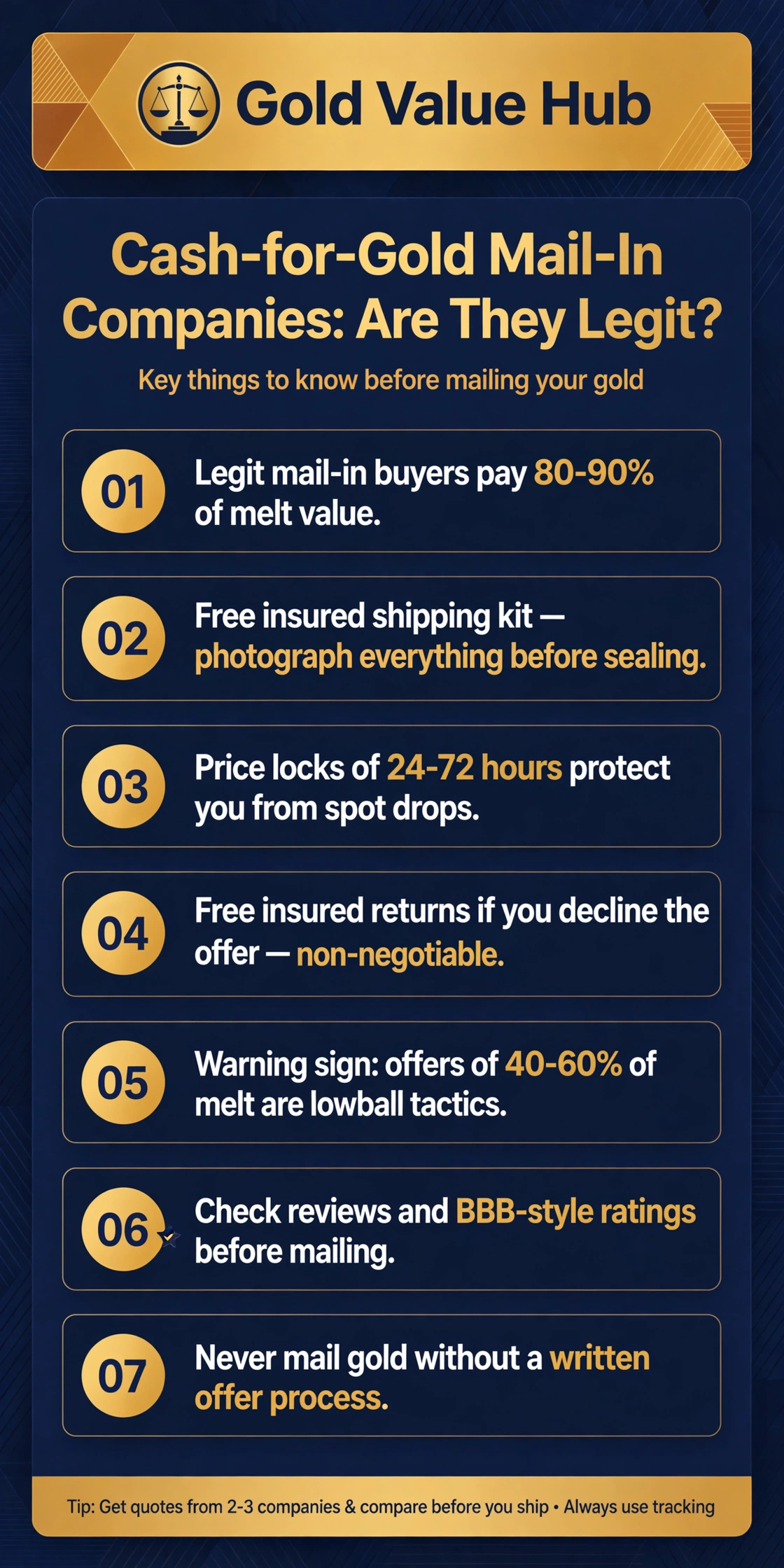
- Most mail-in gold companies are legit — but payouts range from 30% to 90% of melt.
- Cash for gold mail in reviews consistently rank specialist online buyers far above TV-advertised brands.
- Top mail-in buyers pay 80–90% of melt with free insured kits and free returns.
- Never mail gold without a written free-return guarantee and confirmed insurance.
- Photograph and weigh everything before sealing the kit — your records are your leverage.
- Reject low offers freely; trigger price-match guarantees with local written quotes.
- Keep payment records — mail-in gold profits face up to 28% collectibles tax.
Frequently Asked Questions
Are cash-for-gold mail-in companies legit?
Most established ones are legitimate registered businesses — several have operated for a decade-plus with BBB accreditation. But legitimacy doesn’t guarantee fair payouts, which range from 30% to 90% of melt. Verify the address, payout percentage, and free-return policy before mailing anything.
What percentage of melt do mail-in gold buyers pay?
Top-rated online buyers pay 80–90% of melt; mid-tier firms 70–85%; heavily advertised TV brands often 30–60%. Always convert the offer to a percentage of melt and compare against these ranges, as cash for gold mail in reviews consistently advise.
Is it safe to mail gold?
Yes, with a reputable buyer: use their free insured, trackable kit and photograph everything beforehand. Never mail gold in your own uninsured envelope. Confirm the insurance coverage amount in writing before shipping.
What if the offer is too low — can I get my gold back?
With any reputable buyer, yes — free and insured. Decline the offer in writing and they return your items. Never use a company without a written free-return guarantee; that’s the single biggest red flag in the industry.
How long does the mail-in process take?
Typically 3–7 days from acceptance to payment: 2–5 days shipping each way, 24–48 hours for appraisal, then 1–3 days for check or ACH. TV brands can be slower. If you need cash today, sell locally instead.
Do mail-in buyers pay for diamonds?
Small accent diamonds: essentially never — scrap buyers ignore them. Larger certified stones may get separate consideration at some firms, but get an estate-jewelry quote first for anything with significant stones.
Should I cash the check they sent without asking?
No — some TV brands mail unsolicited checks hoping you’ll cash them, because cashing usually counts as accepting their (low) offer. If you didn’t agree to the amount, don’t cash it; request your items back instead.
Can I negotiate with a mail-in gold buyer?
Yes — submit a higher written local quote to trigger price-match guarantees, ask for the itemized assay breakdown, and counter on the percentage (“can you do 88%?”). Rejecting a low offer via the free return is itself powerful leverage.
What happens if my gold is lost in the mail?
The buyer’s kit insurance should cover it — which is why you confirm coverage in writing and keep your own photos and weight records. File the claim with the tracking number immediately. This is why uninsured self-mailing is never worth the risk.
Do I pay taxes on mail-in gold sales?
Yes, same as any gold sale: profits on gold held over a year face up to the 28% collectibles capital-gains rate. The mailed check or ACH confirmation is your sale documentation — keep it with your cost-basis records.
Mail-in gold selling is safe and often the highest-paying option — if you pick the right company. Read cash for gold mail in reviews for payout percentages, verify free returns and insurance, and reject anything under 75% of melt. Start by comparing the best places to sell gold and checking your melt value with our scrap gold calculator.