Should You Clean Gold Before Selling It?
Published Oct 23, 2026
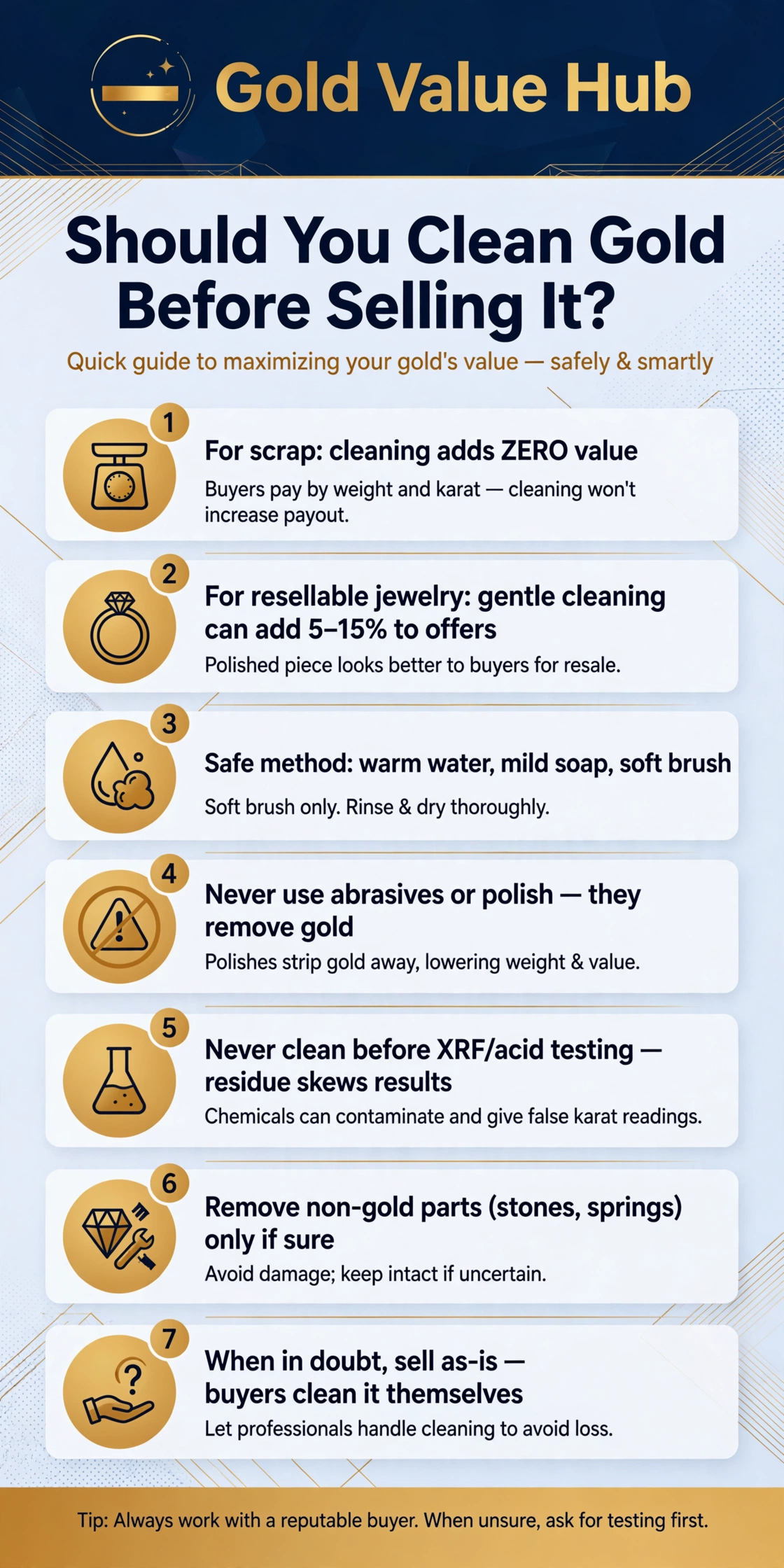
Quick Answer: Should you clean gold before selling? For scrap gold: a gentle soap-and-water rinse is fine but won’t raise your price — buyers pay on weight and karat, not shine. For resellable jewelry: light cleaning helps presentation. For coins: never clean them — cleaning destroys numismatic premium and grading services will detect it.
You’re holding a tarnished old bracelet, wondering if an hour with polish could turn a $400 offer into $500. It’s a natural thought — cleaner looks more valuable. But should you clean gold before selling it? The answer depends entirely on what you’re selling and to whom, and getting it wrong can actually cost you money.
Here’s the core truth: scrap buyers pay for gold content — weight times karat times spot price. No amount of shine changes those three numbers. But presentation does matter when you’re selling a whole piece to an estate buyer or on eBay, and there’s one category where cleaning is actively destructive: coins.
This guide covers exactly when cleaning helps, when it’s pointless, when it hurts, and the safe methods for each situation. Examples reference the October 7, 2026 spot price ($4,098/ozt, $131.76/g pure gold) — check the site’s live calculator before you sell.
Should You Clean Gold Before Selling It? The Short Answer
| What you’re selling | Should you clean gold before selling it? | Why |
| Scrap jewelry (broken, plain) | Optional — won’t change price | Buyers pay weight × karat only |
| Resellable jewelry (estate, eBay) | Yes, gently | Presentation affects perceived value |
| Gold coins (bullion/numismatic) | Never | Cleaning destroys collector premium |
| Dental gold | No need | Refiners melt it regardless |
Should You Clean Gold Before Selling for Scrap? The Price Truth
No — and understanding why saves you wasted effort. A scrap buyer’s offer is pure math: grams × karat purity × spot price × their payout percentage. Polish doesn’t add grams (in fact, aggressive polishing removes microscopic amounts of gold). Run your own numbers in our scrap gold calculator to see it.
So should you clean gold before selling it for scrap? A quick soap-and-water rinse to remove lotion and grime is harmless and makes handling nicer — but it won’t move your offer by a single dollar. Save the elbow grease for pieces you’re selling whole.
When Cleaning DOES Help: Resellable Jewelry
When you’re selling a whole piece — to an estate buyer, on eBay, or privately — you’re selling beauty, not just metal. Clean, bright jewelry photographs better, looks more valuable in person, and signals careful ownership. Here, the question “should you clean gold before selling” gets a clear yes — done gently.
- Soap and warm water: soak 15–20 minutes, soft brush, rinse, pat dry. Safe for all gold.
- Ultrasonic cleaner: great for plain gold; avoid with fragile stones, pearls, or glued settings.
- Polishing cloth: gentle shine for display pieces; go easy — cloths are mildly abrasive.
- Never use: bleach, chlorine, abrasive powders, or toothpaste — they pit gold and destroy finishes.
A note on white gold: most white-gold jewelry carries rhodium plating that wears off over 12–24 months. Cleaning won’t restore it — only professional replating ($50–$150) will. Don’t confuse dull plating with dirt: no home cleaning fixes it, and aggressive polishing wears plating off faster.
If a valuable piece needs more than soap and water — heavy tarnish, intricate filigree — consider professional jeweler cleaning ($25–$75). It’s safe, insured, and worth it for estate-bound pieces where the “should you clean gold before selling” answer is yes.
The Coin Exception: Never Clean Gold Coins
This is the one hard rule. Never clean gold coins — not bullion, not numismatic, not the “dirty old coin” from grandpa’s drawer. Cleaning leaves hairline scratches and removes original mint luster that grading services (PCGS, NGC) detect instantly. A cleaned coin gets a “Details — Cleaned” grade instead of a numeric grade, which can erase hundreds or thousands in numismatic premium.
Bullion coins (Eagles, Maples) trade near melt, so cleaning hurts less — but it still hurts, and there’s zero upside. Even wiping a coin with a dry cloth can leave hairline scratches visible under grading magnification. If a coin is genuinely filthy, leave it alone and let the buyer decide. Should you clean gold before selling when it’s a coin? Absolutely not — this is the exception that swallows the rule.
How to Safely Clean Gold Before Selling: Step by Step
If your answer to “should you clean gold before selling” is yes for resellable pieces, do it right:
- 1. Mix: warm (not hot) water with a drop of mild dish soap.
- 2. Soak: 15–20 minutes to loosen lotion, oils, and grime.
- 3. Brush: soft-bristle brush (a baby toothbrush works) — gently, behind settings and under stones.
- 4. Rinse: under warm running water; plug the sink or use a strainer so nothing escapes.
- 5. Dry: pat with a lint-free cloth, then air-dry fully before storing.
- 6. Inspect: check under good light for loose stones or damage to disclose.
Never substitute bleach, chlorine, toothpaste, or abrasive powders — they pit gold and destroy rhodium plating on white gold. Skip ultrasonic cleaners for pearls, opals, emeralds, or glued settings.
Should You Clean Gold Before Selling to Estate Buyers or on eBay?
Yes — this is where cleaning earns its keep. Estate buyers and eBay shoppers buy with their eyes: bright, well-presented jewelry photographs better and commands stronger offers. Clean gently with the soap method above, photograph in natural daylight against a neutral background, and include clear hallmark close-ups. But disclose everything — hidden flaws discovered on inspection kill deals and invite returns. Presentation opens the door; honesty closes the sale.
For pieces heading to an estate jewelry valuation, this light prep routinely pays for itself in stronger first offers — the one channel where “should you clean gold before selling” has a profitable answer.
What to Research Before You Sell
Decide your selling route first — it determines whether cleaning matters at all. Then know your karat, weight, and today’s spot price for the melt-value baseline. If any piece might be resellable (designer, antique, gemstone), get an estate quote before choosing the scrap route.
How Much Will You Get? Payout Ranges
Cleaning changes none of these numbers — but knowing them keeps a shiny presentation from inflating your expectations:
| Buyer type | Typical % of melt |
| Online gold buyer | 80–90% |
| Local jeweler / coin shop | 70–85% |
| Pawn shop | 30–60% |
| Estate buyer (resellable) | Can exceed melt |
How Buyers Test Gold (Shine Is Irrelevant)
- Hallmark check — karat stamp, unaffected by cleaning.
- Magnet test — gold isn’t magnetic, clean or dirty.
- Acid / electronic test — measures karat, not polish.
- XRF analyzer — reads purity through surface grime.
Every test measures what’s in the metal, not what’s on it. That’s the technical reason the “should you clean gold before selling” answer is “it doesn’t matter” for scrap.
Offer vs Melt Value vs Retail Value
A polished piece can feel more valuable — don’t let shine anchor you to fantasy numbers. Melt value is the ceiling for scrap; the offer is melt minus margin; retail value is irrelevant. Judge every offer against melt, whether the piece gleams or not.
Weight Units: Grams, Pennyweight, Troy Ounces
Weigh in grams (1 dwt = 1.55517g; 1 troy oz = 31.1035g). Note: aggressive polishing removes tiny amounts of gold — another reason heavy cleaning is pointless for scrap. At October 7, 2026 spot, 14K = $77.08/g.
Where to Sell Gold: Every Channel, Ranked
| Rank | Channel | Typical payout | Does cleaning help? |
| 1 | Top online scrap buyer | 80–90% of melt | No — melt math only |
| 2 | Coin dealer | 75–85% of melt | No (never clean coins) |
| 3 | Local jeweler | 70–85% of melt | Slightly, for display pieces |
| 4 | Estate buyer / auction | Can exceed melt | Yes — presentation matters |
| 5 | eBay / private sale | Varies | Yes — photos sell |
| 6 | Pawn shop | 30–60% of melt | No |
The Selling Process Step by Step
- 1. Sort the lot — scrap pile vs resellable pile vs coins (hands off!).
- 2. Clean selectively — gentle soap wash for resellable pieces only.
- 3. Weigh and calculate — melt value per karat group.
- 4. Get quotes — three written, itemized; estate quotes for resellable.
- 5. Sell and document — count payment; keep receipts for taxes.
How to Prepare Gold for Sale (Beyond Cleaning)
Cleaning is the least important prep step. What matters: sort by karat, weigh in grams, remove stones you want to keep, photograph everything, bring photo ID. Scrap is pure melt math; resellable pieces need estate quotes; diamonds add nothing at scrap counters. Should you clean gold before selling? Only after these steps — and only for pieces sold whole.
Payment, Insurance, and Shipping
- Cash: same day locally — count at the counter.
- Business check / ACH: paper trail for taxes; 3–7 days by mail.
- Wire: same-day on $5,000+ lots.
- Mail-in: free insured kit; photograph everything first.
- Price-match guarantees: submit competing written quotes to top online buyers.
Preliminary estimates are directional only — the binding offer follows the buyer’s testing, which no cleaning affects.
Should You Clean Gold Before Selling With an Ultrasonic Cleaner?
Ultrasonic cleaners — the buzzing jewelry baths — are safe for solid gold pieces with no stones and do a genuinely better job than hand-washing on intricate chains. But they’re risky for anything with glued-in stones, fragile settings, pearls, or enamel: vibration can loosen or crack them. If you’re selling for scrap, the machine’s shine buys you nothing (buyers still pay weight × karat). If you’re selling a resellable piece, five minutes in an ultrasonic with warm water and a drop of dish soap is the closest thing to professional presentation you can do at home — just inspect settings afterward and never put antique or damaged pieces in one.
Cleaning Red Flags: When “Helpful” Advice Hurts
- “Polish it to raise the karat” — impossible; karat is alloy composition.
- “Dip it in acid cleaner” — pits gold, can dissolve solder joints.
- “Buff out the scratches” — removes gold; deep buffing thins the piece.
- “Clean coins to raise value” — the costliest myth; cleaning can erase numismatic premium.
- Buyer “cleaning” your gold in the back room — never let items leave your sight.
The FTC advises understanding how buyers value gold before selling — weight and purity, not shine.
Negotiation: Shine Doesn’t Negotiate, Math Does
A gleaming bracelet doesn’t strengthen your negotiating position — melt-value math does. Get three written quotes, counter on percentage of melt, use competing quotes as leverage, walk away once. The sellers who ask “should you clean gold before selling” are really asking “how do I get more” — and the answer is preparation, not polish.
Questions to Ask Before Accepting an Offer
- What percentage of melt is your offer?
- Can you show me the weight and karat test?
- Any fees deducted? Can I get it in writing?
Mistakes to Avoid
- Aggressive polishing that removes gold before weighing.
- Cleaning coins — the single costliest mistake.
- Expecting a higher offer because it “looks nicer.”
- Using bleach or abrasives that damage the piece.
Pawning vs Selling Gold
| Factor | Pawn loan | Outright sale |
| Keep the gold? | Yes, if you repay | No |
| Typical payout | 25–60% as a loan | 70–90% of melt (good buyers) |
| Does cleaning matter? | No | No (scrap) / slightly (resale) |
Taxes When You Sell Gold
The IRS treats physical gold as a collectible: profit on gold held over a year faces up to the 28% collectibles rate; under a year, ordinary income. Keep cost-basis and sale records. (See the IRS rules on capital gains.)
Illustrative Examples: Cleaning vs Not Cleaning
Same 20g 14K chain ($1,541.59 melt) — illustrative math at October 7, 2026 spot:
| Scenario | Scrap offer (85%) | Difference |
| Uncleaned, as found | $1,310.35 | — |
| Gentle soap wash | $1,310.35 | $0.00 |
| Aggressive polish (−0.2g gold) | $1,297.04 | −$13.31 |
Cleaning never adds; over-polishing subtracts. For coins, the math is worse — a cleaned $2,500 numismatic coin can drop to melt value overnight.
Pre-Sale Checklist
- Sort into scrap / resellable / coins piles.
- Decide per piece — should you clean gold before selling it? Clean resellable gently; leave coins untouched.
- Weigh in grams; calculate melt value.
- Get three written quotes; estate quotes for resellable.
- Bring ID; keep receipts for taxes.
Key Takeaways
- Should you clean gold before selling for scrap? Optional — it won’t change your price.
- For resellable jewelry, gentle cleaning improves presentation and photos.
- Never clean coins — cleaning destroys numismatic premium permanently.
- Aggressive polishing removes gold; bleach and abrasives damage pieces.
- Scrap buyers test metal content, not shine — XRF reads through grime.
- Sort into scrap / resellable / coins before deciding anything.
- Keep sale records — gold profits face up to 28% collectibles tax.
Frequently Asked Questions
Should you clean gold before selling it to a pawn shop?
It won’t change the offer — pawn shops pay on weight and karat like any scrap buyer. A quick rinse is harmless but pointless for price. Spend the effort getting a second quote instead; that actually raises your payout.
Does polishing gold increase its value?
No — polishing can’t change karat or add weight; aggressive polishing actually removes tiny amounts of gold. For scrap, value is fixed by melt math. For resale pieces, light polishing improves presentation, which can help the sale price.
Can I clean gold jewelry with toothpaste?
Don’t — toothpaste is abrasive and scratches gold, dulling the finish over time. Use warm water, mild dish soap, and a soft brush instead. It’s safer and just as effective for pre-sale cleaning.
Will a buyer pay less for tarnished gold?
A scrap buyer won’t — tarnish doesn’t change weight, karat, or XRF readings. An estate or eBay buyer might perceive less value, so light cleaning helps there. Pure gold doesn’t tarnish; the discoloration is in the alloy metals.
Should you clean gold coins before selling?
Never. Cleaning leaves hairlines and removes mint luster that graders detect, dropping a coin to “Cleaned” details grade and erasing numismatic premium. Even bullion coins gain nothing from cleaning — leave them exactly as found.
Is it safe to use an ultrasonic cleaner on gold jewelry?
For solid gold pieces without fragile stones, yes — ultrasonics clean effectively. Avoid them with pearls, opals, emeralds, or glued-in stones, which can crack or loosen. When in doubt, stick to soap and water.
Does cleaning remove gold from jewelry?
Gentle soap-and-water cleaning removes essentially nothing. Abrasive polishing compounds and aggressive buffing do remove microscopic layers — measurable on precise scales over time. That’s why heavy polishing before a scrap sale is counterproductive.
Should I clean dental gold before selling?
No need — refiners melt dental gold regardless of appearance, and its value is purely in gold content (typically 10–22K depending on the alloy). A rinse is fine for handling, but cleaning changes nothing about the payout.
Can cleaning reveal fake gold?
Sometimes — heavy plating wear revealed by cleaning can expose base metal underneath, and strong cleaners can discolor fakes. But cleaning isn’t a reliable test; use a magnet check, hallmark inspection, or professional testing instead.
What’s the safest way to clean gold before selling?
Warm water, a drop of mild dish soap, a 15-minute soak, a soft-bristle brush, rinse, and pat dry with a lint-free cloth. This method is safe for all gold jewelry and won’t affect its value in any selling channel.
So should you clean gold before selling? For scrap: don’t bother. For resale: gently, yes. For coins: never. Put your energy where it pays — knowing your melt value and collecting competing quotes. Start with our scrap gold calculator and vetted buyers.