
Scrap Value vs Melt Value: What’s the Difference?
Published Oct 15, 2026
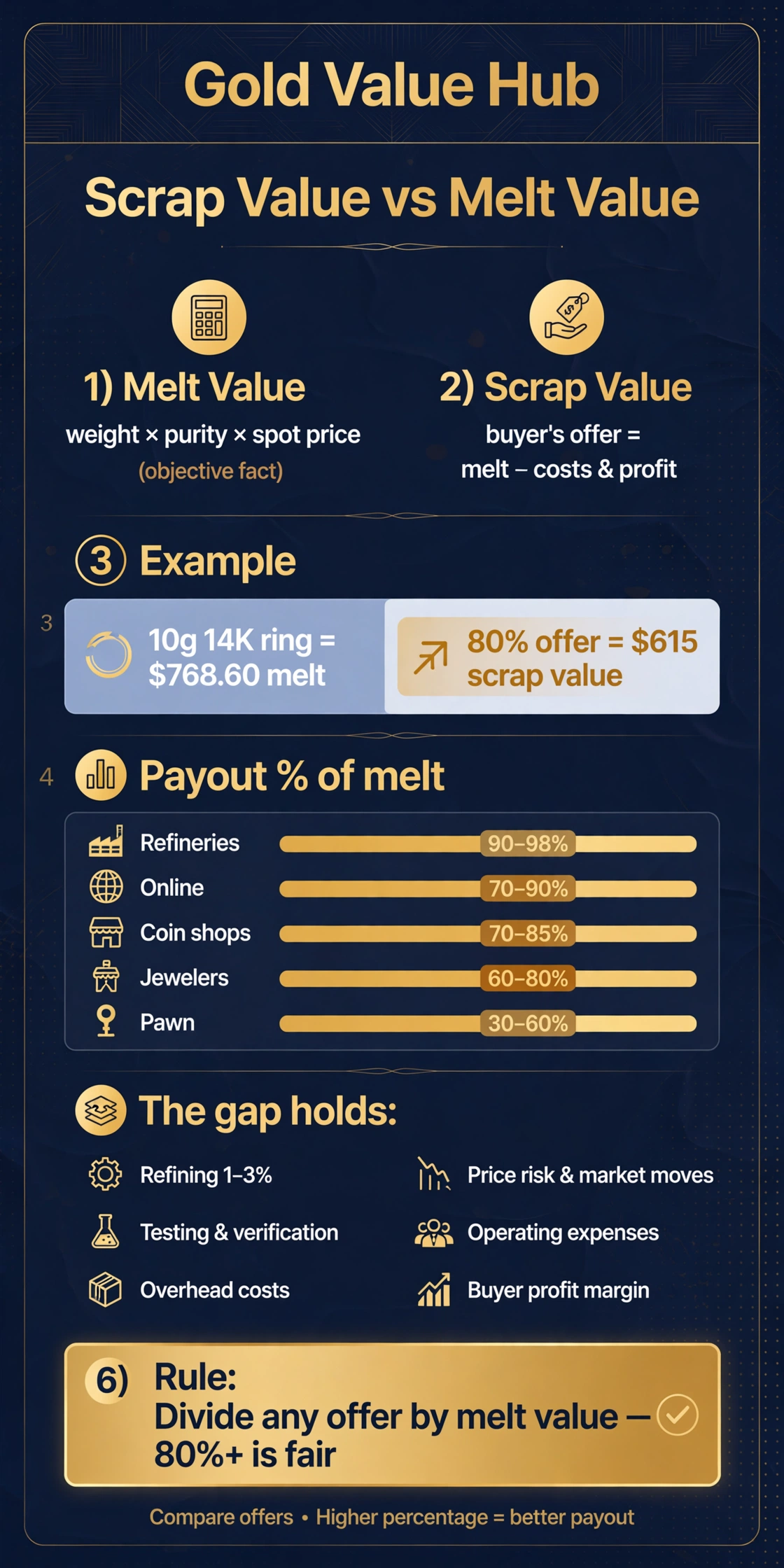
Quick answer: Melt value is the raw commodity worth of the pure gold in an item (weight × purity × spot price); scrap value is what a buyer actually offers you — melt minus their costs and profit. A 14K ring with $768 in melt value might fetch a $615 “scrap value” offer (80% of melt).
People use “scrap value” and “melt value” like they mean the same thing — do they? Not quite, and the difference is where your money goes. Melt value is arithmetic; scrap value is the offer. Knowing both is the most profitable thing a gold seller can learn.
This guide defines each term, shows both calculations, explains what lives in the gap (refining, testing, overhead, risk, profit), and teaches you to shrink it by choosing the right buyer.
Below: both formulas with worked examples, a full term glossary, price tables, every selling channel ranked by how close it pays to melt, refinery payout math, the pennyweight trick, taxes, and real payout examples. Prices use $4,098/oz (~$131.76/g 24K) as an illustrative Oct 7, 2026 reference — check the live calculator before selling, since spot moves daily.
Scrap Value vs Melt Value: The Definitions
Melt value = the dollar value of the pure precious metal in an item if melted and sold at today’s spot price. Formula: weight × purity × spot price. It’s objective — two people with the same scale and the day’s gold price get the same number. Scrap value = the price a buyer offers for that item as scrap. Formula: melt value − buyer’s costs − buyer’s profit. It’s negotiable, and it varies wildly: the same ring can draw “scrap value” offers from 30% to 95% of melt.
Why the confusion? Buyers quote “scrap value” meaning their offer; sellers hear what it’s worth. From now on: melt value is the metal’s worth, scrap value is the offer. The gap between them is the entire gold-buying business.
The Full Glossary: Every Term in the Scrap Value vs Melt Value Debate
| Term | What It Means |
| Spot price | Live market price of one troy ounce of pure gold. Reference: $4,098/oz on Oct 7, 2026. |
| Melt value | Weight × purity × spot. The objective commodity value. Nobody pays above it for scrap. |
| Scrap value (offer) | What a buyer offers = melt − costs − profit. Always ask which “scrap value” they mean. |
| Karat / fineness | Purity: karat out of 24 (14K = 58.3%); fineness in parts per thousand (585 = 58.5%). |
| Troy ounce (ozt) | Gold’s pricing unit: 31.1035 grams. |
| Pennyweight (dwt) | 1.55517 grams; 20 per troy ounce. $/dwt quotes flatter offers. |
| Bid / ask | Bid = what dealers pay; ask = what they charge. The gap is the spread. |
| Premium | Amount above melt for coins/bars. Scrap carries no premium — a key distinction. |
| Refining charges | What refineries deduct: ~1–3% of melt plus a $25–100 lot fee. |
How to Calculate Melt Value in 4 Steps (With Worked Examples)
Step 1: weigh the item in grams. Step 2: find the karat (or test it). Step 3: multiply weight by (karat ÷ 24) for pure-gold content. Step 4: multiply by the 24K per-gram price — $131.76/g at the $4,098/oz reference. That’s melt value, and it takes 60 seconds.
Worked example — gold: a 14K ring weighs 10 g. 10 × 0.583 = 5.83 g pure × $131.76 = $768.16 melt value. If a buyer offers $615, the scrap value is $615 — 80% of melt — and the $153 gap is their costs plus profit. Worked example — silver: a 925 chain at 30 g = 27.75 g pure × $1.54/g (illustrative) = $42.74 melt; a $34 offer = 80% scrap value. Same structure, both metals.
Decode any offer in seconds: divide it by melt value. 0.80 = fair, 0.55 = poor, 0.95 = excellent (verify no hidden fees).
What Lives in the Gap Between Scrap Value and Melt Value
The gap isn’t pure profit — it’s mostly real costs. Refining charges (1–3% of melt + lot fee): your gold must be melted, assayed, and purified. Testing and labor: XRF machines, acids, staff time per item. Price risk: gold can drop 2% between purchase and refinery settlement — buyers hedge or discount for it. Overhead: rent, insurance, security, licensing. Capital costs: money tied up in gold inventory. Profit: what remains, typically 5–15% of melt for honest buyers.
On a $768 melt ring sold at 80% ($615), the $153 gap might be: $20 refining, $15 testing/labor, $15 price-risk buffer, $40 overhead, $63 profit — a legitimate business. The same ring at 50% means a $384 gap; the costs didn’t change, the profit did.
What Today’s Gold Price Means for the Scrap vs Melt Spread
As of October 7, 2026, gold trades near $4,098 per troy ounce — about $131.76 per gram for pure 24K ($4,098 ÷ 31.1035), near record highs. High prices don’t change percentages — an 80% buyer pays 80% at any price — but they magnify the dollars in the gap. At $4,098/oz, each percentage point on a 10 g 14K ring is worth $7.68. The difference between a 70% and an 85% offer is $115 on one ring.
Buyers work off a bid/ask spread; you’ll never get full ask. Treat prices here as illustrative — gold moves daily — and compute your melt value with the live scrap gold calculator before comparing offers. In high-price markets, the channel matters more than ever: percentage gaps are worth real money now.
Scrap Value vs Melt Value by Karat (Price Table)
Illustrative $4,098/oz reference (Oct 7, 2026). Melt value is fixed math; the scrap-value columns show what different buyer tiers actually offer on a 10-gram piece.
| Karat | Melt $/gram | 10 g melt value | Scrap @ 95% (refinery) | Scrap @ 80% (online) | Scrap @ 50% (pawn) |
| 24K | $131.76 | $1,317.60 | $1,252 | $1,054 | $659 |
| 18K | $98.82 | $988.20 | $939 | $791 | $494 |
| 14K | $76.86 | $768.60 | $730 | $615 | $384 |
| 10K | $54.90 | $549.00 | $522 | $439 | $275 |
Read across any row: the metal doesn’t change, only the buyer’s cut. A 14K ring’s melt is $768.60 whether the refiner, the website, or the pawn shop holds it — the $346 spread between 95% and 50% is pure channel economics.
What Sells for Melt — and What Beats It
Almost all damaged, plain, or mass-produced gold sells at scrap (a percentage of melt): broken chains, single earrings, bent rings, dental gold, class rings. Items that can beat melt: bullion coins and bars (carry premiums above melt), numismatic coins (collector value), and designer or antique jewelry (brand/history premium). The scrap-vs-melt framework still applies — premium items just start from melt and go up, while scrap starts from melt and goes down by the buyer’s cut.
- Sells at scrap (below melt): broken jewelry, dental gold, plain chains, single earrings, class rings — anything valued for metal only.
- Sells at melt (rare): essentially only refinery-direct lots — and even those minus refining charges.
- Sells above melt: bullion coins/bars (premium), collectible coins (numismatic value), designer/antique jewelry (brand premium).
- The test: if nobody would wear it or collect it, it’s scrap — price it at a percentage of melt.
Knowing your category prevents the two classic mistakes: accepting scrap prices for a collectible coin, or holding out for “collector value” on a broken rope chain.
Before You Sell: Know Both Numbers Cold
The seller who knows melt value but not scrap-value norms gets surprised; the seller who knows neither gets fleeced. Fifteen minutes of prep covers both.
- Calculate melt value yourself: weight × (karat ÷ 24) × $131.76/g, or the live scrap gold calculator.
- Learn the norms: refineries 90–98%, online buyers 70–90%, coin shops 70–85%, jewelers 60–80%, pawn 30–60%.
- Weigh at home to 0.1 g; photograph readouts. Separate by karat — never blend.
- Remove non-gold parts (steel clasps, solder, stones’ dead weight) before weighing.
- Get three written quotes showing weight, karat, $/gram, and total — then divide each by melt.
- Bring ID; most states require it, with 7–30 day holds before melting.
Where the Gap Is Smallest: Buyers Ranked by % of Melt
Refineries (90–98%): the smallest gap — you’re near the melt source. Minimums of 1–3 oz apply. Online gold buyers (70–90%): tight operations, national volume, transparent per-gram pricing. Local coin shops (70–85%): test in front of you, pay cash, moderate overhead. Local jewelers (60–80%): convenience costs; many forward to refiners and keep the spread.
Pawn shops (30–60%): the widest gap — high overhead, high risk, high margin. Mall kiosks (40–60%): similar economics. The ranking never changes because the cost structures never change: every middleman between you and the refinery takes a cut. Compare all options on our best place to sell gold page.
The Selling Process: Quote to Cash in 5 Steps
1. Quote: testing and weighing in front of you — grams, zeroed scale. 2. Offer: written, with weight, karat, price per gram, total — divide by your melt value on the spot. 3. Decide: never obligated; confirm free return first. 4. Paperwork: ID and receipt; 7–30 day state holds are normal. 5. Payment: cash/check same day locally; 1–3 business days by check/ACH online.
For mail-ins, use the insured kit, photograph everything, and keep tracking until funds clear. Price-match guarantees let you pit written offers against each other — the fine print usually requires identical karat and weight. Preliminary estimates are screening tools; the final scrap value follows the buyer’s own test.
Inside the Refinery: Where Melt Value Becomes Money
Four stages turn scrap into settled cash: 1. XRF screening reads metal content. 2. Melt and sample: the lot melts into a bar; a drill sample is taken. 3. Fire assay: cupelled and weighed — definitive to 1 part in 10,000. 4. Settlement: payment on assayed fine-gold weight minus 1–3% refining charges plus a $25–100 lot fee, 1–5 business days after assay.
The refinery is the only place where scrap value nearly equals melt value — because there’s only one gap (the actual refining cost) instead of a chain of middlemen. That’s the structural reason refinery payouts top the table, and why every other buyer’s offer is best understood as “melt minus the distance from the refinery.”
Red Flags, Scams, and Negotiation
The FTC advises written appraisals and understanding offer math. Watch for: buyers who won’t show the melt calculation; “scrap value” quotes with no per-gram breakdown; mixed-karat blending; pennyweight quotes (decoded below); scales that aren’t zeroed; “today only” pressure; mail-ins without written insurance. The deadliest trick is linguistic — quoting “scrap value” as if it were melt value, then paying 60% of it.
Negotiate with both numbers visible: “Melt is $768. You’re offering $460 — that’s 60%. [Competitor] offered 80% in writing. Match 80% and we have a deal.” Naming the percentage changes the conversation — buyers know you know. Always ask: “What spot price is this based on, and when was it locked?”
The Pennyweight Quote Trick, Fully Decoded
One dwt = 1.555 grams. “We pay $95 per pennyweight for 14K” = $61.09/g — against $76.86/g melt, that’s 79.5% of melt. The trick works by quoting a unit you don’t intuitively convert, so the percentage stays hidden. Worse variants round your weight down (“about 7 and a half dwt” for 7.7) or price against yesterday’s spot.
Defense: convert to dollars per gram, divide by melt-per-gram. $61.09 ÷ $76.86 = 0.795. Say the percentage out loud — “So that’s 79.5% of melt?” — and watch how fast the number improves, or doesn’t.
Taxes: Melt, Scrap, and the IRS
Gold is a collectible to the IRS: gains past one year taxed up to 28%; under a year, ordinary income rates. Taxable gain = scrap value received minus your basis (what you paid). Note the subtlety: you’re taxed on the offer you accepted, not melt value — selling at 60% of melt doesn’t just cost you the 40%, it also shrinks nothing on the tax side. Keep basis records. See our taxes on selling gold guide; general information, not tax advice.
Real Payout Examples: The Gap in Actual Numbers
At the illustrative $4,098/oz reference, a 10 g 14K ring (melt $768.60): refinery ~$730 (95%, $38 gap), online buyer ~$615 (80%, $153 gap), coin shop ~$576 (75%, $192 gap), jeweler ~$499 (65%, $269 gap), pawn ~$384 (50%, $384 gap). A 20 g 18K bracelet (melt $1,976.40): refiner ~$1,878, online ~$1,581, pawn ~$988. The metal is identical in every scenario — only the gap moves, and the gap is the entire decision.
Key Takeaways
• Melt value = weight × purity × spot price (objective fact); scrap value = the buyer’s offer (melt minus costs and profit).
• The gap holds real costs (refining 1–3%, testing, risk, overhead) plus profit — learn to tell fair gaps from gouging.
• Divide any offer by melt value: 80%+ is fair, 60% is poor, 95% is excellent.
• Channel ranking by % of melt: refineries 90–98%, online 70–90%, coin shops 70–85%, jewelers 60–80%, pawn 30–60%.
• Premium items (coins, designer) move up from melt; scrap moves down by the buyer’s cut.
• Convert pennyweight quotes to per-gram; name the percentage out loud when negotiating.
• You’re taxed on the offer accepted, not melt — keep basis records.
Frequently Asked Questions
What is the difference between scrap value and melt value?
Melt value is the objective commodity worth of the pure metal (weight × purity × spot price). Scrap value is what a buyer offers — melt minus their refining costs, overhead, risk, and profit. Same metal, two numbers; the gap is the buyer’s business model.
How do I calculate the melt value of gold?
Weigh in grams, multiply by (karat ÷ 24), multiply by the 24K per-gram price ($131.76/g at the $4,098/oz reference). Example: 10 g of 14K = 10 × 0.583 × $131.76 = $768.16 melt. Or use the scrap gold calculator.
What percentage of melt value do gold buyers pay?
Refineries: 90–98%. Online buyers: 70–90%. Coin shops: 70–85%. Jewelers: 60–80%. Pawn shops: 30–60%. Anyone above 95% on a small lot deserves scrutiny — ask for the full written breakdown.
Is melt value the same as spot price?
No. Spot price is the market price per troy ounce of pure gold. Melt value is spot price applied to your item’s pure-gold content (weight × purity). Spot is the ingredient; melt value is the recipe result.
Why won’t buyers pay full melt value?
Because turning your ring into sellable pure gold costs money: refining (1–3%), testing, labor, price risk, rent, insurance, and profit. Only refineries come close to melt, and even they deduct refining charges. The gap is the business, not a scam — until it gets greedy.
Can scrap value ever exceed melt value?
For scrap, no — nobody pays above melt for metal they’re melting. But items can sell above melt when they’re not scrap: bullion coins carry premiums, collectible coins carry numismatic value, and designer jewelry carries brand premium. Those aren’t scrap transactions.
How do I know if a scrap offer is fair?
Divide the offer by your independently calculated melt value. 80%+ is fair, 70–80% is typical retail, below 60% is poor. Get three written quotes and compare percentages, not dollar amounts — percentages reveal the real ranking.
What does “$95 per pennyweight” really mean?
$95/dwt = $61.09/g (one dwt = 1.555 g). For 14K gold at $76.86/g melt, that’s 79.5% of melt. Convert every dwt quote to dollars per gram, divide by melt-per-gram, and say the percentage out loud.
Do I pay taxes on the melt value or the scrap value?
On the gain from the scrap value you received (sale price minus basis) — melt value doesn’t enter the tax math. Gold is a collectible: up to 28% past one year, ordinary income under a year. Keep basis records.
Should I sell for scrap or try to get melt value?
Get as close to melt as practical: refinery-direct for large lots, competitive online buyers or coin shops for single pieces. Chasing the last 2–3% isn’t worth weeks of effort — but moving from a 60% buyer to an 85% buyer is worth hundreds. Three quotes, then decide.
Melt value is the fact; scrap value is the offer; the gap is negotiable. Calculate your melt, learn the norms, and make buyers compete on percentage. Calculate your scrap value vs melt value with the free tool before anyone quotes you a number.
