
How Much Is a Broken Gold Chain Worth?
Published Oct 8, 2026
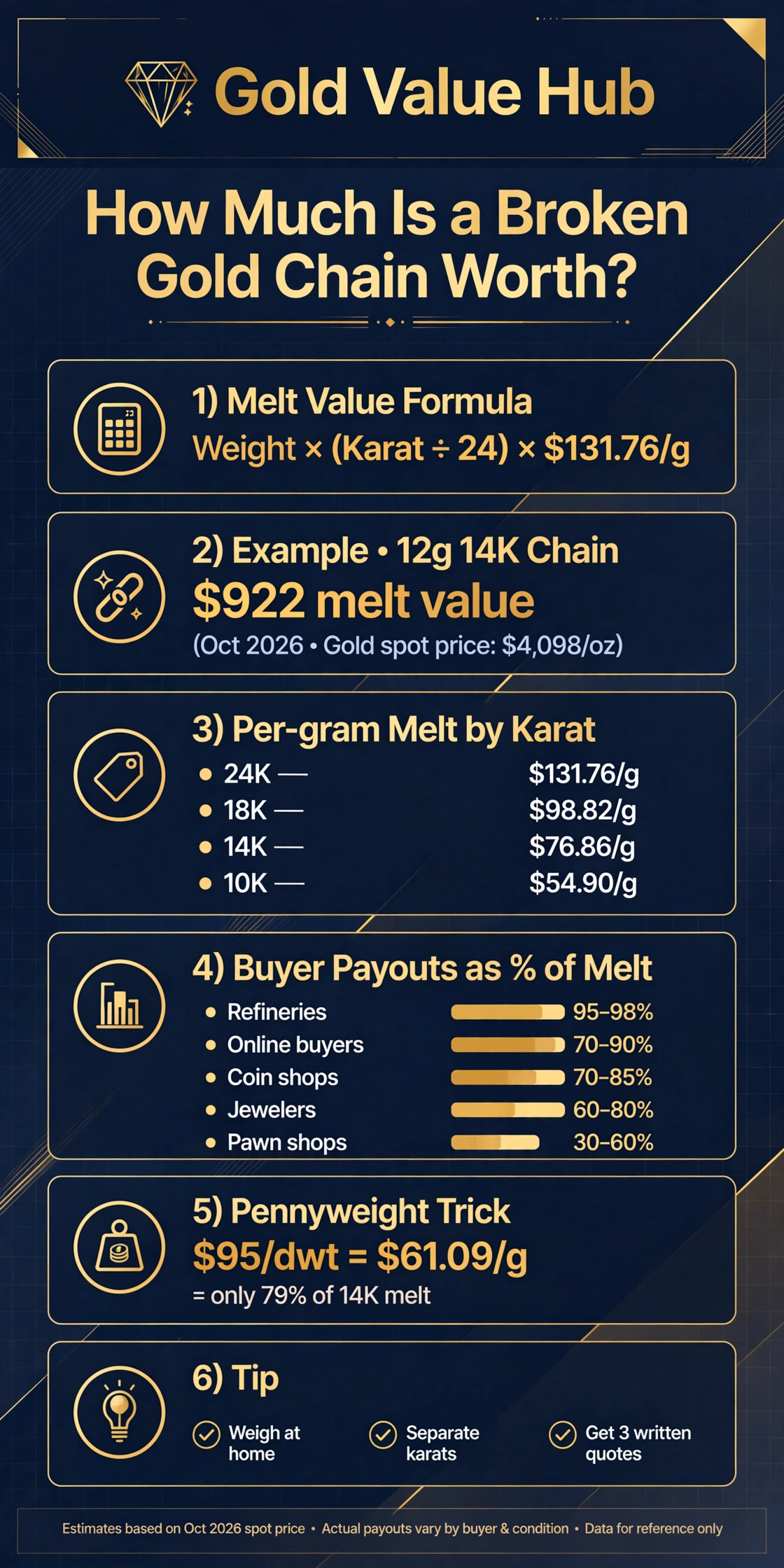
Quick answer: A broken gold chain is worth its melt value — pure-gold weight times the current gold price. A 12-gram 14K chain holds about $922 of gold at illustrative October 2026 prices ($4,098/oz); buyers typically pay 60–95% of melt depending on where you sell.
A broken gold chain in your drawer isn’t trash. Its broken gold chain worth comes down to two numbers: weight and karat. Buyers don’t care that the clasp snapped — they pay melt value minus their margin. This guide gives you the exact formula, today’s price math, and where to sell for the best payout.
Most people assume damage kills value. For scrap it’s the opposite: refiners melt chains down anyway, so a broken chain sells for the same melt value as an intact one of equal weight and purity. Know the formula — weight × purity × spot price — and no buyer can lowball you.
Below: the melt formula, price tables by karat, every selling channel ranked, refinery payout math, the pennyweight trick, taxes, and real examples. Prices use $4,098/oz (~$131.76/g 24K) as an illustrative Oct 7, 2026 reference — check the live calculator before selling, since spot moves daily.
What “Melt Value” Means for Your Broken Gold Chain’s Worth
Melt value is the dollar value of the pure gold inside an item — what it would fetch melted into a bar at today’s market price. It is your chain’s floor price. No buyer pays above melt for scrap, because their profit lives in the gap between melt and what they pay you. Scrap value, by contrast, is the number a buyer actually offers: melt minus their costs and margin. When a buyer says “your scrap value is $800,” ask whether they mean the gold’s content or their offer.
These are the terms you’ll see on every quote sheet. Learn them once and every buyer conversation gets easier.
| Term | What It Means |
| Spot price | Live market price of one troy ounce of pure gold. Reference: $4,098/oz on Oct 7, 2026. |
| Melt value | Pure-gold weight × spot price. The raw commodity value of your chain. |
| Karat (K) | Purity scale out of 24. 14K = 14/24 = 58.3% pure gold. Stamped 585 or “14K”. |
| Troy ounce (ozt) | Gold’s pricing unit: 31.1035 grams (heavier than a regular 28.35 g ounce). |
| Pennyweight (dwt) | 1.55517 grams; 20 per troy ounce. Buyers quote $/dwt to make offers look bigger. |
| Assay / XRF | Purity tests: acid, electronic, or X-ray fluorescence scan. |
| Bid / ask | Bid = what dealers pay; ask = what they charge. The gap is the spread. |
| Premium | Amount above melt for coins/bars. Scrap jewelry carries no premium. |
How to Calculate a Broken Gold Chain’s Worth in 4 Steps
Step 1: weigh the chain in grams after removing non-gold parts like a steel clasp spring. Step 2: find the karat stamp (585, 14K, 750) on the clasp or near a broken end. Step 3: multiply weight by (karat ÷ 24) to get pure-gold weight. Step 4: multiply by the 24K per-gram price — spot ÷ 31.1035, or $131.76/g at the $4,098/oz reference.
Worked example — gold: a broken 14K chain weighs 12 grams. 12 × 0.583 = 7.0 g pure gold. 7.0 × $131.76 = $922.32 melt value — the broken gold chain worth at the refinery gate, the number every offer gets measured against. Same math for silver: a broken 925 sterling chain at 20 g × 0.925 = 18.5 g pure silver; at an illustrative $48/oz ($1.54/g), melt = $28.49. Same four steps, far smaller payout.
Watch for hollow chains: rope and herringbone styles are often hollow tubes — a chunky-looking 14K rope chain can weigh 8 grams while a solid one the same size weighs 25. Broken gold chain worth follows the scale, never the size.
What Today’s Gold Price Means for Your Broken Chain
As of October 7, 2026, gold trades near $4,098 per troy ounce — about $131.76 per gram for pure 24K, near record highs. That’s why broken chains fetch their strongest payouts in years: a chain bought for $200 in 2010 can hold $600+ in melt today. The per-gram price is one division: $4,098 ÷ 31.1035 = $131.76/g. Each karat is a fraction: 18K is 75% ($98.82/g), 14K is 58.3% ($76.86/g), 10K is 41.7% ($54.90/g).
Buyers work off a bid/ask spread — the bid is what they pay you, the ask is what they charge. You’ll never get the full ask for scrap, and anyone promising 100% of melt on a single chain is hiding fees elsewhere. Treat prices here as illustrative baselines: gold moves daily. Before accepting any offer, run your chain through the live scrap gold calculator.
Broken Gold Chain Worth by Karat (Price Table)
Find your karat below and multiply by your chain’s grams — that’s melt value. Illustrative $4,098/oz reference (Oct 7, 2026); last column shows typical buyer payouts for a 12-gram chain.
| Karat | Purity | Melt $/gram | Melt $/dwt | 12g chain melt | Typical payout (12g) |
| 24K | 99.9% | $131.76 | $204.90 | $1,581 | $1,265–$1,502 |
| 22K | 91.7% | $120.78 | $187.83 | $1,449 | $1,159–$1,377 |
| 18K | 75.0% | $98.82 | $153.68 | $1,186 | $949–$1,127 |
| 14K | 58.3% | $76.86 | $119.53 | $922 | $738–$876 |
| 10K | 41.7% | $54.90 | $85.38 | $659 | $527–$626 |
| 9K | 37.5% | $49.41 | $76.84 | $593 | $474–$563 |
For other weights, scale the 12-gram column: a 6 g 14K chain holds ~$461 of melt; a 20 g 18K chain holds ~$1,976. Deduct non-gold parts first — a 1-gram steel clasp costs you $76+ on a 14K chain.
What Sells for Melt — and What Might Beat Its Broken Gold Chain Worth
Almost all broken jewelry sells for melt, since damage ends the wear-it-again option. But check for exceptions first: designer pieces (Tiffany, Cartier), antiques, and chains with large diamonds can bring 2–5× melt from the right buyer — a two-minute eBay “sold listings” search reveals it. Selling for melt still has real perks: instant cash, no listing fees, and none of the 13%+ auction-site fees.
- Sells for melt: broken chains, single earrings, bent bangles, snapped clasps, dental gold, mismatched charms — anything damaged, plain, or mass-produced.
- Check resale first: designer or branded chains, antiques, chains with diamonds over ~0.25 carat, and anything repairable for under $50.
- Stones don’t count: small diamonds and CZ are removed, not paid for. Only the gold weight earns money.
- Plated pays nothing: “14K HGE,” “RGP,” or “EP” stamps mean micron-thin plating over base metal — refiners pay zero for it.
Before You Sell: 15 Minutes of Prep Worth 15–25% More
Walk in unprepared and you accept whatever number they say. Fifteen minutes of prep tells you within a few dollars what every offer should be.
- Weigh at home on a 0.1 g kitchen scale. Photograph the readout with the chain visible.
- Confirm the karat. Find the stamp (585, 14K, 750). No stamp? A coin shop acid-tests free in under a minute — never guess.
- Calculate melt value yourself: weight × (karat ÷ 24) × $131.76/g, or use the live scrap gold calculator.
- Separate by karat. Never let a buyer lump 10K, 14K, and 18K into one pile priced at the lowest karat.
- Remove non-gold parts: steel clasps, solder blobs, base-metal jump rings. Keep solid gold clasps on.
- Skip the polish — refiners melt it anyway, and polishing can remove gold. Bring ID; most states require it.
- Get three written quotes. The spread between the first and best offer averages 15–25%.
Where to Sell a Broken Gold Chain: Every Channel Ranked
Refineries (95–98% of melt): top payout, but most require 1–3 oz minimum lots plus refining fees — best for a pile of scrap, not one chain. Online gold buyers (70–90%): insured mail-in kit, offer in 24–48 hours, free return if you decline. Strong option for a single broken chain. Local coin shops (70–85%): test in front of you, pay cash same day.
Local jewelers (60–80%): convenient, but many forward scrap to refiners and keep the spread. Pawn shops (30–60%): fastest cash, worst price — only when you need money today. Mall cash-for-gold kiosks (40–60%): pawn-shop economics with nicer lighting. Skip eBay for broken chains: 13%+ fees and few buyers for damaged jewelry. Compare every option on our best place to sell gold page.
The Selling Process: Quote to Cash in 5 Steps
Every legitimate sale follows five steps. 1. Quote: the buyer tests your chain (acid, electronic, or XRF) and weighs it in front of you — the scale must read grams and start at zero. 2. Offer: get it in writing with weight, karat, price per gram, and total. No written breakdown, no deal. 3. Decide: you’re never obligated; legitimate buyers return your gold free if you decline — confirm this first.
4. Paperwork: show ID, sign a receipt; many states impose a 7–30 day hold before melting, per anti-theft laws. 5. Payment: cash or check same day locally; 1–3 business days via check or ACH online. For mail-ins, use the buyer’s insured kit, photograph everything, and keep the tracking number until funds clear. Many online buyers price-match — send a competitor’s written offer and they’ll beat it a few percent, though fine print often excludes pawn-shop quotes.
Inside the Refinery: How Your Payout Is Really Calculated
Every scrap chain ends at a refinery, and their four stages explain every deduction on a quote. 1. XRF scan: an X-ray fluorescence gun reads surface metal content in seconds. 2. Melt and sample: your lot melts with other scrap into a bar; a sample is drilled out. 3. Fire assay: the sample is melted with lead, cupelled, and weighed — accurate to 1 part in 10,000. 4. Settlement: payment on assayed pure-gold weight minus refining charges (1–3% of melt plus a $25–100 lot fee), 1–5 business days after assay.
That refining charge is the honest reason nobody pays 100% of melt. When a shop offers 85%, roughly 2–3% covers real refining; the rest is their margin for testing, overhead, price risk, and profit. Anyone offering 98%+ on a single chain is hiding fees — demand the full written breakdown.
Red Flags, Scams, and Negotiation Scripts That Work
The FTC warns sellers to get written appraisals and understand exactly how offers are calculated. Watch for: pennyweight quotes that sound bigger than they are (decoded below); no written breakdown; mixed-karat lumping (“we’ll call it all 10K”); a scale that isn’t zeroed or reads in dwt undisclosed; “today only” pressure; and mail-in deals without written insurance.
Negotiation is one line: “I have a written offer of $X from [shop]. Can you beat it?” Most buyers carry 5–10% of flex, and the walk-away is your leverage. Never negotiate without your melt value written down, and always ask: “What spot price is this based on, and when was it locked?” Honest buyers answer instantly.
The Pennyweight Quote Trick, Fully Decoded
Quoting in pennyweight makes offers sound bigger than they are: one dwt = 1.555 grams. “We pay $95 per pennyweight for 14K” sounds generous — until you divide: $95 ÷ 1.555 = $61.09 per gram. Against 14K melt of $76.86/g, that’s only 79% of melt in a flattering costume. Some buyers also round 7.7 dwt down to “about seven and a half,” or quote yesterday’s price to shave another 1–2%.
The defense never changes: convert every quote to dollars per gram, then divide by your karat’s melt-per-gram number. $61.09 ÷ $76.86 = 0.795 — a 79.5% offer you can compare honestly against the 85% quote across town.
Taxes: Do You Owe the IRS on a Broken Gold Chain Sale?
Gold jewelry is a collectible to the IRS: gains on items held over a year are taxed at up to 28%, versus 15–20% for stocks. Held a year or less, gains are ordinary income. Taxable gain = sale price minus cost basis (what you paid, or fair market value at inheritance). Sell for $800 what you bought for $300 and you owe tax on $500 — without basis records, the IRS can treat the whole sale as gain. See our taxes on selling gold guide; general information, not tax advice.
Real Payout Examples: Broken Chains, Actual Numbers
At the illustrative $4,098/oz reference: a 10 g 14K rope chain (melt $768.60) nets ~$745 (97%) refinery-direct, ~$615 (80%) online, ~$575 (75%) at a coin shop, ~$385 (50%) pawn — a $360 spread on the same chain. A 22 g 18K curb chain (melt $2,174): ~$1,740 online, ~$1,520 jeweler, ~$1,090 pawn. A 4 g 10K chain (melt $219.60): ~$165 coin shop, ~$110 kiosk. The channel matters more than haggling.
Key Takeaways
• Broken gold chain worth = weight × (karat ÷ 24) × current gold price per gram.
• Damage doesn’t cut scrap value — refiners melt the chain anyway.
• At the illustrative Oct 2026 price ($4,098/oz), a 12 g 14K chain holds ~$922 in melt.
• Payouts run 30% of melt (pawn shops) to 97% (refineries); online buyers and coin shops pay 70–90%.
• Convert pennyweight quotes to per-gram before comparing offers.
• Prep pays: separate karats, remove steel clasps, weigh at home, get three written quotes.
• Gold profits are taxed as collectibles (up to 28% past one year) — keep purchase records.
Frequently Asked Questions
Is a broken gold chain worth anything?
Yes — it’s worth its melt value, the pure gold inside it. Damage doesn’t reduce scrap value because refiners melt the gold regardless. A broken 12 g 14K chain holds roughly $922 at illustrative October 2026 prices; buyers pay 60–95% of that.
How do I calculate what my broken gold chain is worth?
Weigh it in grams, find the karat stamp, then multiply: weight × (karat ÷ 24) × current per-gram price ($131.76/g for 24K at the $4,098/oz reference). Example: 12 × 0.583 × $131.76 = $922.32 melt. For a live figure, use the scrap gold calculator.
Where is the best place to sell a broken gold chain?
Refineries pay most (95–98% of melt) but need 1–3 oz minimum lots. For a single chain, reputable online buyers (70–90%) and local coin shops (70–85%) give the best mix of price and convenience. Pawn shops pay least at 30–60% — only for same-day cash.
Do buyers pay less because the chain is broken?
No. Scrap buyers pay for gold weight and purity only, and all scrap gets melted — so broken and intact chains of equal weight and karat fetch identical offers. Exceptions: designer, antique, or diamond-set chains can be worth more sold whole than melted.
What does a “$95 per pennyweight” offer really mean?
One pennyweight = 1.555 g, so $95/dwt equals $61.09/g. Against 14K melt of $76.86/g that’s just 79% of melt — the dwt quote only makes it sound bigger. Always convert to dollars per gram first.
Should I remove the clasp before selling?
Remove non-gold parts: steel spring clasps, base-metal jump rings, solder blobs. At $76+ per gram for 14K, a 1-gram steel clasp costs real money. Keep solid gold clasps attached — they’re payable gold.
Can I sell a broken gold chain without a receipt?
Yes. Buyers test the metal themselves and don’t need proof of purchase. You’ll need a government ID in most states, where sellers must be recorded and gold held 7–30 days before melting. Keep a note of what you paid, for taxes.
How much will a pawn shop pay for a broken gold chain?
Typically 30–60% of melt — the lowest of any channel. A 12 g 14K chain ($922 melt) might fetch $275–$550 at a pawn shop versus $700–$830 from an online buyer or coin shop.
Do I owe taxes when I sell a broken gold chain?
You owe tax on the profit (sale price minus what you paid). Gold jewelry is a collectible: up to 28% on gains if held over a year, ordinary income rates if under a year. Without basis documentation, the IRS can treat the entire sale as gain — keep your receipts.
Should I repair my broken chain or sell it for scrap?
Repair it if it’s solid (not hollow), designer or sentimental, and the fix costs under $50–100 against a far higher replacement value. Sell for scrap if it’s hollow, lightweight, mass-produced, or the repair costs more than half its melt value.
That broken chain is money in a drawer — now you know how much. Weigh it, check the karat, run the melt formula, and collect three written quotes. Calculate your broken gold chain worth with the free scrap gold calculator and sell with confidence.
