
Published Oct 4, 2026
Taxes on Selling Gold: Do You Owe the IRS When You Sell Jewelry, Coins or Bars?
You sold some gold, or you are about to, and a thought arrives a little late: does the IRS want part of this? Questions about taxes on selling gold fill investing forums and Quora, and the answers range from “nobody reports it” to “you owe 28% of everything.” Neither is right.
This guide explains the federal rules for US sellers in plain English, using the IRS’s own pages. It covers jewelry, coins, bars, inherited gold and scrap. It is general information, not tax advice. State rules differ, and a tax professional can look at your exact numbers.
Quick Answer: Taxes on Selling Gold in the US
- You owe tax only on your gain: what you sold the gold for minus what it cost you.
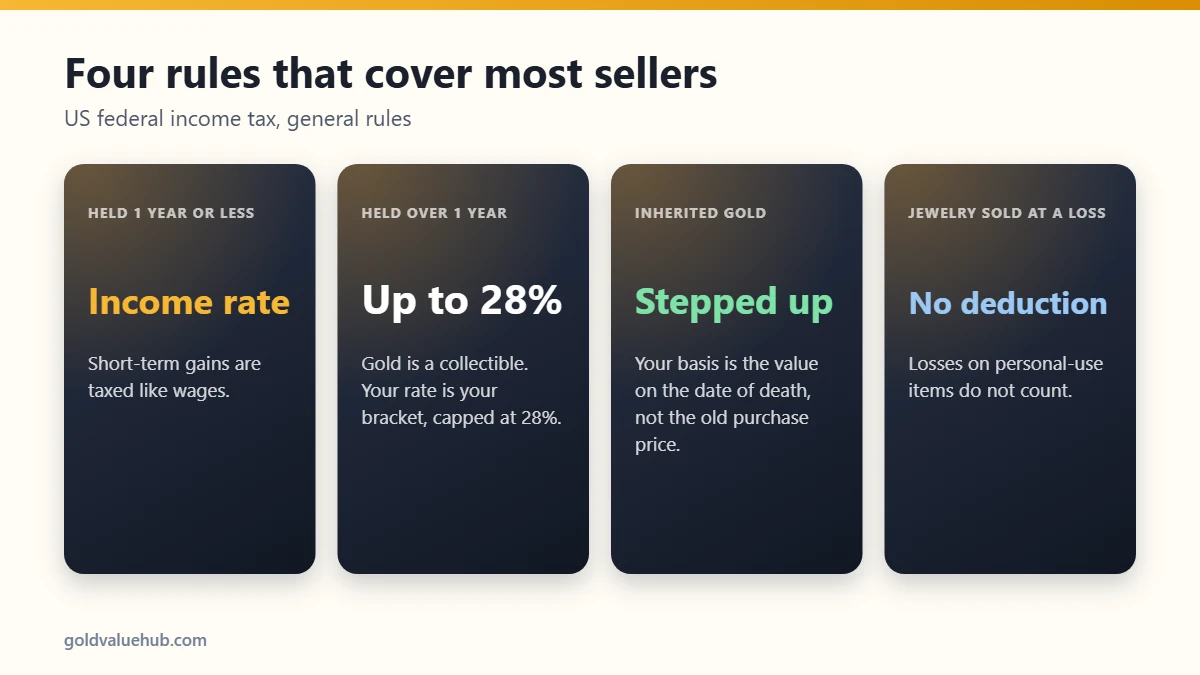
- The IRS treats physical gold as a collectible. Gains on gold held more than one year are taxed at your ordinary rate, up to a maximum of 28%.
- Gold held one year or less is taxed at ordinary income rates.
- Inherited gold gets a new basis equal to its value on the date of death, so a quick sale often has little or no gain.
- If you sell personal jewelry for less than you paid, there is no tax, and the loss is not deductible.
- You report gains on Form 8949 and Schedule D, whether or not the buyer sends a form.
Estimate your gain first with our gold profit calculator
How the IRS Sees Your Gold
The IRS says almost everything you own for personal or investment use is a capital asset. That includes gold coins, bars and jewelry. When you sell a capital asset, the difference between your basis and what you received is a capital gain or loss. The IRS page Topic 409, Capital gains and losses sets this out.
For most investments held more than a year, the top federal rates are 0%, 15% or 20%. Gold is different. Topic 409 lists an exception: net capital gains from selling collectibles, such as coins or art, are taxed at a maximum 28% rate. Precious metals fall in that group.
“Maximum” is the key word in taxes on selling gold. If your regular bracket is 12% or 22%, you pay 12% or 22% on a long-term gold gain. The 28% only matters if your bracket is higher than that.
Step One: Work Out Your Gain
Gain = sale price − selling costs − basis
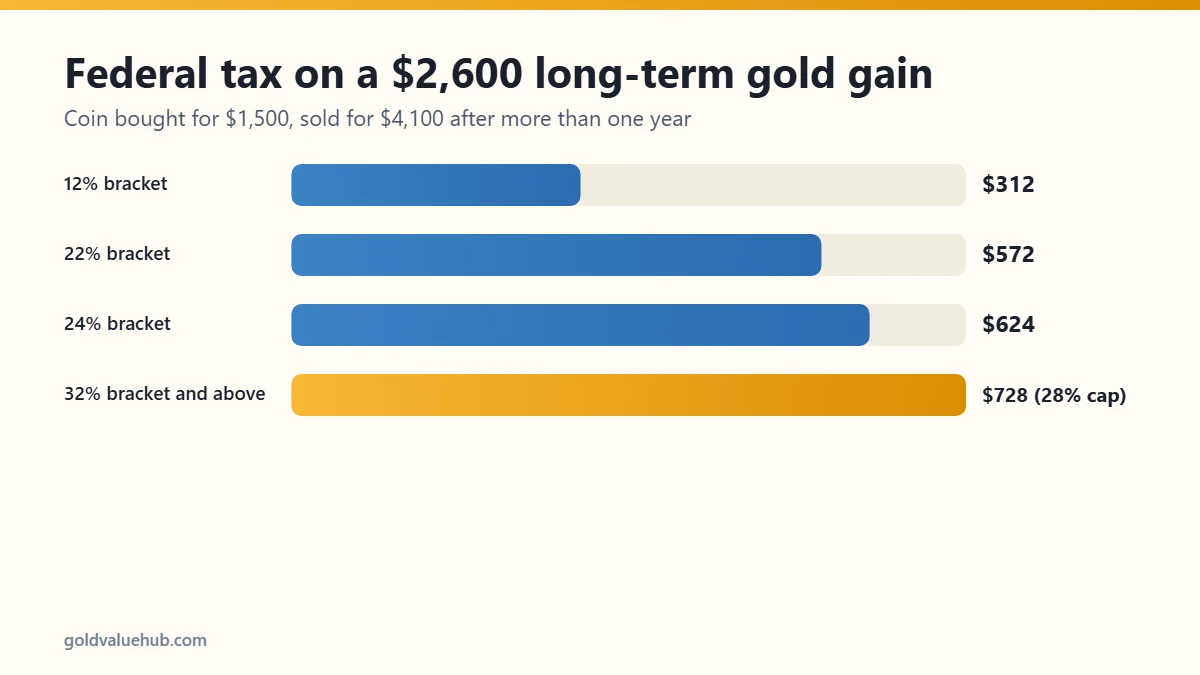
Your basis is normally what you paid, including dealer premiums and shipping. Here is an example with a one-ounce coin.
| Item | Amount |
|---|---|
| Bought in 2019, including premium | $1,500 |
| Sold in October 2026 | $4,100 |
| Gain | $2,600 |
| Held more than one year? | Yes, long-term |
| Tax in the 22% bracket | $572 |
| Tax in the 35% bracket | $728 (capped at 28%) |
You can model your own numbers with the gold profit calculator. For the current value of what you hold, use the gold coin value calculator or check the live price of one ounce: $3,995.87.
Short-Term vs Long-Term
| How long you held it | How the gain is taxed |
|---|---|
| One year or less | Ordinary income rates, same as wages |
| More than one year | Your ordinary rate, capped at 28% |
| Inherited | Treated as long-term, whatever the dates |
You count from the day after you got the gold up to and including the day you sell it. If you are a few weeks short of a year and in a high bracket, waiting can lower the rate.
Inherited Gold: The Stepped-Up Basis
This is the part people get most wrong. One Quora user sold inherited jewelry and asked how to avoid “the 28% capital gains tax rate,” even wondering if buying real estate would help. The replies cleared it up: because the jewelry was inherited, the basis was its fair market value on the date of death, not what the relative paid decades ago.
So if you sell soon after inheriting, the sale price and the basis are close, and the gain is small or zero. The IRS covers this in Publication 551, Basis of Assets.
| Inherited bracelet | Amount |
|---|---|
| Grandmother paid in 1975 | $300 |
| Value on the date of death | $2,000 |
| You sell a few months later | $2,100 |
| Taxable gain | $100, not $1,800 |
Gifts work differently. If someone gives you gold while they are alive, you generally take over their basis. Keep whatever paperwork they have.
Selling Old Jewelry for Scrap
Most people selling a drawer of old jewelry owe nothing. Here is why. Jewelry costs far more at retail than its gold content, and scrap buyers pay less than melt value. A ring bought for $900 that sells for $350 as scrap has no gain.
There is a catch. Topic 409 says losses from the sale of personal-use property are not deductible. So you cannot use that $550 loss to lower your taxes.
It can go the other way now that gold is above $4,000 an ounce. A heavy chain bought for $600 in 2005 might bring $1,500 today. That $900 is a taxable gain. Before you sell, find the melt value with the scrap gold calculator and compare it with what you paid.
| Situation | Tax result |
|---|---|
| Personal jewelry sold for less than you paid | No tax, no deductible loss |
| Personal jewelry sold for more than you paid | Gain is taxable |
| Investment coins or bars sold at a gain | Gain is taxable, up to 28% if long-term |
| Investment coins or bars sold at a loss | Capital loss, subject to the usual limits |
| Inherited gold sold soon after | Little or no gain |
Will the Buyer Report the Sale?
Sometimes. Dealers have to file Form 1099-B for certain bullion bars and coins when a sale reaches set quantities. Sales of ordinary jewelry and small scrap lots are usually not on those forms. Many states also require gold buyers and pawn shops to record your ID, which is about stolen goods, not taxes.
The important point about taxes on selling gold is that your duty to report does not depend on a form. If you have a gain, you report it, whether or not anyone sends the IRS a 1099.
How to Report a Gold Sale
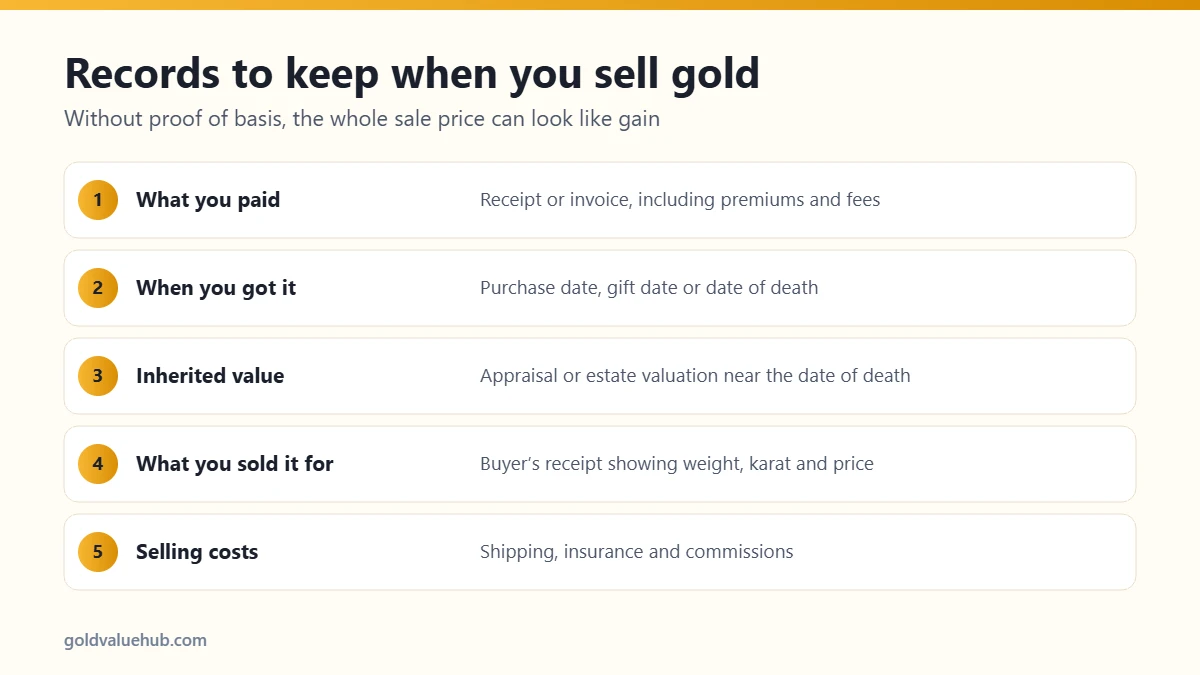
- Gather your basis records and the sale receipt.
- Work out the gain or loss for each sale.
- Enter each sale on Form 8949, marking it short-term or long-term.
- Carry the totals to Schedule D of Form 1040.
- If you have long-term collectibles gains, your tax software or preparer uses the 28% rate worksheet.
- Check whether your state taxes capital gains too.
High earners may also owe the 3.8% net investment income tax on top. That is one more reason to ask a professional if the amounts are large.
Common Mistakes With Taxes on Selling Gold
- Thinking 28% applies to the whole sale price. It applies to the gain.
- Thinking everyone pays 28%. It is a cap, and many sellers are in lower brackets.
- Using the original owner’s purchase price for inherited gold.
- Having no record of what you paid. Without a basis, the whole amount can look like gain.
- Trying to deduct a loss on jewelry you wore.
- Assuming no 1099 means no tax.
- Forgetting state income tax.
If you are still choosing a buyer, see our guide to the best place to sell gold. A higher payout matters more than anything on this page.
Frequently Asked Questions
Do I have to pay taxes when I sell gold?
Only if you sell for more than your basis. The gain is taxable. If you sell personal jewelry for less than you paid, there is no tax and no deductible loss.
What is the tax rate on selling gold?
Gains on gold held more than one year are taxed at your ordinary rate, up to a maximum of 28%, because the IRS treats gold as a collectible. Gold held one year or less is taxed at ordinary income rates.
Do I pay taxes on inherited gold jewelry?
Your basis is the value on the date of death. If you sell soon after for about that value, there is little or no taxable gain.
Do gold buyers report sales to the IRS?
Dealers file Form 1099-B for certain bullion bars and coins in set quantities. Ordinary jewelry and small scrap sales are usually not reported that way, but you must still report any gain.
Is selling scrap gold taxable?
It is taxable if you receive more than you paid for the items. Most old jewelry sells for less than its retail cost, so there is often no gain.
Can I deduct a loss when I sell gold jewelry?
No, not for personal-use jewelry. The IRS does not allow losses on personal-use property. Losses on investment bullion follow the normal capital loss rules.
How do I report selling gold on my tax return?
List each sale on Form 8949 and carry the totals to Schedule D of Form 1040.
How can I lower taxes on selling gold?
Keep proof of what you paid, hold for more than one year, use the stepped-up basis for inherited items and include selling costs. Ask a tax professional about your situation.
Conclusion
Taxes on selling gold are simpler than the forum arguments make them sound. You are taxed on the gain, not the sale. Long-term gains are capped at 28% and are lower if your bracket is lower. Inherited gold starts from its value at the date of death. Old jewelry sold below its cost creates no tax.
Keep your receipts, know your basis and report real gains. For anything large or unusual, spend an hour with a tax professional. This guide is general information and not tax advice.