What ID and Paperwork Do You Need to Sell Gold?
Published Oct 25, 2026
Quick Answer: Do you need ID to sell gold? In almost every US state, yes — licensed gold buyers are legally required to record a government photo ID for every purchase, and many states add holding periods of 7–30 days before your gold can be resold. You don’t need the original purchase receipt, but bring ID, and expect the transaction to be documented.
You’re ready to sell, and a worry pops up: do you need ID to sell gold? What if you don’t have the original receipt? Will the buyer turn you away — or worse, will asking questions make you look suspicious? These are the most common pre-sale jitters, and the answers are reassuring.
Here’s the reality: ID requirements exist to fight stolen-property fencing, not to hassle legitimate sellers. Virtually every licensed buyer in America will photocopy your driver’s license, log the transaction, and possibly hold your items for days or weeks before reselling them. It’s routine, it’s the law in most states, and it protects you too.
This guide covers exactly what ID and paperwork you need, which states add extra rules, whether you can sell without a receipt, and what happens to your information. Examples use the October 7, 2026 spot price ($4,098/ozt, $131.76/g pure gold).
Do You Need ID to Sell Gold? The Direct Answer
Yes — in nearly every US state, licensed gold buyers must record a valid government-issued photo ID for every purchase. This isn’t store policy; it’s the law in most jurisdictions, part of precious-metals dealer and pawnbroker regulations designed to deter trade in stolen goods. Expect the buyer to photocopy or scan your ID and have you sign a transaction record.
So do you need ID to sell gold if you’re selling to a friend or at a private sale? Private person-to-person sales generally aren’t covered by dealer ID laws — but you still want a bill of sale for both parties’ protection. The ID requirement applies to businesses buying gold: pawn shops, jewelers, coin dealers, and “we buy gold” stores.
What ID Works (and What Doesn’t)
Once you’ve confirmed the “do you need ID to sell gold” answer is yes, the next question is which ID counts:
- Driver’s license — the universal standard; accepted everywhere.
- State ID card — equally valid for non-drivers.
- Passport — accepted, though some shops prefer local ID.
- Military ID — valid federal photo ID.
- What won’t work: student IDs, work badges, credit cards, or photos of your license on your phone — buyers need to scan the physical document.
What Paperwork Do You Need Beyond ID?
Beyond the ID that settles “do you need ID to sell gold,” the rest of the paperwork to sell gold is light — but what you bring affects your outcome:
- Original purchase receipts — helpful, not required. They support your tax cost basis.
- Appraisals or certificates — useful for diamonds, designer pieces, and coins; irrelevant for scrap.
- Your own records — weights, karats, and melt-value math keep the negotiation honest.
- Transaction receipt from the buyer — always get one: itemized weights, karats, prices, and total.
- Estate/probate documents — if selling inherited gold, bring letters testamentary if you have them.
Can You Sell Gold Without a Receipt?
The receipt question is separate from “do you need ID to sell gold” — ID is legally required nearly everywhere, while receipts are optional almost everywhere. What buyers do require is your ID and their own transaction record. No receipt has never stopped a legitimate sale.
The one place receipts matter is taxes: without proof of what you paid (cost basis), the IRS can treat more of the sale as taxable gain. For inherited gold, the basis is generally the fair market value at the date of death — document it as best you can. But for the sale itself? Walk in with ID and gold; that’s enough.
Do You Need ID to Sell Gold in Every State? State Rules
Precious-metals regulations are state (and sometimes city) law, so details vary — but the pattern is consistent nationwide. The table below shows common requirement types with illustrative examples; always verify your specific state and city rules before selling:
| Requirement | How it usually works | Example states with this rule type |
| Photo ID recording | Buyer scans/copies government ID every transaction | Nearly all states (e.g., CA, FL, TX, NY) |
| Holding period | Buyer must hold items 7–30 days before reselling/melting | Common (e.g., FL, CA — periods vary) |
| Dealer licensing | Precious-metals buyers need a state/local license | Many states and cities |
| Transaction reporting | Records available to law enforcement on request | Widespread |
| Thumbprint (some areas) | Electronic thumbprint plus ID in certain cities | Select cities/counties |
The holding period surprises sellers most: after you sell, the buyer legally can’t melt or resell your gold for days or weeks, giving police time to check stolen-property reports. It doesn’t affect your payment — you still get paid on the spot. Every rule in the table above flows from the same root: “do you need ID to sell gold?” — yes, and states build holding and licensing requirements on top of that ID foundation.
What Happens to Your ID Information?
Your ID data goes into the buyer’s transaction log — typically name, address, ID number, item descriptions, and amount paid — held for 1–7 years depending on the state and available to law enforcement investigating theft. Reputable buyers store it securely; it’s not marketing data and isn’t sold. Privacy-wise, this is the real cost of the “do you need ID to sell gold” answer: a permanent record linking you to the sale. If a buyer seems casual about records (“we don’t need all that”), they’re either unlicensed or sloppy — both are reasons to leave.
Do You Need ID to Sell Gold Online? Mail-In Rules
Yes — the same legal requirement applies by mail. Reputable mail-in buyers ask you to include a photocopy of your government ID with the shipment, or to upload it through their secure portal. The copy goes into the same transaction log as an in-store scan. If a mail-in company doesn’t ask for ID, treat it like a storefront that doesn’t — as a red flag, not a convenience. And never email ID photos to an unverified address; use the buyer’s secure upload or include the copy in the insured package.
How Much Will You Get? Payout Ranges
Whether you asked “do you need ID to sell gold” yesterday or today, paperwork doesn’t change payouts — but knowing the ranges keeps the transaction focused on price, not procedure:
| Buyer type | Typical % of melt |
| Online gold buyer | 80–90% |
| Local jeweler / coin shop | 70–85% |
| Pawn shop | 30–60% |
| Refinery (large lots) | 90–98% |
How Buyers Test Your Gold
- Hallmark check — karat stamp reading.
- Magnet test — gold isn’t magnetic.
- Acid / electronic test — karat range confirmation.
- XRF analyzer — precise non-destructive purity reading.
Offer vs Melt Value vs Retail Value
Don’t let paperwork anxiety distract from price math. Melt value (weight × karat × spot) is your anchor; the offer is melt minus margin; retail value is irrelevant. Judge the deal on percentage of melt, not on how official the forms look.
Weight Units: Grams, Pennyweight, Troy Ounces
Bring your own gram-scale weights to the appointment (1 dwt = 1.55517g; 1 troy oz = 31.1035g). At October 7, 2026 spot, 14K = $77.08/g. Your own numbers keep the conversation about price — where it belongs — instead of procedure.
Where to Sell Gold: Every Channel, Ranked
| Rank | Channel | Typical payout | ID/paperwork |
| 1 | Top online buyer | 80–90% of melt | ID copy by mail; forms included |
| 2 | Coin dealer / jeweler | 70–85% of melt | ID scanned in store |
| 3 | Refinery (large lots) | 90–98% of melt | ID + account setup |
| 4 | Pawn shop | 30–60% of melt | ID + thumbprint (some areas) |
| 5 | Private sale | Varies | Bill of sale recommended |
The Selling Process Step by Step
Five steps, with the “do you need ID to sell gold” question settled at step one:
- 1. Gather — ID, gold, your weight/karat notes, any receipts.
- 2. Calculate — melt value at today’s spot price.
- 3. Vet buyers — licensed, reviewed, posted payouts.
- 4. Transact — ID recorded, gold tested, written itemized quote.
- 5. Get paid, keep records — receipt for taxes; ID data stays with buyer.
How to Prepare Your Gold and Paperwork
Sort by karat, weigh in grams, gather ID and any receipts or appraisals, photograph everything. Scrap is melt math; resellable pieces deserve estate quotes; diamonds add nothing at scrap counters. Bring a folder with everything behind “do you need ID to sell gold” and beyond: ID, your calculations, prior appraisals — organized sellers get better treatment.
Payment, Insurance, and Shipping
- Cash: same day locally — count at the counter.
- Business check / ACH: paper trail for taxes; 3–7 days by mail.
- Wire: same-day on $5,000+ lots.
- Mail-in: free insured kit; ID copy usually required with shipment.
Note: mail-in buyers typically require a photocopy of your ID with the shipment — same legal requirement, handled by mail. Preliminary estimates are directional only; price-match guarantees at top online buyers accept competing written quotes.
Red Flags in Paperwork and Procedure
Paperwork red flags — including the inverse of “do you need ID to sell gold” (a buyer who never asks):
- No ID requested — legitimate licensed buyers always ask; no ID request suggests unlicensed operation.
- No transaction record — you should sign something and get a copy.
- Asking for SSN unnecessarily — ID is standard; Social Security numbers are not routinely required for gold sales.
- Refusing you a receipt copy — always a walk-away signal.
The FTC advises understanding a buyer’s terms and getting offers in writing before selling gold.
Negotiation: Paperwork Done, Price Next
Once ID is recorded and testing is done, negotiate on the numbers: three written quotes, counter on percentage of melt, walk away once. The sellers who ask “do you need ID to sell gold” are usually first-timers — and first-timers who prepare get treated like regulars.
Questions to Ask About Procedure
- What ID do you need, and how is my information stored?
- Is there a holding period in this state?
- Will I get an itemized receipt?
- What percentage of melt is your offer?
Mistakes to Avoid
- Forgetting ID and wasting a trip.
- Skipping your own weight/karat homework.
- Leaving without an itemized receipt.
- Letting procedure distract from price math.
Pawning vs Selling: Paperwork Compared
| Factor | Pawn loan | Outright sale |
| ID required? | Yes — plus thumbprint in some areas | Yes |
| Holding period | Loan term + grace period | 7–30 days (dealer can’t resell) |
| Paperwork | Loan ticket with terms | Bill of sale / receipt |
Taxes and Your Paperwork
The IRS treats physical gold as a collectible: profit on gold held over a year faces up to the 28% collectibles rate. Your paperwork — purchase receipts, the buyer’s transaction record, ID-logged sale — is your tax documentation. No receipt for the original purchase? Document basis as best you can; see our taxes on selling gold guide and the IRS rules on capital gains.
Illustrative Examples: Paperwork Scenarios
| Your situation | Can you sell? | What to bring |
| Driver’s license, no receipt | Yes — routine | ID + gold |
| Inherited gold, no paperwork | Yes — routine | ID + gold; note date-of-death value for taxes |
| No photo ID at all | Usually no | Get a state ID first |
| Passport only | Usually yes | Passport; call ahead to confirm |
Pre-Sale Paperwork Checklist
- Government photo ID (driver’s license, state ID, or passport).
- Your weight and karat notes.
- Original receipts or appraisals if you have them.
- Know your state’s holding-period rules.
- Plan to get an itemized receipt and keep it for taxes.
Key Takeaways
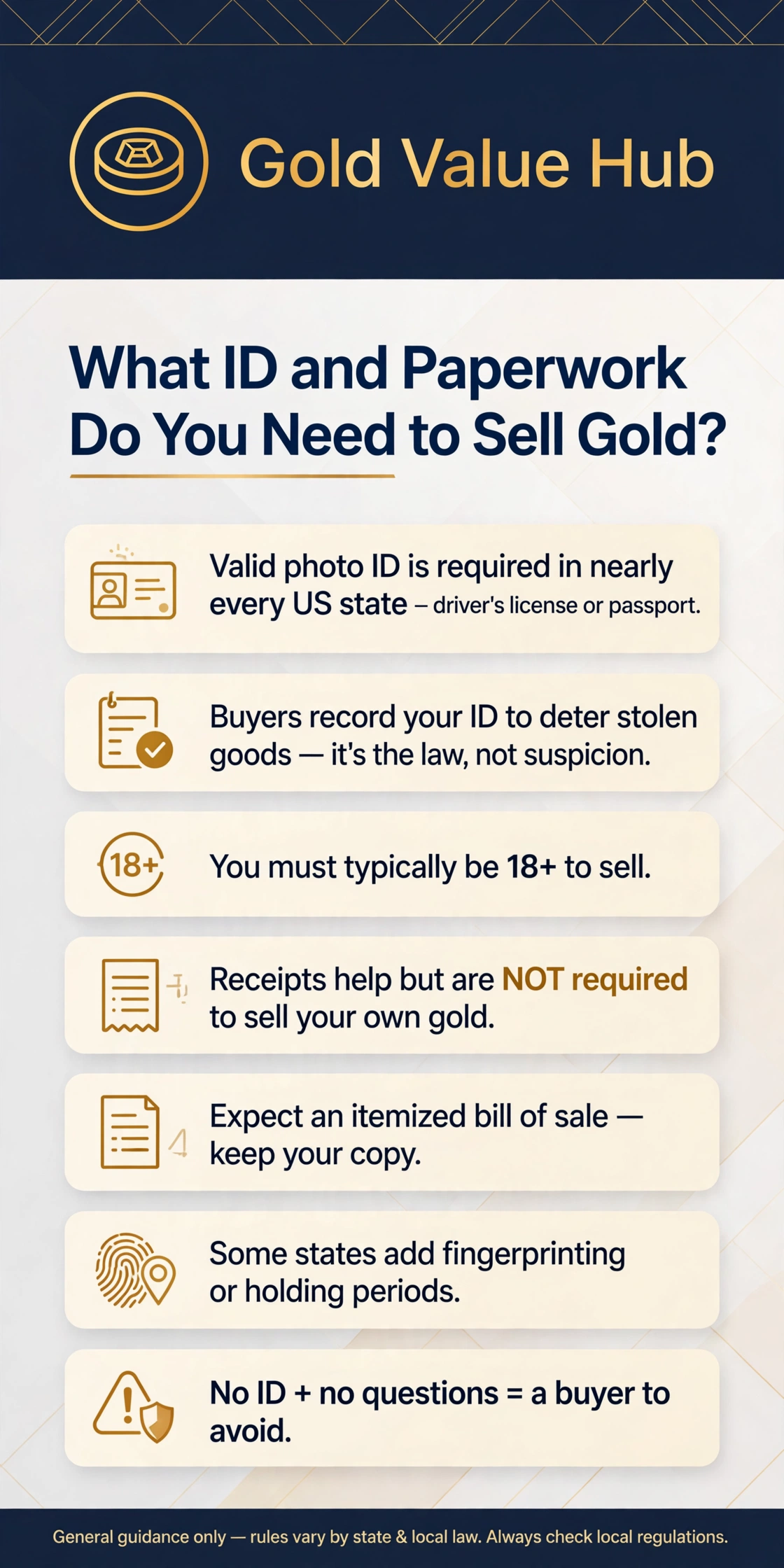
- Do you need ID to sell gold? Yes — nearly every state requires licensed buyers to record government photo ID.
- You don’t need the original purchase receipt to sell — but keep one for tax basis.
- Many states add 7–30 day holding periods before buyers can resell your gold.
- Bring: photo ID, your weight/karat notes, any appraisals; always get an itemized receipt.
- No ID request from a buyer is a red flag — legitimate businesses always ask.
- Your ID data goes into transaction logs available to law enforcement — not marketing lists.
- Keep all paperwork — gold profits face up to 28% collectibles tax.
Frequently Asked Questions
Do you need ID to sell gold at a pawn shop?
Yes — pawn shops face the strictest ID rules of any buyer type, and some jurisdictions add thumbprinting. Bring a driver’s license or state ID; without one, most pawn shops legally cannot transact with you.
Can you sell gold without a receipt?
Yes — receipts are almost never required for the sale itself. Buyers expect gold to come without paperwork (gifts, inheritance, old purchases). Receipts only matter for establishing your tax cost basis.
Do online gold buyers need your ID?
Yes. If you wondered “do you need ID to sell gold” by mail, the answer matches in-person sales — reputable mail-in buyers require a photocopy of your government ID with the shipment. It’s a trust signal, not a red flag.
What is the holding period when selling gold?
Many states require buyers to hold purchased gold 7–30 days before reselling or melting it, giving police time to check stolen-property reports. It doesn’t delay your payment — just the buyer’s resale. Periods vary by state and city.
Will the buyer report my sale to the IRS?
Buyers don’t routinely file 1099s on jewelry purchases, but your ID-logged transaction creates a paper trail, and large cash transactions have separate reporting rules. You’re still legally required to report taxable gains yourself.
Can I sell inherited gold without paperwork?
Yes — bring your ID and the gold; probate documents help but usually aren’t required for the sale. For taxes, your basis is generally the fair market value at the date of death, so document that value as best you can.
Do I need a license to sell my own gold?
No — licensing applies to the buyer (the business purchasing gold), not to you as the seller. You just need valid ID. If you’re selling regularly at volume, though, check whether your activity crosses into dealer territory.
Can a buyer keep a copy of my ID?
Yes — that’s exactly what the law requires them to do in most states. The copy stays in their transaction records, available to law enforcement. If you’re uncomfortable, that’s understandable, but it’s non-negotiable at licensed buyers.
What if I lost my ID — can I still sell gold?
Generally no at licensed buyers — the ID requirement is legal, not optional. Get a state ID card first (usually quick and inexpensive). A passport works as an alternative in the meantime.
Do gold buyers check if gold is stolen?
Indirectly — the ID recording and holding periods exist so police can check. Buyers also watch for red flags like removed hallmarks or mismatched stories. Legitimate sellers with ID have nothing to worry about.
Bring your ID — you now know the full answer to “do you need ID to sell gold” — skip the receipt anxiety, and focus on what actually determines your payout: melt value and competing quotes. Compare licensed gold buyers and run your numbers in our scrap gold calculator.