
How Do Gold Refineries Calculate Your Payout?
Published Oct 16, 2026
Quick answer: Gold refineries calculate your payout as assayed pure-gold weight × spot price, minus refining charges (1–3%) and a lot fee ($25–$100). A 1 oz lot of 14K scrap ($2,390 melt at illustrative Oct 2026 prices) typically settles at $2,270–$2,340 — 95–98% of melt, the highest payout in the industry.
A refinery offered you 95% of melt — how do you check that’s real? By understanding exactly how a gold refinery payout is calculated, line by line. Refineries are the top of the gold-buying food chain: every coin shop, online buyer, and pawn shop eventually sells to one. Sell direct and you skip the middlemen’s cuts — if your lot is big enough and you know the process.
This guide takes you inside the refinery: the four processing stages, every fee and deduction, minimum lot sizes, how to prepare and ship your scrap, refinery vs pawn shop math, and the questions that separate honest refiners from pretenders. Nothing here is theory — it’s the actual settlement pipeline your gold travels.
Below: the payout formula with worked examples, a full term glossary, fee tables, preparation checklists, every alternative channel compared, the pennyweight trick, taxes, and real settlement examples. Prices use $4,098/oz (~$131.76/g 24K) as an illustrative Oct 7, 2026 reference — check the live calculator before selling, since spot moves daily.
What a Gold Refinery Actually Is
A gold refinery is an industrial facility that melts scrap gold, purifies it to 99.9%+ fineness, and sells the resulting bars to banks, mints, and manufacturers. Major US refineries process hundreds of ounces daily from jewelers, pawn shops, dentists, and — increasingly — individuals. They’re licensed, bonded, LBMA-associated or ISO-accredited operations, not storefronts: think factory, not jewelry counter.
The key insight: your local buyer’s offer is just the refinery’s payout minus their margin. A coin shop offering 80% of melt is planning to aggregate your gold with hundreds of other lots and settle with a refinery at 96%. Every percentage point between 80% and 96% is their business. Sell direct, and that spread is yours — minus the refinery’s own (much smaller) charges.
The Gold Refinery Payout Formula, Step by Step
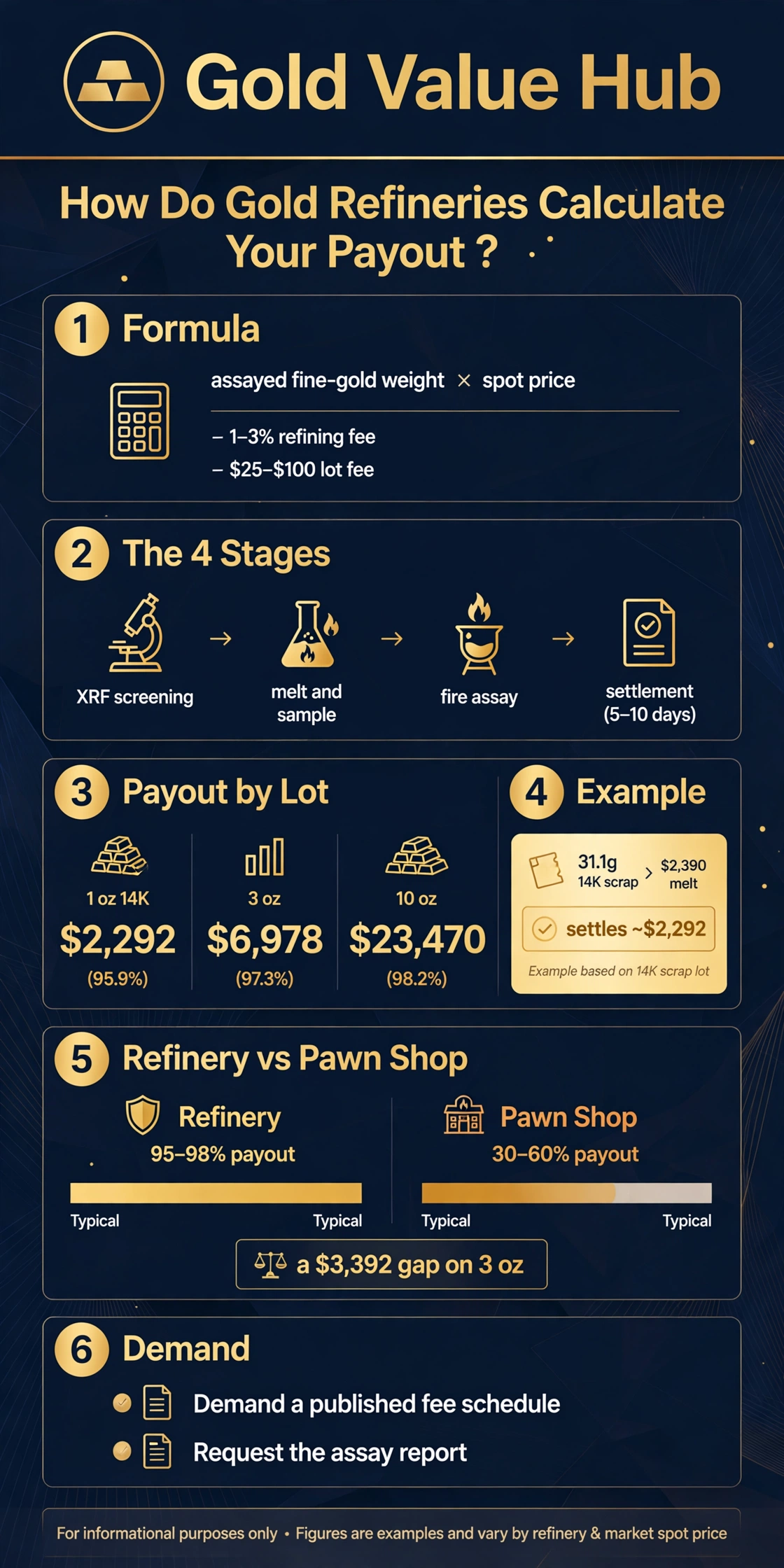
Gold refinery payout = (assayed fine-gold weight × spot price) − refining charges − lot fee. Step 1: your lot is weighed on arrival. Step 2: it’s melted with other scrap into a homogeneous bar. Step 3: a drill sample undergoes fire assay — the definitive purity test, accurate to 1 part in 10,000. Step 4: fine-gold weight (total weight × assayed purity) is priced at the day’s spot. Step 5: refining charges (1–3% of melt) and the flat lot fee ($25–$100) are deducted. Step 6: you receive settlement, usually 1–5 business days after assay.
Worked example — gold: you ship 31.1 g (1 ozt) of 14K scrap. Assay confirms 58.3% = 18.13 g fine gold × $131.76 = $2,388.81 melt. Minus 2% refining ($47.78) and a $50 lot fee = $2,291.03 payout — 95.9% of melt. Worked example — silver: 100 g of 925 scrap at 92.5% = 92.5 g × $1.54/g (illustrative) = $142.45 melt; minus 5% refining + $25 fee = ~$110. Small silver lots barely survive the fees — gold is the refinery game.
The terms on every refinery settlement sheet:
| Term | What It Means |
| Spot price | Live market price of one troy ounce of pure gold. Reference: $4,098/oz on Oct 7, 2026. |
| Fine-gold weight | Total weight × assayed purity. The only weight that earns money. |
| Fire assay | Lab melt-and-weigh purity test, accurate to 1 part in 10,000. The final word. |
| XRF screening | X-ray fluorescence pre-sort — fast surface reading before melting. |
| Refining charges | Typically 1–3% of melt value. The refinery’s core revenue. |
| Lot fee | Flat $25–$100 per lot, covering melt, assay, and handling. |
| Settlement | Final payment after assay — 1–5 business days, by check or wire. |
| Minimum lot | Smallest lot accepted — commonly 1–3 troy ounces of scrap. |
| LBMA | London Bullion Market Association — sets global refining standards. |
Inside the Refinery: The 4 Stages in Detail
Stage 1 — Receiving and XRF screening. Your package is opened on camera, weighed, and each piece XRF-scanned to sort the lot by alloy family and flag non-precious surprises. Reputable refineries video this step — it’s your proof against “we never received it” disputes. Stage 2 — Melt and sampling. Your lot melts in a crucible (often with other customers’ lots) into a homogeneous bar. A drill sample is taken from multiple points — homogeneity is why assay beats any surface test.
Stage 3 — Fire assay. The sample is mixed with lead, melted, and cupelled: base metals absorb into the cupel, leaving a pure gold-silver bead that’s weighed to 0.0001 g. Parting in nitric acid separates the silver. This 3,000-year-old method remains the gold standard (pun intended) — no XRF, acid test, or electronic tester matches it. Stage 4 — Settlement. The assay report prices your fine-gold weight at spot, deducts charges, and triggers payment. You should receive the assay report — read it line by line.
Every Fee and Deduction, Explained
Refinery pricing looks simple until the deductions. Here’s the complete anatomy: refining charge (1–3% of melt) — the actual cost of purification, the refinery’s main revenue; lot/treatment fee ($25–$100) — covers receiving, melting, assay labor; stone removal (if applicable) — some charge per stone; remove stones yourself; shipping/insurance — your cost to get it there, often $15–40 insured; assay fee — usually bundled into the lot fee, but some itemize $25–50.
What you should not see: “processing percentages” above 3%, vague “handling” line items, or purity haircuts (“we pay on 90% of assay”). An honest refinery publishes its schedule: e.g., “98% of melt on lots over 5 oz, 96% on 1–5 oz, $50 lot fee.” If the schedule isn’t published, ask for it in writing before shipping — refusal is a walk-away signal.
What Today’s Gold Price Means for Refinery Sellers
As of October 7, 2026, gold trades near $4,098 per troy ounce — about $131.76 per gram for pure 24K ($4,098 ÷ 31.1035), near record highs. High prices make refinery-direct selling more attractive than ever: the 15–20 point spread between refinery and retail payouts is worth more dollars per ounce than at any point in history. On a 3 oz 14K lot ($7,166 melt), the refinery-vs-pawn gap exceeds $3,200.
Refineries settle on the bid price at time of assay, not the ask — understand the bid/ask spread before you ship. Treat prices here as illustrative — gold moves daily — and estimate your lot with the live scrap gold calculator. Ask your refinery which day’s price the settlement uses: “day of melt” vs “day of receipt” can differ by 1–2% in volatile markets.
Gold Refinery Payout Rates by Lot Size (Fee Table)
Illustrative $4,098/oz reference (Oct 7, 2026). Example lot: 14K scrap at $76.86/g melt. Real schedules vary — always get the refinery’s current sheet.
| Lot size (14K scrap) | Melt value | Refining + lot fee | Net payout | % of melt |
| 1 ozt (31.1 g) | $2,390 | $48 + $50 | $2,292 | 95.9% |
| 3 ozt (93.3 g) | $7,171 | $143 + $50 | $6,978 | 97.3% |
| 10 ozt (311 g) | $23,903 | $358 + $75 | $23,470 | 98.2% |
| 0.5 ozt (15.6 g) | $1,195 | $36 + $50 | $1,109 | 92.8% |
The pattern: flat fees punish small lots and vanish into rounding on large ones. Below ~1 oz, the lot fee eats the refinery advantage — that’s the structural reason small sellers do better with coin shops and online buyers, who aggregate thousands of small lots into refinery-scale shipments.
Can Regular People Sell Directly to a Refinery?
Yes — many major refineries accept individual sellers, though few advertise it. Requirements are straightforward: meet the minimum lot (commonly 1–3 troy ounces of scrap, sometimes lower for dental gold), ship via their insured kit or your own insured carrier, include ID and a lot manifest, and wait 5–10 business days for assay and settlement. Payment comes by check or wire; some offer account credit.
- Best candidates: jewelry-box cleanouts, inherited lots, dental scrap piles — anything over ~1 oz total.
- Skip refinery-direct: single chains, lone earrings, sub-ounce lots — fees erase the advantage.
- Verify legitimacy: physical US address, published fee schedule, assay reports provided, BBB/state licensing checkable.
- Start small: first-timers should test with a modest lot before shipping the family hoard.
Gold Refinery vs Pawn Shop: The Math That Ends the Debate
Same 3 oz 14K lot ($7,171 melt): refinery-direct nets ~$6,978 (97.3%). Online buyer: ~$5,737 (80%). Coin shop: ~$5,378 (75%). Pawn shop: ~$3,586 (50%). The refinery-to-pawn gap is $3,392 — on identical metal. Pawn shops aren’t evil; they’re convenience stores for gold — fast cash, high overhead, maximum margin. But nobody who understands this table sells a multi-ounce lot to a pawn shop.
- Refinery wins when: lot ≥1 oz, you can wait 5–10 days, and you want maximum payout.
- Pawn shop wins when: you need cash in an hour and the lot is small — speed is the only advantage.
- Middle ground: coin shops and online buyers for sub-ounce lots — 70–90% with same-week cash.
- Never pawn a large lot: the dollar loss scales with weight — always get a refinery quote first.
Before You Ship to a Refinery: Prep Checklist
Refinery lots are final — once melted, there’s no “give it back.” Preparation is everything.
Sort by karat and metal type; remove all stones, steel clasps, solder blobs, and non-precious findings; weigh everything to 0.1 g and photograph the lot with a manifest listing each piece; calculate expected melt with the live scrap gold calculator; get the refinery’s fee schedule in writing; confirm insurance coverage matches your lot’s full melt value; ship tracked with signature; keep copies of everything until settlement clears. And never ship your entire holdings to an untested refinery — start with a small lot.
The Selling Process: From Shipment to Settlement
1. Intake: refinery receives, videos the opening, weighs your lot. 2. Screening: XRF sort by alloy. 3. Melt and sample: crucible melt, drill samples. 4. Fire assay: definitive purity, 1–3 days. 5. Settlement report: fine-gold weight × spot, minus charges — review the assay line by line. 6. Payment: check or wire, 1–5 business days after assay. Total timeline: 5–10 business days door to door.
Your rights: the assay report, return of unsettled metal (before melt — confirm the policy), and a written settlement statement. Price-lock policies vary — some refineries lock on receipt day, others on melt day; in volatile markets, ask explicitly. If the assay differs wildly from your estimate, request a re-assay before settlement — reputable refineries allow it.
Red Flags: Refinery Pretenders and Fee Traps
The FTC advises understanding exactly how offers are calculated. Refinery red flags: no published fee schedule; no physical address (PO box only); “we pay 99% of melt!” with unstated lot fees; refusing assay reports; no video intake; pressure to ship immediately; payout in product credit only. Real refineries are boring, transparent, and paperwork-heavy — glamour is a warning sign.
Negotiation at refineries is limited — published schedules are usually firm — but volume talks: “I have 10 oz now and more coming; what’s your 10 oz+ rate?” can unlock a tier. Always ask: “Which day’s spot price applies to settlement, and is the assay report included?” Get both answers in writing.
The Pennyweight Quote Trick (Refinery Edition)
Refineries themselves quote in fine ounces, but middlemen selling “refinery rates” love pennyweight: “we pay refinery-direct $115/dwt for 14K!” Convert: $115 ÷ 1.555 = $73.95/g vs $76.86 melt = 96.2% of melt — plausible. But “$95/dwt” = $61.09/g = 79.5% — that’s a coin-shop rate wearing a refinery costume. Anyone invoking “refinery” while quoting dwt deserves the conversion treatment.
Defense never changes: dollars per gram, divided by melt-per-gram, equals the true percentage. Say it out loud. “Refinery-direct” at 79.5% is just a shop with good marketing.
Taxes: Refinery Settlements and the IRS
Gold is a collectible to the IRS: gains past one year taxed up to 28%; under a year, ordinary income rates. Refinery settlements over $600 may generate information reporting — keep every settlement statement and assay report as your basis documentation. Large lots mean large gains: a $6,978 settlement on a $2,000 basis = $4,978 taxable gain. See our taxes on selling gold guide; general information, not tax advice.
Real Settlement Examples: Refinery Payouts, Actual Numbers
At the illustrative $4,098/oz reference: 1 ozt 14K scrap (melt $2,390) settles ~$2,292 (95.9%) after $48 refining + $50 lot fee. 3 ozt mixed 14K/18K (melt $7,560) settles ~$7,360 (97.3%). 10 ozt estate lot (melt $23,900) settles ~$23,470 (98.2%). Dental lot 2 ozt at 70% gold (melt $5,736) settles ~$5,560 (96.9%) — plus separate palladium/platinum credits from the assay. The pattern: scale is the discount — bigger lots, smaller percentage lost.
Key Takeaways
• Gold refinery payout = assayed fine-gold weight × spot − refining charges (1–3%) − lot fee ($25–$100).
• Expect 95–98% of melt — the highest payout of any channel, but minimums of 1–3 oz apply.
• The 4 stages: XRF screening → melt and sample → fire assay → settlement (5–10 days total).
• Flat fees punish small lots; below ~1 oz, coin shops and online buyers pay better net.
• Demand a published fee schedule and the assay report — refuse to ship without both.
• Refinery vs pawn on 3 oz 14K: ~$6,978 vs ~$3,586 — a $3,392 gap on identical metal.
• Settlements are taxable collectible gains (up to 28%) — keep every settlement statement.
Frequently Asked Questions
How do gold refineries calculate your payout?
They melt your lot, fire-assay a sample for exact purity, multiply fine-gold weight by spot price, then deduct refining charges (1–3%) and a lot fee ($25–$100). A 1 oz 14K lot ($2,390 melt) typically settles around $2,292 — 95.9% of melt.
What percentage of melt do refineries pay?
Typically 95–98% of melt after all charges, with bigger lots earning higher percentages (flat fees dilute with scale). Below ~1 oz, fees can drag the net under 93% — that’s when middlemen become the better deal.
Can I sell gold directly to a refinery?
Yes — many major refineries accept individuals meeting minimum lots (usually 1–3 troy ounces). You’ll ship via insured kit with ID and a manifest, wait 5–10 business days for assay and settlement, and receive check or wire. Start with a small test lot.
What is fire assay?
The definitive purity test: a sample is melted with lead, cupelled to isolate precious metals, and weighed to 0.0001 g. Accurate to 1 part in 10,000, it beats XRF, acid, and electronic tests — and it’s what refinery payouts are legally based on.
How long does refinery settlement take?
Typically 5–10 business days door to door: 1–3 days shipping, 1–3 days for melt and assay, 1–5 days for settlement and payment. If you need cash faster, coin shops pay same-day at 70–85% — speed costs percentage.
What are typical gold refinery charges?
Refining charges of 1–3% of melt value plus a flat lot fee of $25–$100. Reputable refineries publish this schedule; anyone vague about fees is a red flag. Stone removal and shipping are usually extra.
Do refineries buy small amounts of gold?
Most require 1–3 troy ounce minimums; some dental-gold specialists take less. Below minimums, sell to a coin shop or online buyer — they aggregate small lots into refinery-scale shipments and pay you 70–90%.
Is it better to sell to a refinery or pawn shop?
Refinery, by a landslide — 95–98% vs 30–60% of melt. On a 3 oz 14K lot that’s ~$6,978 vs ~$3,586. Pawn shops win only on speed (cash in an hour). Never sell a large lot to a pawn shop without a refinery quote first.
What does “$115 per pennyweight, refinery-direct” mean?
$115/dwt = $73.95/g (one dwt = 1.555 g). For 14K at $76.86/g melt, that’s 96.2% — a plausible refinery-level rate. But “$95/dwt” = 79.5% — a shop rate in refinery costume. Always convert dwt to per-gram and check the percentage.
Do I pay taxes on refinery payouts?
Yes — on the gain (settlement minus basis). Gold is a collectible: up to 28% past one year, ordinary income under a year. Keep every assay report and settlement statement; large lots can generate information reporting.
The refinery is where your gold’s journey ends — selling direct means keeping the spread everyone else lives on. Compare gold refinery payout options and find your best buyer before your lot ships anywhere.
