
How Much Is 9K Gold Worth? (And Why US Buyers Treat It Differently)
Published Oct 12, 2026
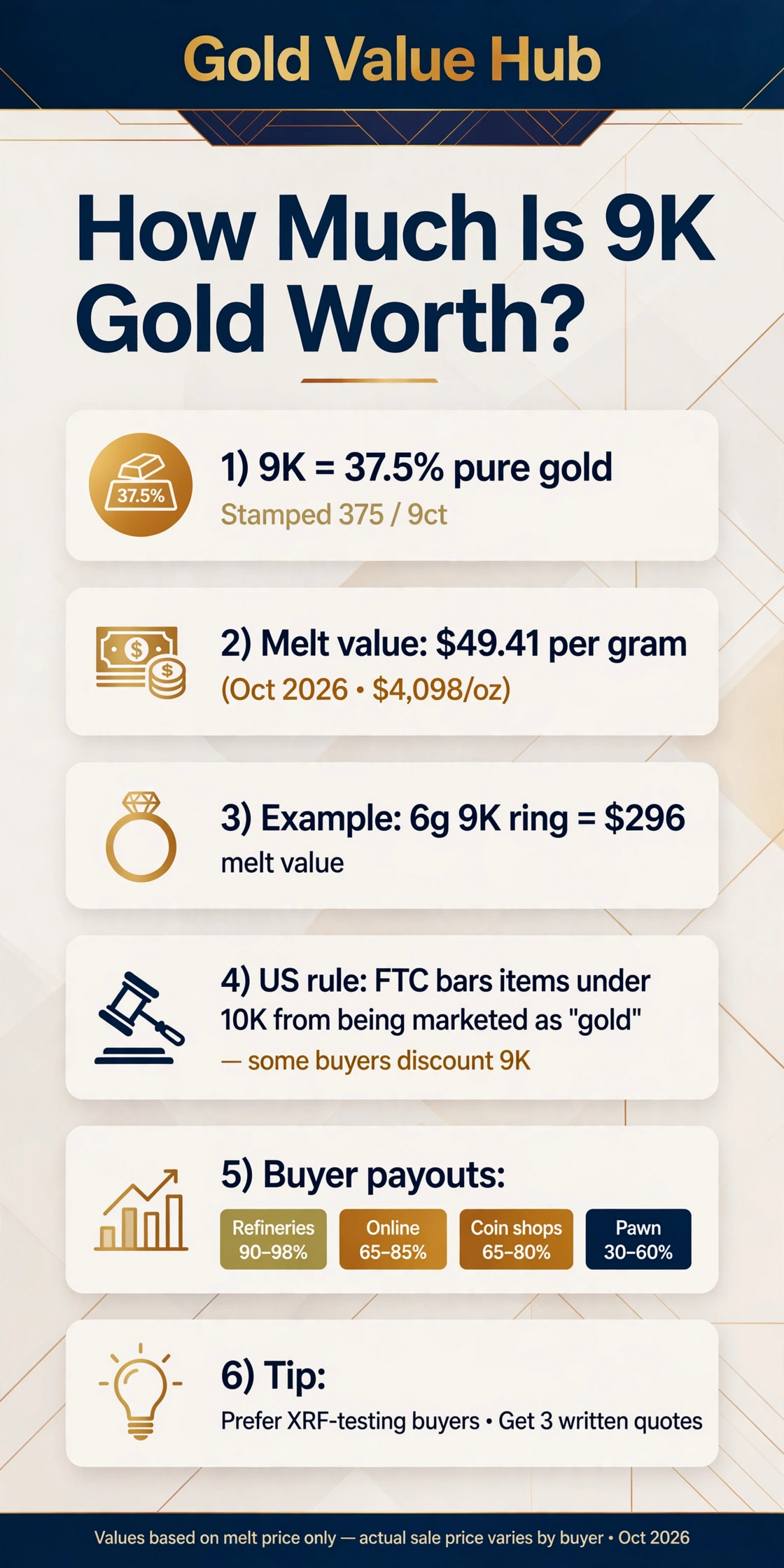
Quick answer: 9K gold is worth its melt value like any gold: 37.5% pure, about $49.41 per gram at illustrative October 2026 prices ($4,098/oz). But US buyers treat it differently — federal rules bar anything under 10K from being called “gold,” so expect lower offers (50–80% of melt) and fewer buyers than for 10K+ pieces.
Your ring is stamped “9ct” or “375” and you’re wondering: is 9K gold even real gold, and what is 9K gold worth? Yes, it’s real gold — 37.5% pure, alloyed with silver, copper, and zinc. But in the United States it occupies an awkward middle ground: legal to own and sell as scrap, yet not legally describable as “gold” jewelry. That single quirk shapes everything about its resale value.
9K gold is everywhere in British and Commonwealth jewelry — the UK’s most popular gold grade for decades — so Americans inherit it, find it thrifting, or receive it as gifts. This guide covers exactly what 9K gold is worth per gram, why US buyers discount it, how to calculate its melt value, and where to sell it for the best price.
Below: the melt formula with 9K worked examples, karat comparison tables, every selling channel ranked, refinery payout math, the pennyweight trick, taxes, and real payout examples. Prices use $4,098/oz (~$131.76/g 24K) as an illustrative Oct 7, 2026 reference — check the live calculator before selling, since spot moves daily.
What 9K Gold Actually Is
9 karat means 9 parts gold out of 24 — 37.5% pure gold, 62.5% alloy metals (usually silver, copper, and zinc). It’s stamped “9K,” “9ct,” or “375” (the European millesimal mark for 37.5% fineness). The high alloy content makes 9K harder and more scratch-resistant than 14K or 18K — which is exactly why Britain embraced it for everyday rings that take abuse.
Here’s the US twist: the FTC’s Jewelry Guides state that a product must be at least 10 karat to be described as “gold” in marketing. A 9K ring sold by a US jeweler must be labeled “9 karat gold” with the karat disclosed — it can’t just say “gold ring.” For scrap sellers this matters because some US buyers, especially pawn shops, use the rule as an excuse to lowball or refuse 9K entirely. The metal is identical; the paperwork prejudice is local.
How Much Is 9K Gold Worth? The Melt Value Formula
9K gold worth = melt value, like all scrap: weight × 0.375 × spot price per gram. Step 1: weigh in grams on a 0.1 g scale, removing non-gold parts. Step 2: confirm the 375/9K/9ct stamp. Step 3: multiply weight by 0.375 for pure-gold content. Step 4: multiply by $131.76/g (24K at the $4,098/oz reference) = $49.41 per gram of 9K gold.
Worked example — gold: a 9K ring weighing 6 g = 6 × 0.375 = 2.25 g pure gold × $131.76 = $296.46 melt value. Worked example — silver: the same math on a 925 silver ring at 6 g = 5.55 g pure × $1.54/g (illustrative) = $8.55. Note the gap: 9K gold at $49.41/g is still worth 32× its weight in silver — low-karat gold is still real money.
Quote-sheet terms:
| Term | What It Means |
| Spot price | Live market price of one troy ounce of pure gold. Reference: $4,098/oz on Oct 7, 2026. |
| Melt value | Pure-gold weight × spot price. Your 9K piece’s raw commodity value. |
| 375 / 9ct / 9K | Stamps meaning 37.5% pure gold (9 parts in 24). |
| FTC Jewelry Guides | US rules: items under 10K can’t be marketed simply as “gold.” |
| Troy ounce (ozt) | Gold’s pricing unit: 31.1035 grams. |
| Pennyweight (dwt) | 1.55517 grams; 20 per troy ounce. $/dwt quotes flatter offers. |
| Assay / XRF | Purity tests: acid, electronic, or X-ray fluorescence scan. |
| Bid / ask | Bid = what dealers pay; ask = what they charge. The gap is the spread. |
What Today’s Gold Price Means for 9K Gold
As of October 7, 2026, gold trades near $4,098 per troy ounce — about $131.76 per gram for pure 24K ($4,098 ÷ 31.1035), near record highs. At 37.5% purity, 9K gold’s melt value is $49.41/g — lower than 10K’s $54.90/g, but still the highest per-gram value 9K has ever had. A 9K wedding band bought for £150 in 1990s Britain can hold $250+ in melt today.
Buyers work off a bid/ask spread; you’ll never get full ask for scrap. Treat prices here as illustrative — gold moves daily — and run your piece through the live gold price converter before accepting any offer. Record gold prices are precisely why low-karat pieces are worth selling now: the math finally favors the seller.
9K Gold Worth vs Other Karats (Price Table)
Illustrative $4,098/oz reference (Oct 7, 2026). The payout column shows typical buyer ranges for a 6-gram piece.
| Karat | Purity | Melt $/gram | 6 g piece melt | Typical payout (6 g) | US buyer attitude |
| 18K | 75.0% | $98.82 | $592.92 | $415–$534 | Eager |
| 14K | 58.3% | $76.86 | $461.16 | $323–$415 | Eager |
| 10K | 41.7% | $54.90 | $329.40 | $197–$296 | Normal |
| 9K | 37.5% | $49.41 | $296.46 | $148–$237 | Cautious/discounted |
| 8K (333) | 33.3% | $43.92 | $263.52 | $105–$184 | Often refused |
The last column is the story: 9K’s melt value is only 10% below 10K’s, but its payout percentage runs lower because fewer buyers compete for it. That gap is negotiable — it’s prejudice, not metallurgy, and a refiner doesn’t care about the stamp at all.
Why US Buyers Treat 9K Gold Differently
Three reasons, one of them legitimate. First, the FTC rule: US sellers can’t market sub-10K as “gold,” which makes some buyers nervous about resale — even though refiners melt it identically. Second, testing: cheap acid test kits jump from 10K to 14K, so some shops lack a 9K test solution and guess low. Third, simple unfamiliarity: many US buyers rarely see 375 stamps and default to caution pricing.
- What to say: “It’s stamped 375 — that’s 37.5% gold, worth $49.41 a gram in melt at current prices. Please test it rather than guessing.”
- Ask for XRF: an X-ray scan reads exact purity in seconds — no 9K test-solution problem.
- Refiners don’t discriminate: a refinery assay prices 37.5% gold exactly like 37.5% from any source.
- Walk from flat refusals: “We don’t buy 9K” usually means “we don’t understand 9K” — the next buyer will.
Selling 9K for melt sidesteps the entire debate: refiners pay on assayed gold content, and 37.5% gold melts exactly like 37.5% from a 10K piece. The discount is a retail-buyer phenomenon, not a metallurgical one.
Before You Sell 9K Gold: Prep Checklist
9K sellers need one extra step versus other karats: proving the purity, since some buyers won’t test properly.
- Weigh to 0.1 g and photograph the readout with the piece visible.
- Photograph the 375/9ct stamp — show the buyer before they guess.
- Calculate melt yourself: weight × 0.375 × $131.76/g, or the live gold price converter.
- Separate by karat — never let 9K blend with 10K+ at anyone’s “average.”
- Remove non-gold parts: steel clasps, solder, base-metal findings.
- Get three written quotes with weight, tested purity, price per gram, total. Bring ID.
- Prefer testers: choose buyers with XRF over acid-only shops for 9K.
Where to Sell 9K Gold: Every Channel Ranked
Refineries (90–98% of melt): the great equalizer — assay-based, no karat prejudice, but 1–3 oz minimums. Online gold buyers (65–85%): most accept 9K explicitly; check their karat list before shipping. Local coin shops (65–80%): usually test properly and pay cash same day — call ahead to confirm they buy 9K. Local jewelers (55–75%): variable; some match UK familiarity, others lowball.
Pawn shops (30–60%): the worst for 9K — unfamiliarity plus standard low payouts compound. Mall kiosks (35–55%): similar story. Skip eBay for 9K scrap: fees exceed 13% and “9ct gold” listings confuse US buyers. Compare all channels on our best place to sell gold page.
The Selling Process: Quote to Cash in 5 Steps
1. Quote: the buyer tests your piece (XRF ideal for 9K) and weighs in front of you — grams, zeroed scale. 2. Offer: written, with weight, tested purity, price per gram, total. 3. Decide: never obligated; confirm free return first. 4. Paperwork: ID and receipt; many states impose a 7–30 day hold. 5. Payment: cash/check same day locally; 1–3 business days by check/ACH online.
For mail-ins, use the insured kit, photograph everything, and keep tracking until funds clear. If a buyer “calls it 10K” without testing, that’s actually in your favor on price — but get the real number; some will “call it 9K” on 10K pieces. Preliminary estimates are screening tools; the final offer follows the buyer’s own test.
Inside the Refinery: How 9K Payouts Are Calculated
Four stages, zero karat prejudice: 1. XRF screening reads exact gold percentage. 2. Melt and sample: your lot melts into a bar; a drill sample is taken. 3. Fire assay: cupelled and weighed — definitive to 1 part in 10,000. 4. Settlement: payment on assayed fine-gold weight minus 1–3% refining charges plus a $25–100 lot fee, 1–5 business days after assay.
This is why refiners are 9K sellers’ best friend: the assay doesn’t know or care about FTC marketing rules — 37.5% gold is 37.5% gold. The ~2–3% refining cost is the honest reason nobody pays 100% of melt; everything above that is the middleman’s margin. Anyone offering 98%+ on a small 9K lot is hiding fees.
Red Flags, Scams, and Negotiation for 9K Gold
The FTC advises written appraisals and understanding offer math. 9K-specific traps: “we don’t buy 9K” flat refusals (go elsewhere); acid-only shops guessing low without a 9K solution; mixed-karat blending at “9K prices”; pennyweight quotes (decoded below); “today only” pressure; mail-ins without written insurance. Also watch buyers who test your 9K, see 37.5%, and quote as if it were 33% (8K) — know your number.
Negotiate from knowledge: “It’s stamped 375 — $49.41 a gram melt at current prices. Your offer is 60% of melt; [competitor] offered 78% in writing. Can you beat it?” Most buyers carry 5–10% flex. Always ask: “What spot price is this based on, and when was it locked?” Honest buyers answer instantly.
The Pennyweight Quote Trick, Fully Decoded
One dwt = 1.555 grams. “We pay $60 per pennyweight for 9K” sounds fine — it’s $38.59 per gram. Against 9K melt of $49.41/g, that’s only 78% of melt. 9K sellers hear dwt quotes often, because the per-gram numbers look “small” and buyers prefer the bigger-sounding unit.
Defense: convert to dollars per gram, divide by $49.41. $38.59 ÷ $49.41 = 0.781 — a 78% offer. Compare honestly against the 85% online-buyer quote and the refiner’s 95%.
Taxes: Do You Owe the IRS on 9K Gold?
Gold is a collectible to the IRS regardless of karat: gains past one year taxed up to 28%; under a year, ordinary income rates. Taxable gain = sale price minus basis (what you paid, or fair market value at inheritance). Inherited British 9K jewelry gets a stepped-up basis at the owner’s death — often erasing the taxable gain entirely. See our taxes on selling gold guide; general information, not tax advice.
Real Payout Examples: 9K Gold, Actual Numbers
At the illustrative $4,098/oz reference: a 6 g 9K ring (melt $296.46) nets ~$282 (95%) refiner-direct, ~$237 (80%) online, ~$207 (70%) coin shop, ~$148 (50%) pawn. A 12 g 9K bracelet (melt $592.92): ~$474 online, ~$415 coin shop, ~$296 pawn. A 3 g 9K charm (melt $148.23): ~$111 coin shop, ~$74 kiosk. Notice the pattern: the channel discount hits 9K harder than 14K — which is exactly why getting three quotes matters most for low-karat gold.
Key Takeaways
• 9K gold is 37.5% pure gold — real gold, worth $49.41/g melt at illustrative Oct 2026 prices.
• US rules bar sub-10K items from being marketed as “gold,” so some buyers discount or refuse 9K.
• Value = weight × 0.375 × current gold price per gram; a 6 g ring holds ~$296 in melt.
• Refiners (90–98%) don’t discriminate by karat — assay is the great equalizer.
• Prefer XRF-testing buyers; acid-only shops may guess low without a 9K solution.
• Convert pennyweight quotes to per-gram; get three written quotes.
• Gains are collectibles taxed up to 28% — inherited 9K often gets a stepped-up basis.
Frequently Asked Questions
How much is 9K gold worth per gram?
About $49.41 per gram in melt value at the illustrative $4,098/oz reference (Oct 2026): 37.5% × $131.76/g. Buyers typically pay 50–85% of that ($25–$42/g) depending on channel. Check the live gold price converter for today’s figure.
Is 9K gold real gold?
Yes — 9K is 37.5% pure gold alloyed with other metals, and it’s the standard gold grade in the UK. What it isn’t, under US FTC rules, is marketable as simply “gold” — it must be disclosed as 9 karat. Refiners treat it as exactly what it is: 37.5% gold.
Why do US buyers pay less for 9K gold?
Three reasons: FTC rules bar sub-10K marketing as “gold,” some shops lack 9K acid-test solutions and guess low, and plain unfamiliarity with 375 stamps. None are metallurgical — a refiner’s assay pays full 37.5% value. The discount is negotiable.
What does 375 stamped on jewelry mean?
375 is the European millesimal mark for 37.5% gold fineness — the same as 9K or 9ct. It’s the most common 9K stamp on British and Commonwealth jewelry. If you see 375, you have 9 karat gold.
Where is the best place to sell 9K gold?
Refineries (90–98% of melt) for larger lots — no karat prejudice. For single pieces, online gold buyers (65–85%) and coin shops with XRF testing (65–80%). Avoid pawn shops (30–60%), which compound low payouts with 9K unfamiliarity.
Can I sell 9K gold in the USA?
Absolutely — it’s legal to own, buy, and sell. The FTC rule only restricts how it’s marketed (it must be disclosed as 9 karat, not just “gold”). Any buyer who claims 9K “isn’t real gold” is either misinformed or negotiating — walk away.
Is 9K gold worth less than 10K gold?
In melt value, only slightly: $49.41/g vs $54.90/g at current prices — about 10% less, matching the purity difference. In buyer payouts the gap can be wider due to the US 9K discount, which is why three quotes matter especially for 9K.
What does “$60 per pennyweight” mean for 9K?
$60/dwt = $38.59/g (one dwt = 1.555 g). Against 9K melt of $49.41/g, that’s 78% of melt. Always convert dwt quotes to dollars per gram and divide by your karat’s melt-per-gram number.
Do I pay taxes selling 9K gold?
Tax applies to the gain (sale minus basis), karat-independent. Gold is a collectible: up to 28% past one year, ordinary income under a year. Inherited 9K jewelry typically gets a stepped-up basis at death, often erasing taxable gain.
Should I sell my 9K jewelry or keep it?
Sell for scrap if it’s broken, unworn, or plain — 9K has no collector premium and record prices favor sellers. Keep it if it’s wearable, sentimental, or a family piece; 9K’s hardness makes it excellent everyday jewelry. Melt value won’t disappear while you decide.
9K gold is real gold at a real price — don’t let unfamiliarity discount it. Weigh it, test it, and sell where the assay is honest. Check what your 9K gold is worth with the free gold price converter before any buyer quotes you a number.
