How Much Is Dental Gold Worth Per Gram?
Published Oct 10, 2026
Quick answer: Dental gold is worth its melt value like any scrap gold. A typical gold crown weighs 2–5 grams at 60–85% gold purity, so one crown holds roughly $160–$560 of gold at illustrative October 2026 prices ($4,098/oz). Specialized dental-gold refiners pay 85–95% of melt after assay.
Your dentist handed back your old gold crown in a little plastic box — now what? Dental gold worth is simpler than it looks: it’s scrap gold with a medical past. The crown in that box is a high-gold alloy worth real money at today’s prices, and selling it works exactly like selling any other scrap, with a few dental-specific twists around purity testing and finding the right buyer.
Most people don’t know what dental gold contains, so they throw crowns away or accept the first lowball offer. This guide covers what dental alloys contain, how to estimate your crown’s gold content, what refiners really pay, and where to sell dental gold for the best price — including the specialized buyers most guides never mention.
Below: the melt formula with dental worked examples, karat-content tables, every selling channel ranked, inside-the-refinery payout math, the pennyweight trick, taxes, and real payout examples. Prices use $4,098/oz (~$131.76/g 24K) as an illustrative Oct 7, 2026 reference — check the live calculator before selling, since spot moves daily.
What Dental Gold Is Actually Made Of
Dental gold isn’t jewelry gold — it’s engineered for chewing. Crowns and bridges use high-noble alloys (at least 60% gold by weight) mixed with platinum, palladium, silver, and copper for hardness. A “gold crown” is typically 60–85% pure gold, the equivalent of roughly 14K to 20K. Yellow-gold crowns sit at the high end; white-gold dental alloys trade some gold for palladium and platinum, which refiners also pay for.
Not everything from a dentist is valuable. Porcelain-fused-to-metal (PFM) crowns have only a thin metal coping — often under 1 gram of low-gold alloy beneath the porcelain. Pure porcelain or zirconia crowns contain no precious metal at all. Silver amalgam fillings contain no gold either. If your crown is yellow metal all the way through, it’s worth weighing; if it’s white porcelain with a metal edge, the gold content is minimal.
Dental Gold Worth: The Melt Value Formula in 4 Steps
Melt value decides dental gold worth: pure-gold weight × spot price. Step 1: weigh the crown in grams on a 0.01 g scale, brushing off any attached tooth material or cement — buyers pay for metal, not debris. Step 2: estimate purity. Without a stamp (dental work is never stamped), assume 60–75% gold for a yellow crown unless tested; white dental alloys run 40–60% gold plus palladium/platinum. Step 3: multiply weight by purity for pure-gold content. Step 4: multiply by $131.76/g (24K price at the $4,098/oz reference).
Worked example — gold crown: a 3.5 g yellow crown at 75% gold = 2.625 g pure gold × $131.76 = $345.87 melt value. Conservative example: the same crown at 60% gold = 2.1 g × $131.76 = $276.70. The 15-point purity swing is worth $69 — which is exactly why professional assay matters for dental gold. Silver comparison: dental scrap sometimes includes silver alloy at 40% silver; a 3 g piece = 1.2 g pure silver × $1.54/g (illustrative) = $1.85. Negligible — gold is the prize.
Key terms for the quote sheet:
| Term | What It Means |
| Spot price | Live market price of one troy ounce of pure gold. Reference: $4,098/oz on Oct 7, 2026. |
| Melt value | Pure-gold weight × spot price. Your crown’s raw commodity value. |
| High-noble alloy | Dental alloy with ≥60% noble metal (gold + platinum + palladium). Most gold crowns qualify. |
| Troy ounce (ozt) | Gold’s pricing unit: 31.1035 grams. |
| Pennyweight (dwt) | 1.55517 grams; 20 per troy ounce. $/dwt quotes flatter offers. |
| Fire assay | Lab melt-and-weigh test, accurate to 1 part in 10,000. The final word on dental purity. |
| XRF | X-ray fluorescence scan — instant surface purity reading, used by most buyers. |
| Bid / ask | Bid = what dealers pay; ask = what they charge. The gap is the spread. |
What Today’s Gold Price Means for Dental Gold
As of October 7, 2026, gold trades near $4,098 per troy ounce — about $131.76 per gram for pure 24K ($4,098 ÷ 31.1035), near record highs. For dental gold this matters more than for jewelry: crowns can’t be resold as jewelry, so their entire value is melt — and melt has roughly tripled since 2015. A crown worth $100 a decade ago holds $300+ today.
Buyers work off a bid/ask spread — you’ll never get full ask for scrap. Treat prices here as illustrative baselines; gold moves daily. Run your crown’s weight through the live scrap gold calculator before accepting any offer, using 65–75% purity as your estimate until it’s assayed.
Dental Gold Worth Per Gram by Alloy Type (Price Table)
Dental alloys aren’t stamped in karats, so this table uses gold-content percentages. Illustrative $4,098/oz reference (Oct 7, 2026); payout column for a typical 3.5 g crown.
| Alloy type | Gold content | ≈ Karat equiv. | Melt $/gram | 3.5 g crown melt | Typical payout |
| High-gold crown (yellow) | 85% | ~20K | $112.00 | $392 | $333–$372 |
| Standard gold crown | 75% | ~18K | $98.82 | $346 | $294–$329 |
| Economy gold crown | 60% | ~14K | $79.06 | $277 | $235–$263 |
| White dental alloy | 50% + Pd/Pt | ~12K | $65.88* | $231* | $196–$219 |
| PFM coping only | ~50% of 1 g | — | — | ~$33 | $20–$30 |
*White alloys contain palladium/platinum that refiners pay for separately — the gold-only figure understates true value; a specialized refiner’s assay captures it all. PFM copings are barely worth the envelope; porcelain and zirconia crowns are worth $0 in metal.
What Sells for Melt in Dental Scrap
All dental gold sells for melt — there’s no secondhand market for used crowns. But the category has sharp divides. Full gold crowns and bridges are the prize; PFM copings are marginal; porcelain, zirconia, and amalgam are worthless as scrap. Selling for melt is still the right move: instant cash, no fees, no awkward listings — and unlike jewelry, there’s zero chance a crown is “worth more intact.”
- Sells for melt: full gold crowns, gold bridges, gold inlays/onlays, extracted gold teeth with metal intact.
- Marginal: PFM copings (tiny gold content), white dental alloys (gold + palladium/platinum — needs a specialist).
- Worth $0: porcelain crowns, zirconia crowns, silver amalgam fillings, acrylic dentures.
- Clean before weighing: remove tooth fragments, cement, and debris — buyers deduct non-metal weight or reject dirty lots.
Before You Sell Dental Gold: Prep Checklist
Dental gold rewards preparation more than any other scrap category, because purity is invisible. An untested crown is a guessing game the buyer always wins.
- Clean the pieces. Soak in denture cleaner, brush off cement and debris. Weigh only metal.
- Weigh to 0.01 g and photograph the readout. Sort yellow crowns from white alloys from PFM copings.
- Get an XRF test. Many coin shops and jewelers scan free — it reads gold, palladium, and platinum content in seconds.
- Estimate conservatively: 60–75% gold for yellow crowns until assayed. Use the live scrap gold calculator.
- Bundle it all. One crown plus any other scrap clears minimums and dilutes flat fees.
- Get three written quotes showing weight, assayed purity, price per gram, and total. Bring ID.
- Ask about palladium/platinum. White alloys contain them — a buyer who “doesn’t pay for those” is pocketing your money.
Where to Sell Dental Gold: Every Channel Ranked
Specialized dental-gold refiners (85–95% of melt): the best channel — they assay for gold, palladium, and platinum and publish their payout schedules. Many accept mail-in lots from individuals with no minimum. General precious-metal refineries (90–98%): top rates but usually 1–3 oz minimums; ideal if you’re bundling a pile. Local coin shops (70–85%): will XRF-test on the spot and pay cash — fine for one or two crowns.
Online gold buyers (70–90%): most accept dental gold explicitly (some advertise it); confirm they pay for palladium/platinum before shipping. Dentists and dental labs: some buy back or consign scrap — convenient but rarely top dollar. Pawn shops (30–60%): often lowball dental gold because they can’t test it confidently — avoid. Compare all options on our best place to sell gold page.
The Selling Process: Quote to Cash in 5 Steps
1. Quote: the buyer XRF-scans or acid-tests your crowns and weighs them in front of you — scale in grams, starting at zero. 2. Offer: get it in writing: weight, tested purity, price per gram, total. 3. Decide: never obligated; legitimate buyers return your metal free — confirm first. 4. Paperwork: ID and receipt; many states impose a 7–30 day hold. 5. Payment: cash/check same day locally; 1–3 business days by check/ACH online. Refinery mail-ins take 5–10 business days including assay.
For refinery mail-ins, use the insured kit, photograph everything, and keep tracking until settlement clears. Dental refiners typically email the assay report — read it: it lists gold, silver, palladium, and platinum percentages, and your payout should match it line for line. Price-match guarantees exist but rarely cover assay-based dental quotes; treat preliminary estimates as screening tools only.
Inside the Refinery: How Dental Gold Payouts Are Calculated
Dental refiners run four stages: 1. XRF screening sorts your lot by alloy family. 2. Melt and sample: the lot melts into a bar; a drill sample is taken. 3. Fire assay: the sample is cupelled and weighed — the definitive purity verdict, accurate to 1 part in 10,000, and it catches palladium and platinum XRF can miss at depth. 4. Settlement: payment on assayed fine-metal weight minus refining charges (1–3% plus a $25–100 lot fee), 1–5 business days after assay.
The assay is why specialists beat general buyers for dental gold: a coin shop’s XRF reads the surface, but fire assay prices every precious metal in the alloy. On a white-gold bridge with 12% palladium, the assay can add 10–20% to your payout versus a gold-only XRF quote. Never accept a dental offer based on a guessed purity — “we’ll call it 14K” on an 18K-equivalent crown costs you 25%.
Red Flags, Scams, and Negotiation for Dental Gold
The FTC advises sellers to get written appraisals and understand offer math. Dental-specific traps: buyers who won’t test and just “call it 10K”; anyone who doesn’t pay for palladium/platinum in white alloys; flat fees that eat single-crown payouts; pennyweight quotes (decoded below); “today only” pressure; mail-ins without written insurance. Also: never let a buyer keep the assay sample without crediting its weight.
Negotiate with the assay: “The XRF shows 74% gold plus 6% palladium — your quote prices gold only. Adjust it or I go to [refiner].” That sentence is worth real money. Get three written quotes, walk away freely, and always ask: “What spot price is this based on, and when was it locked?” Honest buyers answer instantly.
The Pennyweight Quote Trick, Fully Decoded
One dwt = 1.555 grams. “We pay $95 per pennyweight” sounds generous — it’s $61.09 per gram. For a crown assayed at 75% gold (melt $98.82/g), that’s only 62% of melt wearing a costume. Dental sellers get this trick more than most, because crowns are light and buyers assume you won’t do the math.
Defense: convert every quote to dollars per gram, divide by your alloy’s melt-per-gram value. $61.09 ÷ $98.82 = 0.618 — a 62% offer. Compare it honestly against the dental refiner’s 90% quote and the choice makes itself.
Taxes: Do You Owe the IRS on Dental Gold?
Gold is a collectible to the IRS: gains past one year of ownership are taxed up to 28%; under a year, ordinary income rates. Basis for a crown is what you paid the dentist — check old dental bills, since crowns cost $800–$1,500 and your taxable gain may be smaller than you think (or even a loss). Without records the IRS can treat the whole sale as gain. See our taxes on selling gold guide; general information, not tax advice.
Real Payout Examples: Dental Gold, Actual Numbers
At the illustrative $4,098/oz reference: a 3.5 g crown at 75% gold (melt $345.87) nets ~$328 (95%) from a dental refiner, ~$277 (80%) online, ~$259 (75%) at a coin shop, ~$173 (50%) pawn. Two crowns + a bridge totaling 9 g at 70% (melt $830.30): ~$789 refiner, ~$664 online, ~$415 pawn. A PFM coping (melt ~$33): ~$28 refiner, ~$17 pawn — barely worth the trip unless bundled. The assay, not haggling, decides your number.
Key Takeaways
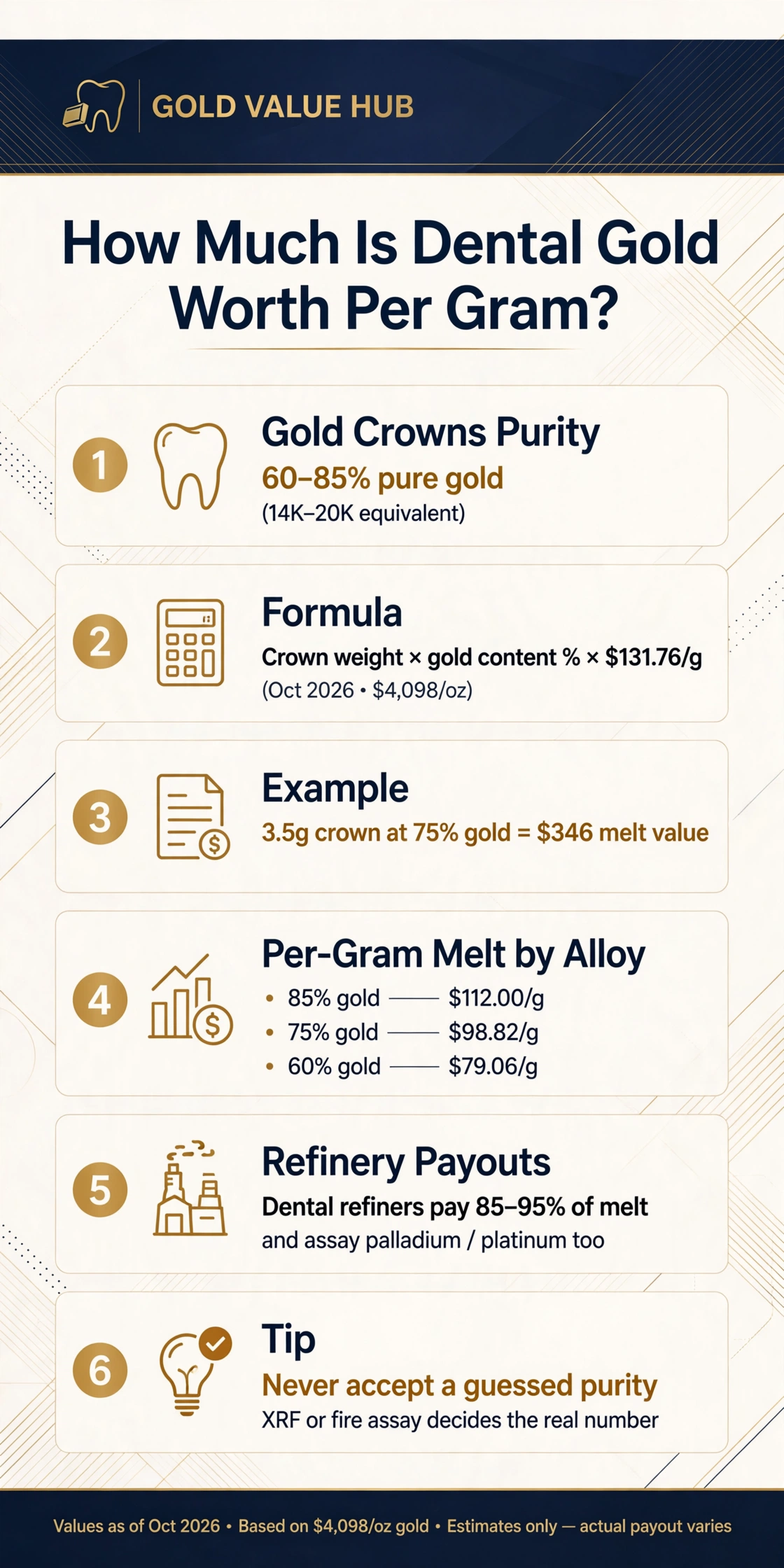
• Dental gold worth = crown weight × gold content % × current gold price per gram.
• Gold crowns run 60–85% pure gold (14K–20K equivalent); PFM copings, porcelain, and zirconia are near-worthless.
• A 3.5 g crown at 75% gold holds ~$346 in melt at illustrative Oct 2026 prices.
• Specialized dental refiners pay 85–95% and assay for palladium/platinum — the best channel.
• Never accept a guessed purity; XRF or fire assay decides the real number.
• Convert pennyweight quotes to per-gram; get three written quotes with assayed purity.
• Dental gold gains are collectibles taxed up to 28% — old dental bills establish your basis.
Frequently Asked Questions
How much is dental gold worth per gram?
Multiply the alloy’s gold content by $131.76/g (illustrative 24K price, Oct 2026). A 75%-gold crown = $98.82/g of crown weight; a 60%-gold crown = $79.06/g. Buyers pay 85–95% of that at refiners, 70–90% elsewhere. Use the scrap gold calculator with 65–75% purity for an estimate.
What karat is dental gold?
Dental gold isn’t sold by karat — it’s sold by alloy percentage. Most gold crowns are 60–85% gold, roughly the equivalent of 14K to 20K. High-noble alloys (the dental term) contain at least 60% noble metals including gold, platinum, and palladium.
Where can I sell my gold crown?
Specialized dental-gold refiners pay best (85–95% of melt) and many accept mail-ins from individuals. Local coin shops (70–85%) work for one or two crowns with same-day cash. Most online gold buyers accept dental gold too — confirm they pay for palladium/platinum before shipping.
How much does a gold crown weigh?
Typically 2–5 grams for a full crown, 5–12 grams for a multi-unit bridge. PFM copings weigh around 1 gram of metal under the porcelain. Weigh yours on a 0.01 g scale after cleaning off cement and debris — buyers pay for metal weight only.
Do buyers pay for the palladium in dental gold?
Specialized refiners do — their assays price gold, silver, palladium, and platinum separately. General buyers often price gold only and pocket the rest. If your crown is a white dental alloy, always sell to a buyer who assays and pays for all four metals.
Is a porcelain-fused crown worth anything?
Barely. The metal coping under the porcelain holds roughly $20–$35 in gold at current prices — worth tossing into a larger scrap lot, but not a trip on its own. Pure porcelain or zirconia crowns contain no precious metal and are worth $0 as scrap.
How is dental gold tested?
Buyers start with XRF scanning (instant, non-destructive) or acid testing. Refineries finish with fire assay — melting a sample with lead and weighing the result, accurate to 1 part in 10,000. For dental gold, always prefer assay-based quotes over guesses.
What does “$95 per pennyweight” mean for my crown?
One dwt = 1.555 g, so $95/dwt = $61.09/g. Against a 75%-gold crown’s melt of $98.82/g, that’s only 62% of melt. Convert every dwt quote to dollars per gram and divide by your alloy’s melt-per-gram value.
Do I pay taxes on selling dental gold?
You owe tax on the gain (sale price minus what you paid the dentist). Gold is a collectible: up to 28% past one year, ordinary income rates under a year. Dig up old dental bills — crowns cost $800–$1,500, so your taxable gain may be small or even a loss.
Can I sell a gold tooth still in… extracted with root attached?
Buyers want clean metal — remove all tooth, bone, and tissue material before selling (soak, brush, and pick clean). Refiners will reject or heavily discount dirty lots, and some buyers refuse biological material outright. Clean crowns only.
That little plastic box from your dentist is real money — clean the crown, weigh it, get it tested, and send it to a buyer who assays. Calculate your dental gold worth with the free scrap gold calculator and don’t accept a guessed purity from anyone.
